


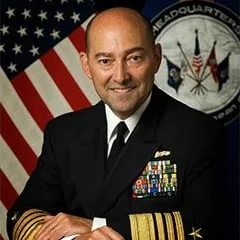
Admiral James Stavridis Former NATO Supreme Allied Commander Europe
The world in conflict
Transcript
Automated transcript · uncorrectedWith us today is Admiral James Tavridis. He was a Supreme Allied Commander of NATO for four years and a friend one more guy. Also vice chair of Global Affairs for the Carlile Group and Chairman of the Board of the Trustees of the Rockefellow Foundation. So he makes the money, gives away the money. Admiral, what’s going on in the
world right now that you’re worried about.
First, I want to start with a tragedy, which is a murder of Alexi Navalney. This was the leader of the opposition in Russia. A sham election. Balney was imprisoned by Putin justly quote mysteriously end quote, died in prison a few days ago, pretty clearly murdered by the forces of Vladimir Putin. That’s a personal tragedy because Alexi Lebonni
was a man of immense inteprity and honor, a believer in democracy and liberty. But it’s also an indication to the West of how confident, how strong Vladimir Putin feels he is. He can with complete impunity murder is leading political opponent. So we do a couple of things here.
Number one, we had to stop and say thank God I live in the United States of America, that I live in a real democracy, that I live in a country that does not allow people to kill their opponents in a political race. I feel very lucky to be an American and not a Russian Number two. What Putin
has done is very personal. He’s gone after in a very personal way, a leading opponent. I think it’s time that our sanctions on Russia, and new sanctions are being announced even as you and I are speaking. These sanctions need to target Putin personally. They need to go after his personal wealth, his ability to and his friends and
his family to travel in the world. He needs to be indicted in a criminal court, an international criminal court. We need to personalize these sanctions. And then, third and finally, John, this ought to serve as a wake up call to our Congress here in the United States, who have been fumbling the ball in terms of allocating sixty billion dollars
to the Ukrainians to fight against this monster, Vladimir Putin. We had a recognized Putin for what he is. A killer. Someone who has invaded Ukraine would like to do to President Zelenski what he just did it to Alexi Valni and we had to stop it because it’s in the interests of our country to stop it. And so I
call on the US Congress, Republicans and Democrats together to stand and say enough Putin. The best way to push back on Putin is to arm the Ukrainians. They won’t do the fighting for.
Us, understood, and there’s been a lot of fights in Congress about the Ukrainians, the Israelis, and the Republicans are standing up and saying that unless you secure the borders of the United States, we’re not going to give you money to secure the borders of Ukraine. Any feeling about.
That, Well, if you recall about just over a month ago, there was I thought a very good piece of legislation that did all of that. It provided funding, significant funding for the border, along with I think some realistic policy changes because I agree we have to secure our border.
That bill included funding to do so, alongside funding for Ukraine, for Israel, and for Taiwan. It was a smart piece of legislation. Unfortunately, the consensus between the parties fell apart. So now they’ve parked border security kind of off to the side, and now they’re trying to resolve the Ukraine in the Israeli part of this. So my view, John
is let’s get Ukraine in Israel done. A vast majority of both Houses of Congress, both parties support funding to Ukraine into Israel. That is eminently doable. Let’s get that done, and then let’s turn our attention back to the border.
Will get that secured. I think both parties want to do that, particularly in the run up to an election where most Americans would say border security matters deeply understood.
Now, Admiral, Uh, we got a problem. Uh. All these new all these new and old terrorist groups are back to life again. Uh. We got the you know uh and spring to America. Who’s you know? We know that Iran is funding the Hoodies and the Harmases and the uh Hesba llah and and who and maybe Sordi is finding finding uh funding ices,
Who’s funding al Qaeda? I know? I mean, the American people really are confused.
It is confusing. And in the course of one quick radio intern you were not going to cover all this waterfront, as would say in the Navy. But let me take three things. One is Iran and you mentioned Hutis who are trying to close down the Red Sea, and the Suez Canal. You mentioned Hamas, the terrorists who attacked, raped,
mutilated Israeli civilians on October the seventh, and you mentioned Hezbollah, which is a group in Lebanon, north of Israel. Here’s what they have in common. There are all three terrorist groups. Their names all begin with H. That’s just a coincidence.
But the big thing they have in common is they’re all trained, equipped, organized, funded and directed by the Islamic Republic of Iran. They are directed by mulahs in Iran. So that’s one discrete set of challenges. It’s got three heads on it. But the United States, working with a big coalition of allies, partners, and friends, is pushing back
on all three of those. You also mentioned Al Qaeda. Al Qaeda is on its back foot. It’s still conducting some operations. It has bases here and there, but it is fading in importance. And what funding it gets it generates on its own through extortion, cyber activity, and various criminal enterprises. I don’t overthink al Qaeda these days. Last one,
a Islamic state based essentially in Syria and Iraq, is a Sunni terrorist group that receives its funding like Al Qaeda, but it gets more because it’s better at the extortion racket, the cyber criminal activity, selling antiquities. It has a very broad business base. That one is also being addressed by a coalition set of forces in Iraq and Syria itself. So, John,
it is very confusing, and the way to think about all these groups, it’s like fighting a forest fire. You put out the big fire, but you’ve got to be aware there’s still embers on the ground and that these things could reflash at any moment. That’s the situation we’re in.
Now, understood, uh Aro, what else there? We got about a minute or so left. What else do you have to do? You want to get off your chest that you think the American people should know.
Well, I think the American people should know something that’s going relatively well compared to what we’ve just talked about, and that’s at the moment, Uless China relations are going not terribly but kind of okay, and that is the result they’re.
Sending us pandas again, so they must be feeling better.
Exactly. That’s not a bad thing, and we want us and China to work together over time. We’re going to have a lot of disagreements with China. China as our principal strategic competitor, but at least for the next year or two, largely because China is having economic problems, China is willing to work with us more than they have
been in the past. Let’s take a little bit of comfort out of that. And who knows, there might be a scenario in which we could actually work with China to resolve some of the other problems you and I have talked about. That’s in the future, but at the moment, what I would say to Americans is we’re at least
we’re not in high tension with China at this particular moment. Let’s so if it stays that.
Way, I agree one percent. Admiral Stavridis, thank you for everything you’ve done for America and continue to speak out for America, and let’s catch up again real soon.
If gott E Stowe, my friend Tux says yes, so I’ve got
Sunday, February 25, 2024

Guardian Group party at the ballpark
Ray Kelly Former New York City Police Commissioner

Helping the community with a new bike drive program.
Eric Shuffler and Roseann Caruana

Interviews Brad Klatt Co-Founder & Executive Chairman, Logical Buildings
Michael Stoler Real Estate Expert


Admiral James Stavridis
Report from around the globe.
Admiral James Stavridis Former NATO Supreme Allied Commander Europe
Trump has new plans for NATO.
Admiral James Stavridis Former NATO Supreme Allied Commander Europe
New book: Restless Wave.
Admiral James Stavridis Former NATO Supreme Allied Commander Europe
White House take out the Houthis?
Admiral James Stavridis Former NATO Supreme Allied Commander Europe
Future of Ukraine unclear with Trump.
Admiral James Stavridis Former NATO Supreme Allied Commander Europe
Holding up arms shipments is not good for Ukraine.
Admiral James Stavridis Former NATO Supreme Allied Commander Europe
