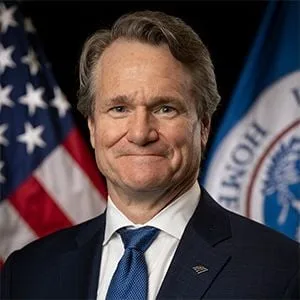
Brian Moynihan Chairman & CEO, Bank of America
Federal Reserve keeps raising interest rates.
Transcript
Automated transcript · uncorrectedWith us today is Brian morning Hand, CEO of Bank America and one of the largest banks in our country, in the world, seventy million customers in thirty five countries. And Brian, welcome to WABC and thank you for coming on.
And the world is moving in so many directions. Let’s talk about the economy. The economy right now on a national basis, tell us what you feel.
Sure, let me bring to it first, John, thanks for having me on. Second, and rb of the economy by our experts and our research team is that there will be no recession. We just changed that recently. There’ll still be a slowing down next year, so the economy will grow at about a one percent clip and then about
a half a percent clip in the middle of twenty twenty four, with an unemployment rate that pushes up to four percent. So it’s a soft landing in the parlance that people are using. But on the other hand, it’s sowing down from here. And everything we see sees consumer spending by our customers in line with a low growth,
low inflation economy. Their behavior, their money and their accounts continues to be elevated from pre pandemic, but isn’t growing anymore, and it is coming down just to hair, which shows that they’re using the money to support their living. The impacts of inflation on spending, et cetera. So we think the economy basically will not have a recession, but it
will have a slow down. We think that that slow down will be a sort of peak at the middle of next year in terms of the lowest growth rate annuallyzed and then starts working this way back out from there.
The Fed has been raising rates at a tremendous pace and is targeting a two percent inflation rate. Some of the whispers coming out of Wall Street now said, well, maybe the Fed should accept the three percent inflation rate because if they raise interest rates any more right now, the real estate industry is in bad shape.
What say you on that, Well, so start back to the One of the reasons why the Fed is there is to make sure inflation stays under control. So this is a primary responsibility they have. So they had to raise rates because they were, by their own admission, they relate to the game to raise rates. Then they raised
them faster to have the impact. The effect of a drag on economy now from all factors from the rates structure, being higher, mortgage rates, commercial borrowing rates, et cetera. Are much higher, and that drag is still coming through the system.
The lending conditions and are much tighter, and also the demand by our clients honestly is lower. Why because if you’re going to spend twice as much for the credit costs, you’re going to think harder about the opportunity. And so if you look at all that the rate structure is having the impact on the economy, our economists believe that
if you think about it fourth quarter of twenty three versus fourth quarter twenty two, which is the way economists look at it, then likewise for the next couple of years, they think inflation is down to about three point seven percent fourth quarter of twenty three measured against last year.
Then it goes to two point eight fourth quarter next year measured against this year, and then to two point two. So what they’re really saying it takes all of twenty four and into twenty five to get down close to that two percent rate. And they believe that the first rate cuts come next year mid year, and there will
be about seventy five basis points next year and one hundred basis points. But if you do the math. That still means that the FED funds rates sitting around four percent plus, which is higher than it’s been for many many the average for many years. So it’ll still be restrictive, and so this inflation will be a tough fight. But
I think the risk is more of a Fed overshoot today than it was six months ago because the economy is flowing down in response to the rate structure and they now have just got to keep letting it manage.
Through debate about a two percent inflation rate versus three percent inflation rate versus two and a half, there’s great debate among economists about that. The reality is you don’t want to hurt the economy just to hit a target, and I hate Defen has been clear.
About that understood and interest rates. As far as mortgage rates, most of the people still have a mortgage rate of under three percent, Like I think seventy I forget the number. Seventy percent of the consumers have an interest rate on their homes of condos under three percent, So none of them want to sell because they don’t want to buy
another house and pay seven percent. And that in the construction loan industry, in the real estate industry, and it’s hard to borrow to build a new building and justify paying seven eight percent for money.
Yes, so there are two things that that’s what I mean by the rate structure. With a higher rate structure, it’s having a drag. But that drag is still being felt through the system. And if you look at it on the consumer side of mortgages, your statistics are right basically ninety five percent of below five percent, eighty below four,
and seventy below three or something like that. So think about one hundred and thirty million households in the United States, and there’s only about sixty million mortgage holders. The rest of the people don’t have a mortgage involved in our housing expense. The people that do, you know, all the people are locked in at rates are very favorable. And
so the impact that this is having is on the next activity. To your point, am I going to sell my house and pay a higher rate on the house I borrow against? Next? Well, I will if two things.
One is I just have to I have more kids, I need a bigger house, whatever it is where I’m downsizing in a condo from a house of you know that you’re my age bracket and things like that. So there’s going to be another reason to sell, and that’s why you’re still seeing houses, you know, turnover, market turnover.
There’s a natural thing. What’s not going on as a refinance. And so for half of America who don’t have a mortgage, this is probably a rent question. And rents have peaked and they’re starting to flat now, and that’s what we got to watch them inflation. But from an ownership perspective, the impact has been in the system for a while.
And you just saw the four million annualized existing home sales today, you know, lower than usual, but you know, not falling off a cliff. So the market’s bumping along and it will take a while for it to get used to this rate structure and then move out from there.
Brian. A lot of the banks, the smaller banks, worried about their own existence because rates went up so fast it took the loan portfolios, their bond portfolios, in their in their real estate portfolios and took them upside down.
And the banks are worried about their own existence. Not Bank America and not JP Morgan, but the smaller banks, and they have shut down, affecting a lot of small borrowers around the whole country.
Yeah, I think. I think the banking system itself, you know, in the total has a very strong capital, very strong liquidity. And you know, there’s been a concern about the impact of the rapid rate rise. Earlier this year, we saw some of the impacts that that’s largely settled through the system.
So as you look around, you know, there’ll be individual business decisions that were made about long portfolio concentrations and banks and stuff that may or may not hurt them, but overall, the industry is in very good shape and it’s all absorbable. And the basic principle is banks have failed, you know forever. The banking system pays the entire cost
of that always does, always has done since it because the FDIC is a government guarantee, but all the money comes from the banking system and pays it. And so we got to get away from a bank or this bank and sit there and says the system healthy. It is is the equity and the system strong as a
little system strong. And then you flip and say, you know, we have four thousand banks or whatever the number is in you know, other countries, impliably we’d have you know, if you look at our country, we’d have a lot less banks, and that’s because the economies of scale that come from, you know, being able to consolidate branches and
things like that. That’s going on too, and people are mistaking that trend which has been going on for many years to cause by the recent activities. It may be enhanced by it, but that’s a trend of efficiency, and it’ll be a barbell banking system. Large banks and small banks, and large banks do serve a small business community very well.
We were the largest small business leander in the country and you know, we do a great job of that and that business is actually growing for us. So I think people have to be a little careful about all this stuff because a lot of technical accounting and techlo and regulatory rules. But the general thing is banks are
in great shape and the banking industry will take care of itself. There’s a problem.
The consumer are our poor. Our middle class in America has been effected greatly by the rate and gasoline prices. They raising in food prices, and it’s basically because of what happened in the fossil fuel industry and the price of oil went from fifty five in the last two years to one hundred one hundred. Now it’s back down
to eighty. The future of energy in America, how do you see that? Because in my opinion, the world is not gonna run on solar in the world is not gonna run on wind. It’s I mean, it’s it’s good, it reduces carbon, but it’s the United States is not gonna run on that. One of our investments that we’re
making is SMRs, which is small modular reactors that all of a sudden the world is calling green energy any opinion.
So I take the couple things. In number one, all parts of the energy production capacity are going to be needed to help do the almost impossible task for people to think through, but it is a very doable business task, which is to continue to have more and more energy available at reasonable price and also for economic growth not
only in this country, around the world. And then secondly, continue to manage the emissions of that sector down over time. And that’s what’s going on. And so the we just had another the first nuclear plant in many years open in Georgia. You know, not well, but the company opened up the United States had these small modular reactors. These
are all ways to stabilize the grid and the production in a way that doesn’t emit carbon emissions. Therefore is cleaner and you know, frankly is safe. You know, the nuclear system in the United Stasis has been improved like all systems have and safe. And so the idea of using is a stabilizer, a base load, whatever the right
words are, is critical. The idea what’s fascinating in the United States is if you think about some of the recent statistics you read, they talk about how you know, wind and solar have had this impact and helped in Texas and other things. That’s all great news. It doesn’t mean you can do it only with that. It means
that you have to have all things working. And so what’s interesting is the range of the companies doing carbon capturing storage that the you know, at the operating facility level, whether the production facility meaning an industry facility, or whether it’s actual production of oil, in capturing, methane capturing, emissions capturing.
That the idea of these pipelines to put it back and around. These are wonderful technologies, will bias time to continue to see their technologies come along. And so I think this is a great place for United States to dominate the world. Honestly, all the activity people see today, which is huge, has really was done in sixteen to
seventy in eighteen. These projects take so long to get up. So if you think about how much talk you have about new projects today and what that means five years out, those those will be wonderful things that will help. And what will happen is we’ll see a blended cost, hopefully it maintains it’s control, a blended production, meaning where it
comes from gas, oil, nuclear, whend solar and other, geothermal, all these different ways you’re doing it. You know, all this stuff will grow, and so what we’ll have is ability to have the United States be energy and independent and continue to be a leader in figuring out how to do this transition to take can export and actually
becomes a bigger and bigger industry for US.
Agreed. The chairman of the CEO of Toyota said the same thing about vehicles. He says, we want to make electric vehicles, we want to make gas vehicles, we want to make these old vehicles, we want to make hybrid vehicles.
Let the American people decide what they want, and I think that’s a smart way to do it. Brian, we got a minute left. What would you want to tell all the American people?
Well, I think, you know, the idea is that the expected outcome of a tightening cycle is for things to slow down. And I think people have to maintain their confidence. The employment levels are strong, they the wage growth is strong.
You know, inflation hurts people. That’s why they had to get under control. Your discussion earlier about that, but it is getting under control, and you know, I think you know, look, this is a country in the world that has the best place for business to invest. That’s why all this investments coming in, around the green transition, around the infrastructure bill,
around things like that. All the companies want to come here, you know, around the world because they can make money. They have good work rules. We have a set of rules you can understand from how to do things. May take it long and be bureaucratic, and I think we just have to realize that capitalism is the way US style.
Capitalism is the thing that does the most good for the world, and we just have to support it.
Ryan Mornihan, CEO Bank America and one of the largest banks in the world, Thank you so much for coming on and thank you for your vision, and thank you for your optimism because America wins and we will continue to win.
Thank you so much, Thank you, John,
Sunday, August 27, 2023

FerryHawks Vs. Long Island Ducks
Eric Shuffler Founding Partner, River Crossing Strategy Group


20,000 migrant school children. Can schools cope?
Peter King Former U.S. Representative from New York

The migrant situation in the City, will have a dangerous outcome.
Alfonse D'Amato Former U.S. Senator from New York

Migrants and congestion pricing killing the City.
Nicole Malliotakis U.S. Representative from New York

Putin's henchman Prigozhin killed. Who did it?
Tidal McCoy Venture Capitalist & Former Asst. Secretary of the Air Force
Interviews Jeffrey Levine, Chairman, Douglaston Companies, Douglaston Development
Michael Stoler Real Estate Expert

India's moon landing South poll of the moon.
Steve Kates Space and astronomy broadcaster (Dr. Sky)

Resetting genes to be young again. Restoring blindness
Dr. Peter Michalos WABC Medical Expert