


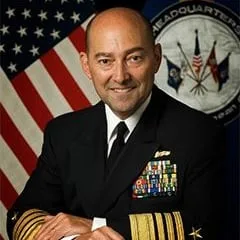
Admiral James Stavridis Former NATO Supreme Allied Commander Europe
Report on the war in Ukraine.
Transcript
Automated transcript · uncorrectedWillis today is Admiral James Stavridis, and he’s retired four star officer in the Navy and Supreme Allied Commander of NATO and one knowledgeable person. There’s nobody more knowledgeable that could depend on than Admiral Steve Riti’s admiral. There’s so many things happening in our city or state, our country, the world. You served mostly in Europe running NATO, So
let’s go. Let’s go to Europe first. Ukraine in Russia, nobody really knows what’s going on. Ukraine is wants more money. You’ll give us an update.
Let’s start with the fundamental fact here, which is Vladimir Putin invaded Ukraine. He’s carved out about fifteen percent of that country. He would like to overrun the entire country, and he will not stop assuming he is given the opportunity to conquer Ukraine. We ought to stop him in Ukraine before he threatens other nations, including NATO allies in
Western Europe. Everything I just said is a fact. The question is where are we today? And we were at a stalemate until us AID started to run out, and as a result of that, the Russians are now starting to inch forward, and that’s not going to get better unless the US provides this sixty billion dollar additional amount
of aid. Now, John, I know that sounds like a lot of money, but in the context of the US defense budget, which is about nine hundred billion dollars, sixty billion dollars is not a huge amount. And secondly, before you ask me, well, what about those Europeans, the Europeans have already provided well over sixty billion. So this is
the United States effectively matching the European contribution, and it’s in our interest to do it. If we don’t do it, Putin has a reasonable shot at taking more territory. He’ll gain all the resources that come with conquering the country like Ukraine. He’ll use those resources and he’ll keep rolling to the east. What is this like, John, It’s like
the nineteen thirties watching a malevolent Hitler’s Germany push across Europe. We need to stop him. Now.
It seems like that we’re living in the nineteen thirty seven well over again. And yeah, it’s horrible, it’s.
And so what we need is good leadership. And I’m encouraged by press reports that Speaker of the House Johnson wants to get this aid in front of the House. If it gets in front of the House, it’ll pass by at least two thirds of the House members. It’s already passed the Congress. And oh, by the way, we
can then start allocating money reasonably to our borders. Security equally important, as well as money for Taiwan to deter China. So yeah, it’s a big complicated world out there. But the answer is not for us to curl up into a fetal ball back home in the United States and drift into some kind of isolationism. We have to continue
to engage the world because the world economy is what fuels our own economy. Those are the lessons of the nineteen thirties, agreed.
It seems like the price of gasoline oil is going up, the price of food is going up. It comes down to the Red Sea and the Suez Canal. And I know we’re very capable of wiping out all those hoodies, but it doesn’t seem like we did it.
We have done it, I agree, I think we have been too timid in our approach in striking back at the hooties. They are proxies, They’re creatures of Iran We’re trying to be very calibrated in our approach, and it’s not working. They’re continuing to shoot at our warships, They’re shooting at merchant traffic, and sooner or later, one of
those ballistic missiles is going to get through and you’re going to see dozens of American sailors killed, or a big merchant ship sunk with an environmental disaster, or blocking the Suez Canal approaches. So my view, John, we need to increase the offensive work we’re doing against the Jutis themselves, and we are probably going to have to start thinking
about going after Iranian maritime targets to send them a signal to stop supplying these Houti rebels. So yes, I agree we have been too timid thus far in our approach against these pirates, and that’s what they are. Every nation has an interest in seeing this stob agreed now.
On Friday afternoon, Kuwait and Qatar told the US that if there’s a problem with Iran, they cannot use their airspace.
I’ve seen reports of that, and I think it’s too soon to determine whether that would be standing policy or not. Particularly, Qatar has reasonable relations with the Iran. I think it would all depend john on what the Iranians do that caused the United States to come into the war. I, for one, don’t think we’re going to get to that point.
I don’t think the Iranians are looking for a conflict with the United States, so I don’t think their strike that could be happening at any time may have already happened by the time this broadcast is made. That strike, I do not think is going to be huge. I don’t think it’ll be thousands of missiles launched at Tel Aviv.
I think the Iranians will try to stay precise and surgical, much like the Israeli strike that was conducted. Again they’re consolate in Damascus. They’ll try and stay proportional, not because they’re good guys, but because they don’t want to see the United States come into this war. And in terms of our other allies partners in the region, Guitar, uae
kuwate Oman, each of them will make individual decisions about airspace access. The one I would worry about the most would be Guitar because in Guitar we have our largest air base in the entire region outside of the capital of Doha. A base called Aluded. That’ll be quite critical for the United States to be able to fly in
and out of there.
Understood, we have about thirty seconds left of forty seconds. Anything you want to get off your chest on a Sunday.
Morning, I want to say something cautiously optimistic, which is, we’re very worried about the Middle East. We’re very worried about the war in Ukraine. On a kind of a side bar, but a very important thing is US China relations, and if you think about it, those have been pretty calm for the last six months or so. We’ve got
an inauguration coming up in Taiwan on twenty May. Let’s hope China maintains a path of not wanting to crack open big conflict in the Pacific, and I don’t think they will. So bottom line, John, on this Sunday morning, we are to be hopeful and I think cautiously optimistic about US China relations.
Well, God bless America. I agree with you, and let’s pray for peace and we’ll catch up again real soon.
Thank you, Edmar I’m Betti still patriari. Thank you, my friend. Thank you
Sunday, April 14, 2024

Pablo Sandoval Signs With Staten Island FerryHawks.
Eric Shuffler Founding Partner, River Crossing Strategy Group
Controversial recruiting a volunteer force for emergencies.
Bruce Blakeman Nassau County Executive; nominee for Governor

Greek parade on 5th Ave.
Fr. Alex Karloutsos Greek Orthodox Protopresbyter and Former Vicar General

Just returned from Europe. Europe is fed up with migrants.
Bill O'Reilly Host of No Spin News and Author

Just returned from the Southern border. TikTok.
Marsha Blackburn U.S. Senator from Tennessee; nominee for Governor
Jay Neveloff, Partner, Chair, Real Estate, Kramer Levin Naftalis & Frankel LLP
Michael Stoler Real Estate Expert

The most mysterious thing in the universe. Dark matter.
Steve Kates Space and astronomy broadcaster (Dr. Sky)

Admiral James Stavridis
Report from around the globe.
Admiral James Stavridis Former NATO Supreme Allied Commander Europe
Trump has new plans for NATO.
Admiral James Stavridis Former NATO Supreme Allied Commander Europe
New book: Restless Wave.
Admiral James Stavridis Former NATO Supreme Allied Commander Europe
White House take out the Houthis?
Admiral James Stavridis Former NATO Supreme Allied Commander Europe
Future of Ukraine unclear with Trump.
Admiral James Stavridis Former NATO Supreme Allied Commander Europe
Holding up arms shipments is not good for Ukraine.
Admiral James Stavridis Former NATO Supreme Allied Commander Europe
