


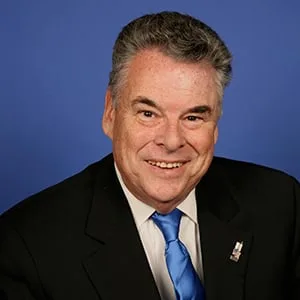
Peter King Former U.S. Representative from New York
The city and state and federal governments have to get the migrant situation in hand.
Transcript
Automated transcript · uncorrectedThis is Sunday, Memorial Day, a special day for many of us. We respect the soldiers that passed helping us live a better life in the United States of America and with us today is one great Congressman, Congressman Peter King.
Congressman King, how do you feel this Memorial Day weekend?
John? To me, every Memorial Day causes you to think about the tremendous sacrifices that men and women and the armed forces are made over the years. We wouldn’t be here today. You wouldn’t have your radio station, and I wouldn’t have had my career in Congress. We can go to all of that if we’re not for the bravery
of these men and women. And I think too often people just look upon Memorial there as a holiday, as a chance to get away, as a chance to get a good sale with the local shopping center or stores.
So I think it’s really important to take at least a few minutes out to think of the sacrifices that these men and women, So the sacrifices their family made. The family went without a father or a son, or a brother, a cousin. And this is what has made America great, which what keeps America great, and we should
always keep that in mind when we complain about this, you know, this being wrong and that being wrong, think of the overall good of how you know, the great country we have, and it’s from May great because of great people like the men and women who gave their lives depending our country.
You talk about sacrifice, and I often think that. I think about the Normandy and me and you have talked about it, and I think about the orders the generals gave for those soldiers to get into those boats and attack Normandy, almost going into certain death, and the decisions that were made to do that. And I hate to
ask you this next question is do you think that could ever happen again, where soldiers would just watch into certain death?
And I’ve been to Normandy twice once we’re President Bush for the sixtieth anniversary of Normandy of D Day, And you know when you go there, I mean the movies, the documentaries, nothing does it justice how those soldiers got out of the boats, which is daring enough in itself, right across at a long stretch of beach and then
climbed up cliffs that literally went straight up and with the German soldiers at the top shooting down with them. So many things could have gone wrong for many you did, many died that day and the days afterwards. It could be done today. You know, we do a volunteer military.
There’s a lot of very obviously, very dedicated people in there. But it’d be difficult for a lot of reasons. One, it would be very hard to get this many people involved in the military as we had during World War Two, or even they you know, an equivalent number. And then secondly, with the media, if the media had been there on
D Day and you saw men drowning before they even get out of the boats, so as they were getting out of the boats, and saw all those bodies on the beaches, and that was being televised back to the United States, people maybe up in arms, and it can be hard to sustain that. I mean, if if the
American people had known on January sixth, I mean, excuse me, on the June sixth, and on June seventh, on D Day, if they had known how vicious that was, it could have made it impossible to followed through on the attack. Now, thank god they were able to carry through because the the deaths on that day were probably less than would
have happened if the war had gone on Otherwise. That did more short in the war than anything. It was a real sacrifice. It was a tough decision by generalized an hour. He actually had written a statement I think, prepared to put out if the attack had had evident failure and he was going to take full responsibility for it.
So and again, I don’t know if that would happen to either. I don’t know how many people would take responsibility or something goes wrong without trying to how many soldiers.
Don’t remember how many soldiers actually died in Normandy.
No, I don’t have the count, John but I know it was well into the thousands. I know that, and there was others were seriously wounded injured. My uncle come in I think on two days after D Day. He survived D Day, but then a few weeks later in a battle he was actually blown out of a jeep
and was seriously wounded. He survived, but he spent I think several months in the army hospital. No, that’s a I don’t think that. You know, Americans have seen it in movies, whether it’s for John Way or whether it’s Band of Brothers, anything like that. They realized just how intense and how deadly and how vicious those days were.
And again when I went there, I cannot believe it’s seeing the height of those cliffs, seeing the length of the beach, and seeing the crashing waves on the beach itself. Any one of those things, to me, would have stopped most people from going ad with that. And yet somehow they made it all the way to the top. And
again it’s really a great tribute to them. And if that didn’t happen, maybe we’d always speaking German today.
It is mind boggling. Now that’s Memorial Day. We have so many problems back home here. If you wake up at three o’clock in the morning, what do you worry about the most? In lock country right now this Memorial Day weekend.
John, It’s not one thing for say overall, whether or not we’re losing our grip as a country, if we don’t have borders, if basically people from Washington Kent sem to come to terms in anything. When we see the police being disrespected, when we see increasing not just increasing crimes, but increasing disrespect for authority, We’re seeing so many strange,
crazy things being taught to our kids in school it just seems if the country is coming close or getting closer to coming apart of the seams, and that’s what worries me. And if we can get a leader at least too, not that everyone would agree on the answer, but agree that we’re all going in the same direction
and find the best way to approach it, rather than it appears that we can’t agree in anything today. What the end goal is, how to get there, what we should be focused on. Some people want to defund the police, do away with the police. Then you find in schools, I mean, some of the things that are being taught
so much against what parents want. And if you try to correct any of that, let’s talk about it, you’re branded as a racist or a bigot. Same with immigration, I mean you and I. I don’t know if any two people who are more strongly committed to immigration. I mean, now you’re actually immigrant myself. All my grandparents are immigrants.
They grew up in an immigrant type community, and I think immigrants, immigration is what makes America great. That’s like the new force that comes in every generation. So there’s a new group of immigrants coming in to revitalize the country.
As Almo as like transfusions were getting but now when they’re coming in uncontrolled, not knowing who’s coming in, not knowing who’s sick, who’s healthy, not knowing who could be connected to a terrorist group, not knowing who could be related to a drug hotel, and really coming with not any real sense of royalty in the United States, just
like coming in un mass. So that is something that really has to be addressed, and we have to be able to address it without being called anti immigrant or bigoted, because you want to get immigration under control. And so that to me is it goes beyond the issue of just immigration. It goes to the issue of you know,
whether or not we’re going to be a country or that if everyone come into whatever they want, there’s no borders, how does that make this different from any other country in the Western hemisphere, any other country in the world.
But that whole idea of institutional memory, of all of us bending together, we.
Don’t have a country without borders, that’s for sure.
Absolutely we don’t.
Yeah, I think some of the Democrats have started to understand that too, And I think we have to come to a face down and for our city that mean you love there’s fifty one city council seats coming up this November. So this is how do we use to say, coming to Jesus meeting to see what the hell is
going to happen.
We again have to make this an issue in the campaigns, discuss it in an intelligent way, and hopefully we get some more support from the media. I mean, seventy seven w ABC can’t do it all by itself. We have to get at least not even take out sides, but at least get the issue out there and treat it
as a legitimate issue. And let’s just say that if you don’t want uncontrolled.
We need common sense.
Somehow, you’re a bigot common We need common sense.
Thank you so much, Peter King, have a great weekend, enjoy the family, and we’ll catch up again next week.
Great. Thank you very much, John, you too, you and again your whole family. Thank you. Thank you.
Sunday, May 28, 2023

New York City is going to turn around. Remember the Vets today.
Bruce Mosler Chairman of Global Brokerage, Cushman & Wakefield

Between crime and the mentally ill, businesses are closing all over the Country.
John Chachas Investment Banker, Founder of Methuselah Advisors

The satellite business both public and private cause for concern.
General John Teichert Brigadier General, USAF (Ret.)

The country is in dire straits. Leadership is vacant.
Judge Jeanine Pirro U.S. Attorney for the District of Columbia

Venus and Mars converge in late May skies.
Steve Kates Space and astronomy broadcaster (Dr. Sky)

Interviews Jason Richter, Managing Principal, Capricorn Realty Advisors
Michael Stoler Real Estate Expert
Peter King

A New Memoir of Service and Leadership for New York
Peter King Former U.S. Representative from New York
Punishing a Former Leader Is That of a Banana Republic
Peter King Former U.S. Representative from New York
Blakeman's Nassau Win Shows He Is GOP's Best Shot for NY Governor
Peter King Former U.S. Representative from New York
A Mamdani Victory Will Bring Crime and Chaos
Peter King Former U.S. Representative from New York
The businesses and tax revenues will escape NYC if Mamdani becomes mayor.
Peter King Former U.S. Representative from New York
President Trump has done a phenomenal job securing the border.
Peter King Former U.S. Representative from New York
