


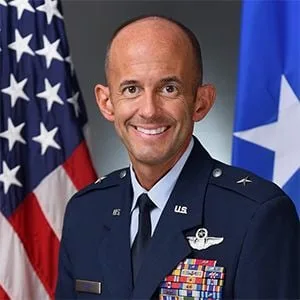
General John Teichert Brigadier General, USAF (Ret.)
The satellite business both public and private cause for concern.
Transcript
Automated transcript · uncorrectedIt is today, on this Memorial Day weekend, we have General John Tykerk and he’s a US Air Force Brigadier general retired now a national security expert, and he handled international affairs programs for the Air Force as well as Space Force. And still the American people still don’t know what Space Force does. So General, welcome to a Memorial
Day weekend. It’s a solemn weekend for all Americans. And we respect our we respect our past, our past soldiers, and we respect our our veterans. Tell us, uh, Space Force, Americans still don’t know what they do.
You’re right now, John, having me on, and this is a great weekend. Just to remember, everyone that serves today is standing on the shoulders of giants who have gone on before us. There is a new branch of the military that’s called the United States Space Force. President Trump created it three and a half years ago. It’s a
fairly small branch of the military, but they now are responsible for all United States military activities in or through space. And they’ve been doing that very professionally and productively for the last three and a half years.
What do they actually do.
Now, so, John, that’s a great question, and people do ask that we have a lot of military space assets and capabilities that are important to the United States and our allies and partners. That includes, of course GPS that provides navigation and timing signals, but it also includes the intelligence, surveillance and reconnaissance capabilities and communications capabilities that flow to
or come from space, and all of those satellites need to be defended, and to some extent, we need to make sure that we can minimize the capability of an adverse and time of war and protect our own capability and time of war so that those extremely important capabilities can be maintained for our benefit during a conflict.
Now a lot of people are saying that we got to be prepared our adversaries and I won’t mention any names, but are they do they have any capabilities of taking out our GPS system where in other words, every cloud that we’re driving stops.
So, John, that is a great question. And there are some extremely capable space adversaries. And when we think about taking out capabilities, it doesn’t just mean that you do something physically to hinder that satellite’s ability to be used.
But you can lase it, or you can jam it, or you can jam the uplink and the down link from it, and all of those things are capabilities that exist today. And you mentioned navigation that’s important, but those GPS constellation satellites provide precise timing that all of our international banking relies upon. And you add communications that come
through space as well, and so there’s a lot of capability that the average American doesn’t understand is important in space and the Space force role is there to protect it.
What percentage of those satellites being go down and still have the system working?
There are redundancies and part of the thing that Space Force is now trying to create is something called a resilient space force architecture, and that essentially means that the satellites that we have up in space are shielded from jamming or able to move to protect themselves. But another criteria or component of that resilient space architecture is the
ability instead of relying on big, high value capable satellites and finding ways to create more, less capable network satellites that make it a whole lot more difficult for an adversary to attack a few targets and take them out instead of what we hope to do is create something that is more resilient and more distributed to avoid that
type of attack.
And I’m sure it sounds like to me that some of these aircraft or spacecraft that we have up there in space for us are capable. How’s the nicest way for me to say, taking care of themselves and taking care of a satellite, cet are.
Up there, John. The goal ultimately is something called space control and space superiority, which means that we can use space for our own desired purposes and we can prevent those that are adversaries from doing the same. And so we are developing and have developed capabilities of a variety of types to maintain space superiority, to stop the adversary
from using it, and to protect ourselves so that we can use it.
Now. The other thing, since we’re still up in the satellites, Elon Muska is planning to put up like forty two thousand Starlink satellites. I mean, does that space create so much space garbage? Where where we have a mess? Or are they do they have licenses? Do they have to work it up? Work it out with NASA? How does
that work?
John? All of that stuff is coordinated and then tracked actively by the space force and something called space situational awareness forty two thousand pieces up. There is a lot, but there is also far more than that in satellites and the breakdown of satellites over the course of time.
So we will need to be very active in understanding where those satellites are and constantly monitor them so that we cannot infringe on other things that the rest of you may needs to do in that orbit and in space.
I hate to say this one, do we have or planning to have a sanitation department of space to pick up the garbage that is accumulating.
So you’re spot on on that there’s a lot of things that have now accumulated over time that create a hazard in orbit and ultimately take up place that we could use in orbit. And part of an international understanding of what we need to do in the future is to create, just like you said, a garbage truck or
a sweet street sweeper that can help us clean up some of those things that could otherwise be hazardous and infringe on our ability to use orbits in the space domain that are important to us.
General Memorial Day weekend, what else would you like to tell the American people again.
Our military members and those veterans and their families are absolutely incredible, and it stuns me to consider the amount of service provided by less than one percent of our population that serves in the United States Military, and then think of all those family members that serve alongside of them.
I’m proud to be part of that legacy and absolutely take some time this weekend to consider those who have paid the ultimate price for our freedoms and thank those who continue to serve.
General Ty Card, thank you for everything you’ve done for our country. And it seems like you’re one smart guy. I hope you’re there someplace helping our country still, and God bless you, and God bless America.
Sunday, May 28, 2023

The city and state and federal governments have to get the migrant situation in hand.
Peter King Former U.S. Representative from New York

New York City is going to turn around. Remember the Vets today.
Bruce Mosler Chairman of Global Brokerage, Cushman & Wakefield

Between crime and the mentally ill, businesses are closing all over the Country.
John Chachas Investment Banker, Founder of Methuselah Advisors

The country is in dire straits. Leadership is vacant.
Judge Jeanine Pirro U.S. Attorney for the District of Columbia

Venus and Mars converge in late May skies.
Steve Kates Space and astronomy broadcaster (Dr. Sky)

Interviews Jason Richter, Managing Principal, Capricorn Realty Advisors
Michael Stoler Real Estate Expert
General John Teichert
Building Military Readiness for an Increasingly Dangerous World
General John Teichert Brigadier General, USAF (Ret.)
Saudi F-35 Purchase is Detrimental to Iran
General John Teichert Brigadier General, USAF (Ret.)
Space Command is moving from Colorado to Alabama.
General John Teichert Brigadier General, USAF (Ret.)
Where is Ukraine spending all this money?
General John Teichert Brigadier General, USAF (Ret.)
The Canadian aircraft accident. Pilot error?
General John Teichert Brigadier General, USAF (Ret.)
Israel has plenty of armaments to retaliate.
General John Teichert Brigadier General, USAF (Ret.)
