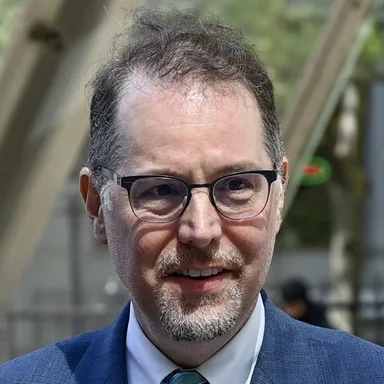
Mark Levine New York City Comptroller
Tackling New York City's Housing Crisis and the High Cost of Living
Transcript
Automated transcript · uncorrectedSunday morning, Well, what is going on in New York City. Well, a few weeks ago we spoke to Tom DiNapoli and the news is he won his primary and he’s responsible for New York State. Now today we are speaking to the New York City Comptroller, Mark Levin, and he is working very hard. He’s one smart guy. And he spoke
in front of the Police Athletic League lunch a few weeks ago and everybody, everybody there was very impressed. Well, Mark Levin, give us an update of what the heck is going on in New York City, because nobody really knows.
Oh Man, John, thank you first for having me on the show, and boy was it wonderful to spend that afternoon with you and the leaders of the Police Athletically. I’m so grateful for what you’re doing to help young people around the city.
Boy man, it’s been a busy summer in New York City. There’s so much to talk.
About on our budget and our economy.
But I got to start John with news that came out just in the couple of days about rents. Rents in Manhattan and.
Other parts of New York City are at their all time highest.
Did you see this, John, I saw it.
It’s an all time high because I understand that there might be as many as twenty thirty thousand apartments that are vacant because people can’t afford to do anything with them.
Yeah, we’ll talk about that, but first, the numbers are pretty incredible, so media and rents in Manhattan, believe it or not, five two hundred and ninety five dollars per month. It’s just it’s insane. And in Brooklyn it’s.
Not much better. Four thy three hundred and fifty.
And I know your listeners understand that those are rents that are out of reach, not just the long term people, but of a nurse, of a social worker, of a firefighter.
These are really outrageously high rents.
And the problem is we just have a shortage, a shortage of supply of homes in New York City.
And you pointed to one of the reasons, which is that.
In rent stabilized buildings, we have tens of thousands of apartments that are sitting vacant. And your listeners are probably shocked, would they why would a landlord leave an apartment vacant? Well, unfortunately, the law is very difficult when apartments become vacant and they need very expensive renovations.
Sometimes a six figure price tag.
The owners of the buildings are not able to raise their rents enough to cover the cost of that renovation, and so many of these apartments remain vacant.
This has got to be fixed.
We’ve got to activate these homes so they can go back on the market, and it can be done in the way that preserves affordability but allows for more flexibility for landlords to be able to pay for the renovations.
But in general, we have a shortage. We probably have a shortage.
Of five hundred thousand apartments across New York City, and in part is because there’s just not enough financing. And so my office is doing something about this.
John, We’re going to.
Invest four billion dollars of pension money in financing housing all over New York City new construction, renovating, preserving existing buildings, and converting former vacant office buildings into homes. This is going to be like a shot of adrenaline into housing production all over New York City.
I’m super excited about it.
Let me ask you a stilly question. You know, we know that what the problems with Niger is in New York City Housing Authority. There’s three hundred thousand apartments there. But the big item is like three Like the people never pay rent, but nobody wants to make them homeless either, So what do you do with that?
Yeah, rent payment has actually gone down city wise since the pandemic. We during the middle of the emergency, we had a pause on rental payments for many tenants. Understandably people were out of work at the time, but it’s been hard to get back to where we were pre pandemic, and this has been a challenge for all kinds of housing,
particularly for NISCHA. And as you say, you don’t want to push people out because then they land in the homo shelters and we don’t want that. That’s a tragedy for families. So I just think we need to help coax people back into paying their rent because we do need.
It for the operations of NICHA.
But you know, I got to remind you, John, people are suffering economically because we’ve had a very bad job situation. Jobs are totally flat in New York and we do need to do better and get jobs growing again so that families can pay rent.
And we don’t have problems in Nisha and elsewhere.
And I don’t know if you followed this, but job creation is basically just flat in New York. The only area where it’s growing is in healthcare, specifically home healthcare AIDS. And it’s partly because we have a lot more competition from other parts of the country, places like Texas and Florida and other states. So we’ve also got to up
our game to get job growth going again in New York.
If this is something I’m all in.
On, understood now, how can we induce people to build more homes when they’re putting on so many restrictions. Why would anybody build a new home or build a new building in New York when all these new restrictions coming up.
They want red freezes, et cetera, et cetera. I mean, how do you how do you pay the mortgage? How do you pay the mortgage when you have a red freeze.
There’s a lot of reasons why New York is behind on building housing. One historically has been our zoning has been very, very restrictive, but that was largely fixed, Uh, the Atoms administration passed something called City of Yes.
I’m sure you’ve covered it here.
That’s going to make it easier to build from a zoning perspective. We’ve talked about the financing challenge, which I’m working on with our investments.
But it’s just.
Cost too damn much to build in New York, where we’re seeing average apartment costs of three quarters of a million for low end projects, well over a million for some projects.
And that’s just it’s outrageous. It is partly the fault of.
City government, which has so many rules and regulations and makes it very, very difficult to get approval for permits. If you want to get approval for building affordable housing in New York, it probably takes twelve to eighteen months to get the paperwork done.
And that’s beyond.
Getting the mortgage and getting the zoning, that’s just getting.
The paperwork approved. We’ve got to do better. I think technology can maybe speed that up.
I think you should get approval in twelve to eighteen days, not twelve to eighteen months.
And then the building’s department the same problems. Just takes too long.
You know what expeditors are john where people hire staff. It’s crazy you have to hire someone just to get your paperwork through. Even the city hires expeditors to get its own projects built. It’s really outrageous. So we’ve got to clear out the bureaucracy and make it easier to build gold in New York City. Lower the cost. That
will help lower the ranch long term supply and demand.
John, you know this as a.
Business agree, and we got to solve the problem real soon because right now, I mean I’m saying to if I’m taking the money that I’m going to spend in New York and it’s my kid’s future money, i got to invest it better in a place where I’m going to get a return on investment, and that could be Florida.
Well, we don’t want that to happen. And we know there’s in a lot of.
Housing development in Florida and some of it is at New York’s expense, and so we got to win that battle.
We want people to.
Grow here and invest here, and most importantly, we want housing that New York is going to afford, and that requires expanding the supply.
We can do that, but it’s going to require the kind of work we’re talking about.
Well, there’s another rule that says that you only build ninety nine apartments because you build more than ninety nine apartments that you have to have all these other new restrictions that and nobody’s building more than ninety nine apartments, even though you can build one hundred and fifty.
Yes, look into it, rock Levan.
We’re out of time, but look into it.
Look into it.
You’re one smart guy, and you’re one common sense guy, and we’ll talk to you again real soon.
Thank you, John, I really appreciate it. Have a great one. Do well.
Sunday, July 19, 2026


The Democratic Party Has Lost Touch with Mainstream America
Newt Gingrich 50th Speaker of the House
Strengthening Fiscal Accountability and America's National Security
Ron Johnson U.S. Senator from Wisconsin

A Conservative Vision for Economic Growth and Fiscal Responsibility
Roger Marshall U.S. Senator from Kansas

Lindsey Graham's Legacy and the Future of New York
George Pataki Former Governor of New York
Confronting the Threats Posed by Iran, China and Global Instability
Brian Mast Chairman, House Foreign Affairs Committee

Advocating for Senior Tax Relief and Tougher Public Safety Policies
Nicole Malliotakis U.S. Representative from New York

Election Integrity Must Be a National Priority
Claudia Tenney U.S. Representative from New York
Federal Prosecution Matters in New York
John Sarcone First Assistant U.S. Attorney, Northern District of NY


Lessons From 90 Years of Life and Public Service
Andrew Spano Former Westchester County Executive

Congressional Campaign Focused on Law Enforcement and Tax Relief
Michael LiPetri Nominee for Congress, NY-3; Former NY Assemblyman

Trust in Institutions and the Future of American Leadership
Michael Cohen Former Attorney to President Trump & 77 WABC Host

Building Military Readiness for an Increasingly Dangerous World
General John Teichert Brigadier General, USAF (Ret.)
Honoring the Legacy of Detective Steven McDonald
Mary Murphy & Susan Birnbaum Emmy-Winning Journalist & NYC Police Foundation CEO
Politics Behind the Horse Carriage Debate
Christina Hansen Carriage Driver & TWU Local 100 Spokesperson
The Stoler Report with Michael Stoler: Steve Kliegerman
Michael Stoler Real Estate Expert


China's Mini-Moon Mission and Space's Next Frontier
Steve Kates Space and astronomy broadcaster (Dr. Sky)