


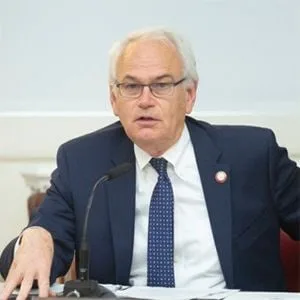
Robert Holden Former New York City Council Member
Testing for prevalent drugs in the illicit drug trade.
Transcript
Automated transcript · uncorrectedWhat is the today is city Counsulman Robert Holden, a common sense Democrat, and he has some new revelations that he wants to talk about the two new bills and a counselman, what would you like to talk about this Sunday morning?
I got two things. One is, of course, we have a drug situation in New York City and actually in the country, and we have to get a handle on it. So I have an idea in questioning some city officials that maybe we can start to, you know, find out where most of the drugs are being used and how
we could put an end to it or at least address it. And the other is I have a resolution to talk about honoring our Korean War veterans. So anytime, you know, I can explain it, I can get into it.
Well. On the drugs thing in the water, I don’t understand that. I know that Suffolk County got was in trouble with the US Attorney’s Office on certain pollutants in the water in Suffolk County. I don’t know if you read about that. Is it similar to that?
Yeah, But this is a little different. This is the wastewater where many countries now can you know, we knew by the way where COVID was prevalent by the wastewater. We were testing the wastewater. And then when I was questioning the officials, I said, well, that’s interesting how you can test for COVID, the COVID virus, But are you
testing for drugs like illicit drugs like fentanyl or the track. So they said no, and they at first they said they’d get back to me, and then weeks later they did and they said, no, we’re not testing for illicit drugs.
So I said, well, that’s pretty inexpensive. We could test it. It costs like a between one hundred and two hundred dollars per test. If you tested the wastewater, you can find out where most of the fentanyl or other drugs are being consumed and used. Obviously it’s coming out in the waste water. We have fourteen wastewater resource recovery facilities,
and if we tested a couple of times a week, we can get a handle. For instance, many in countries like Australia and many countries in Europe, they’re testing their wastewater regularly and they’re identifying, you know, patterns of use and at a fraction of the cost. Like I mentioned, so the body excretes metabolites that can be tested in wastewater,
and it’s and it really shows real time consumption of particular drugs. For instance, in Europe, they they found out that they were testing and finding out that the use of cocaine in ecstasy was on weekends, and they they that’s when they started. Had they could crack down on certain areas.
They don’t arrest. They don’t arrest anybody anyway, So what.
Would you do, Well, we need programs. Obviously, we have to get the people off the drugs, and we need to crack down on the on the drug dealers. And they are putting people away, if you know, obviously the big dealers, and we want to we want to actually address that. But we don’t want people, you know now
with the fentanyl on the track, we don’t want people walking around the streets like in San Francisco like zombies. And it’s starting to happen in New York City, in certainly Manhattan.
Well absolutely, I mean when they legalize marijuana. In addition, the US Attorney’s Office when they did the thing on Suffolk County, I tried to get them on the radio and they refused to come on the radio because I was wondering. The other problem Suffolk County was I understand from Brookhaven, Uh, you know they have that nuclear plant
out there and that there may be a nuclear examination in the drinking water.
Right that would come out also partially, but most of it is you can test that in the drinking water, which is very different in wastewater obviously, but we really have to kind of pinpoint the focus of if we’re going to have these anti drug programs and spend billions.
You want to know where where you want to know what area is to talk.
We want to know where where can we where can we put the obviously the treatment areas where people where we have to focus our average.
It gives you, it gives you additional intelligence. I understand that. And also on the Korean War veterans, I agree with you. I think fifty Americans idea they deserve to be honored. And are the Vietnam War veterans honored?
We you know, we never really honored them. They did come up with a date for the Vietnam that’s to be honored. We don’t have one for the Korean War yet. So July twenty seventh. This coming July twenty seventh will be the seventieth anniversary of the signing of the Korean Armiscists Agreement.
We will have you on We will have you on our five o’clock show in July twenty seventh, and you give us an update then of what’s going on. That’s terrific. Thank you, Consulman Robert Holden, Thank you for being having common sense, and we’ll catch up with you again real soon.
Thanks my pleasure. Chomp
Sunday, July 16, 2023

Redistricting of state CD lines heavily favor Democrats.. legal action.
Ed Cox Chair, NY Republican State Committee
Gilgo Beach serial murderer.. guy next door.
Peter King Former U.S. Representative from New York
Start of a 9-game! Homestand Jul 18 (Tue) 6:30 PM vs Frederick
Eric Shuffler Founding Partner, River Crossing Strategy Group

We need the truth from the Justice Department
Alan Dershowitz Harvard Law Professor Emeritus
The City is going through a difficult period but will come out better.
Former Rep. Anthony Weiner

The jobs report did not tell the whole story.
Larry Kudlow Fox Business Host and Former NEC Director
The New York state budget has a few holes in it.
David Paterson Former Governor of New York
No Labels caucus looking for common sense candidate 2024.
Joe Lieberman Former U.S. Senator from Connecticut
NATO meeting in Lithuania an American success?
Former Deputy National Security Advisor K.T. McFarland
Interviews Lev Mavashev Founder and Principal Alpha Realty
Michael Stoler Real Estate Expert

Mid-July skies offer great views of the Milky Way!
Steve Kates Space and astronomy broadcaster (Dr. Sky)
Robert Holden

Migrants in New York.. running out of space.
Robert Holden Former New York City Council Member
Illegal migrants drain precious City resources.
Robert Holden Former New York City Council Member
Migrants are a growing issue for the homeless system.
Robert Holden Former New York City Council Member
Closing Rikers is still a bad idea. 40 story neighborhood prisons.
Robert Holden Former New York City Council Member
Not everybody is on board with closing Rikers Island.
Robert Holden Former New York City Council Member
