


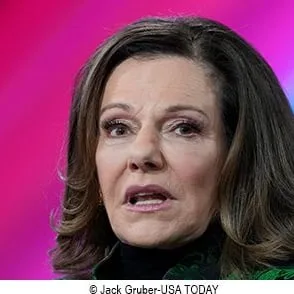
KT McFarland Former Deputy National Security Advisor
It is about time the US takes out the Houthis.
Transcript
Automated transcript · uncorrectedWith US is Kat McFarland, and she was the Deputy National Security Advisor to the United States and this KT there’s so many things going on. I don’t know where to begin. I don’t know where to and the good US is on On Thursday afternoon, they extended to the Senate extended the budget. So that’s one less headache. You
tell us what’s going on.
You know, there’s an expression that says great nations decline slowly and then quickly, and war starts slowly and then quickly. And we’re now at the quickly part because not the Middle East is on fire, Europe is on fire with Ukraine, China’s on fire with Taiwan, and the United States appears to be incident in all these situations. And Iran, for example, Iran,
for every day Iran ups the ante, either with Iranian proxies attacking American or ally ships in the region, or Iran itself now is directly attacking Pakistan, directly attacking American interests in northern Iraq from Iran proper. So as long as a Biden administration just doesn’t respond or looks the other way, or has a half, you know, just a
half effort to try to retaliate against what they’re doing. These attacks will continue, you know, for example, on American ships, these missiles that are coming from the whosi’s in Yemen. The perimeter defense in other words, that as a miss just about to hit an American ship, then we knock it out of it, but we’re not going back to
the source of the missile missile launcher in Yemen. And as long as we don’t go to the missile launder, then you know, the missiles are going to keep flying. And it’s the attempt of the Bidy administration. They think they’re preventing war by doing this, by not having much of a response, by making nice to Iran, by placating Irun,
but in fact they’re encouraging a war because Iran is going to keep doing this, and keep doing this, and keep doing this until at one point a missile is going to get through our defensive perimeter. It’s going to strike an American ship, and you’re going to have a lot of americansky and then rerewar a war. We don’t
want a war. We’re not prepared to fight in a war that could have been avoided.
I understand last week that even you know, the Pakistan got involved, and China has almost threatened the United States. I don’t know exactly what the words were, that they shouldn’t debumb the hoodies anymore. I mean, who else can get involved?
Well, the North Koreans are making a little noise, maybe they’ll stick their heads up. And there’s of course South America. For you never know what’s going to happen in South America. But at the point being that the Bible, you know, what’s the world in particular, our adversaries pursued weakness and confusion or distraction on the part of the American president.
That’s when they make your moves. They don’t wait until we’re strong. They make the move when we’re weak. And that’s what’s happening now. And so I think you’ll see increasing threats and challenges to the United States increase in frequency and in intensity.
Has uh I’m losing track. Has France and Spain in Italy reversed its course on their Red Sea policy because last week they said they’re not going to help UH.
They’re they’re they’re leaving it up to the United States. In Great Britain. But the point being in the Red Sea, you know that’s European trade, they should be involved with this. And if the United States is going to defend free shipping, you know, international shipping, freedom of the seas in the Red Sea, that’s the trade that goes from Europe to
the Suez Canal through the Red Sea to Asia. That’s not our stuff. That’s the stuff that’s going from Europe to Asia. So any European country that says, well, we’re going to sit it out, We’ll let America do it, No, we should insist. If you expect us to defend freedom of navigation in these seas, freedom of commerce, you should
be with us, at least be with us in moral support. If you’re not going to land any any contribute to the effort. But it brings up the point that Donald Trump was very hard on the Europeans, said, where’s your two percent? You all pledged to put two percent of your GMP towards defense. You’re not doing it. America is
spending a lot more than it’s two percent. We’re spending three and a half percent of our gmpn defense. We’re spending to defend you. You’ve got to up the ante. You’ve got to come up with their contributions and all of these countries, you know, the German. Everybody said, wow, not now, it’s really tough. Now we’ll get to an
adventure of it. Not now, but this should make the point to the European countries, if we have a common defense, you have to pay the share, and they’re not doing it well.
Katie mcfallan, thank you so much for the update, and let’s go day by day and see where we go the you know, by next week. Thank you so much.
Thank you, John
Sunday, January 21, 2024

Mayor Adams has migrant budget problems. City Council resists his cuts.
Nicole Gelinas Manhattan Institute Senior Fellow and Columnist


Governor Hochul's budget partly wishful thinking.
David Paterson Former Governor of New York

Meeting with White House to urge moderation.
Joe Manchin Former U.S. Senator from West Virginia

China's dominance is creeping up on us.
David Malpass Former President, World Bank Group
No diplomacy will take Iran out of the picture.
Mike Pompeo Former U.S. Secretary of State
This week's guest: Kara Rakowski Partner & Co-Chair of Administrative Dept. Belkin Burden Goldman, LLP
Michael Stoler Real Estate Expert

Eclipse day is 78 days away. Governor Hochul notes.
Steve Kates Space and astronomy broadcaster (Dr. Sky)

KT McFarland

President Trump has won the tariffs wars.
KT McFarland Former Deputy National Security Advisor
President Trump has successfully entered a ceasefire agreement in the Middle East.
KT McFarland Former Deputy National Security Advisor
Putin has lied about the Soviet aggression in Ukraine. Chaos at the DOD.
KT McFarland Former Deputy National Security Advisor
Russia & Ukraine are moving towards a ceasefire.
KT McFarland Former Deputy National Security Advisor
Trump moves to negotiate peace in Ukraine.
KT McFarland Former Deputy National Security Advisor
