


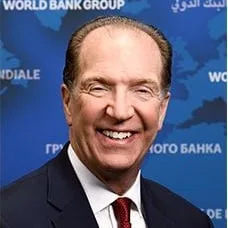
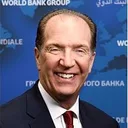
David Malpass Former President, World Bank Group
The Economic Strategy to Counter China
Transcript
Automated transcript · uncorrectedWell, what is going on in the world with us today? Is David Malpass and he was the President of the World Bank from twenty nineteen to twenty twenty three, and well, one of the smartest guys that I know in world economy, David Malpass, what’s on your mind today? What kept you up at three o’clock in the morning?
Hi? John. The higher bond yields are concern You know, we hit four point seven percent today on the ten year and mortgage rates are up, so people are feeling this and that’s going to go along with the gasoline prices rising. So we’ve got lots to worry about. But we can also think about how do we get here
and how do we get where are we going going forward? Which I think is pretty good. Basically, as you look out the next five years, ten years, there’s a lot of good going on. We just don’t see it today.
Well, yes, and you know that oil prices were up almost forty in ten fifteen twenty days, and if the right thing happens in the war, you’ll go down ten fifteen twenty days. It’s not a permanent problem, so I’m not looking at it as a permitive problem as far as world peace or as far as inflation rates or
anything like that. Let’s see what happens and hopefully the problem solves itself over the next few weeks.
That’s right. And the good thing about that is the US is and energy superpower. So from the standpoint of protecting ourselves and we protect the world, that still goes on. And so that’s that’s going to come to pass. As we look around, though, we have to keep in mind, and I think the President is doing this, that China
is this big overriding problem because of the way it’s operating its economy. It’s a centrally planned economy that has made manufacturing rapacious, manufacturing that is really destabilizing quite a few parts of the world. So that’s one of the issues I think that has to be resolved as we look forward to the bright future.
I yes, and you know when I look back and what bothers me at three o’clock in the morning sometimes, how what was it is it ten years ago, fifteen years ago, twenty years ago when we started shipping all our automobile companies to Mexico or to China, or the pharmaceutical companies to China. What you know, you were around
what happened? Why did we do that?
I think people were wishful thinking that China’s Communist Party would become almost a democracy. Remember the excitement out of Tiananman Square, which was that was nineteen eighty nine, and then by nineteen nine China said it was going to be reforming and becoming a market economy. People got sucked into that. The World Trade Organization came up, and in
the meantime, China kind of chuckled all the way to the bank. So they were building big factories with robotics while the US was exporting the capital to help them do it. So we’re now in that box, and the question is how do you get out. I don’t know if you saw, but there was an executive order in
the last three days or so where the Defense Department is changing the way it’s protecting the supply chain for its procurement. It’s saying that they need to be domestically procured or with allies, not with people that are going to end up being our enemies or our adversaries like China.
And I think that’s a good step. It’s going to take a huge amount of work, Plus we need to retrain lots of high school students. They have in their mind that they’re going to be the best workers in the world in terms of manufacturing innovation using digital technology AI.
They can all do that, but they’re not getting that training out of colleges right now.
Well, the Chinese people are so hard working, is so smart. I expected it better. But you know, it seems like we’re under attack in so many directions. And I shouldn’t blame all the Chinese people. I guess it’s Chinese Communist Party through Fetanola, through Mexico, through a lot of schemes, baby making operations in the United States. I mean, what
is going on with that?
John, I’ve got to push back some. I think people around the world are good. And if you take people from their bad environment that may be a bad economy or in China’s case, the Communist Party dominated, they become good.
They’re as good workers as Americans or workers. We’ve got this most amazing country where people come in and once they hit the United States, they suddenly become hugely productive. So take take people, you know, and I worked a lot with Africa and they’re they’re burdened by systems that don’t work. You bring them out of that environment and
they they become good workers. And so we can hope that for people in Africa, I think we should be hoping that so that they are able to stay at home, get good jobs, have families that work together, and small businesses that actually work. And for China, same thing that that they gain freedoms and are able to have freedom
within a market based system. Right now they’re there, they don’t have that. They’re they’re working in order to export and to drive down prices for goods in a way that leaves them poorer. And that’s not a good system.
I think it could change. I don’t see them changing that system right now. They’re they’re doubling down on heavy centrally planned investments in their economy. So what do we do. We should compete and we should make sure that we’re number one in lots of sectors and in overall economy and education.
Well, David Malpass, former President of the World Bank, thank you so much for coming on this Sunday morning. And let’s pray we continue to go in the right direction, and let’s pray for peace and for energy prices to come down and interest rates to come down to help the American economy even more.
Thank you, John, good thoughts,
Sunday, July 26, 2026
Inside the Bureau's Largest Security Operation Ever
Christopher Raia Deputy Director, FBI

The GOP's Path to Victory in Arizona
Andy Biggs U.S. Representative from Arizona; nominee for Governor

Examining New Jersey's Voter Registration System
Christine Hanlon Chair, New Jersey Republican Party

Defending the Political Center Against the Far Left
Jerry Kremer Former NY Assemblyman & Political Columnist

Why Free Markets Are the Answer to New York's Housing Crisis
Judge Richard Weinberg Retired New York City Criminal Court Judge; 77 WABC Host

Supporting Independence for People With Disabilities
Geraldo Rivera Journalist & Author


The West Must Take a Harder Line on Iran
Tal Heinrich Former Spokesperson, Israeli Prime Minister's Office

How the Jones Act Hurts the U.S. Economy
Rachel Greszler Senior Research Fellow, Advancing American Freedom

Traditional Democrats Must Push Back Against Socialists
Hank Sheinkopf Political Consultant

Protecting Yourself From Legionnaires' and Cyclosporiasis
Dr. Mason Pimsler Geriatrician, Lincoln Medical Center
Challenging New York City's Bike Lane Expansion
Hartley Bernstein Attorney, Bernstein Cherney LLP



SpaceX, Voyager and the Untold Stories of Apollo 11
Steve Kates Space and astronomy broadcaster (Dr. Sky)

How Big Tech and AI Are Putting Children at Risk
Lynn Shaw Founder of Lynn's Warriors

David Malpass
U.S. Strength Lies in Innovation and Energy Independence
David Malpass Former President, World Bank Group
Small businesses are key to economic growth.
David Malpass Former President, World Bank Group
Will the Fed finally move on to cut interest rates?
David Malpass Former President, World Bank Group
Trump has rearranged the world order of trade.
David Malpass Former President, World Bank Group
World Bank chairman discusses tariffs.
David Malpass Former President, World Bank Group
