


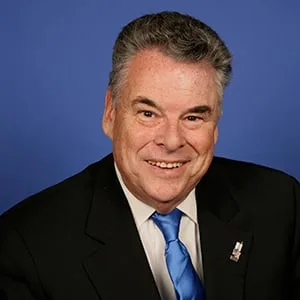
Peter King Former U.S. Representative from New York
Affirmative action, student loans…SCOTUS
Transcript
Automated transcript · uncorrectedWhat is today? Congressman Peter King, and in Congress for twenty eight years, knows every function of Congress and is a great American in is concerned about America for our kids and grandkids. Congress Span King, what keeps you up at night these days?
John? I would say, in many ways, it’s how our country is changing, and not for the better. Listen, I realize that times are always going to change. The country is ever going to be the same it was when we were growing up, or our fathers or our grandfathers.
But despite the changes over the years, it’s always kept its basic fabric or basic beliefs. I just think now we’re going off the deep end. Everyone becomes a victim, everyone becomes a title or something. And fris I fully support the Supreme Court decision, even though there’s such a backlash against it. As far as college admissions, as far
as saying that race should not be the factor. You should find ways to get the most qualified students in and you can use different ways to determine that. If you’re a poor white kid growing up in Appalatia and you and your parents work hard, your grades may not be as high as a person who went to a
private school, but I can see that person being admitted to them, and you look at the whole picture fame of a person who’s brought up in the inner city, but not because they happen to be black, it happened to be white, depending on their life experience, that can be factored in. But over the last twenty twenty five
thirty years with colleges, it seems they just checked the box. They have to get so many people of color in, and so there’s many white kids being rejected for that reason, were very qualified. Certainly Asian kids were being rejected. And also I think it’s unfair to, you know, the black community.
They’re being somehow branded is only getting in because of their race. So it doesn’t really help anyone. I think though, I would have no problem if the school was fifty percent black or one hundred percent black, as long as you getting the most qualified people, and you can determine qualifications in a different way. It doesn’t have to be
SAT scores. It doesn’t have to be a highest grade average, or you’re coming to a very poor background and you’ve worked your way up. I can understand the way your grades may not be as high, but you’re still be qualified then to the school. But I think that John Roberts, the Supreme Court, the Chief Justice, was right when you
said you don’t and discrimination by creating racial discrimination. And we think of all those Asian young people, men and women who were kept out of school because they were Asian. I mean, that’s you know, not being a minuted to college.
That is racism. Just like back in the nineteen twenties when Jews were being rejected because they’re figured there were too many Jews coming into the school, they were too qualified. That’s insane. We can’t go back to that. So I think the Supreme Court is taking us in the right direction of that. But if you listen to the mainstream media,
this means that Supreme Court doesn’t want blacks to go to school, does Hispanics together to school. It’s exact opposite. They want them to get the best possible education. And for the people who claim there so concerned about minorities, then they shouldn’t be tying the hands of the cops who do more to protect old people black and white
and brown than anyone else. And they should have better schools for the kids, have more charter schools. We can support organizations like Coup. Yeah, you’re Ragan working within the community. So anyway, I just hope that we can stop the trend that’s going in the wrong direction and maybe try to reverse it.
Of this Congressman, I agree with you, and I had a problem when I was growing up, since I came to America six months old. My parents spoke Greek at home, so English was almost my second language. And when I was taking the SATs, my English SAT was like in the four hundreds, but my Math SAT was like seven ninety.
So that’s what I’m worried about when trying to get into college, and it’s there’s going to be I guess the colleges have to have a little bit of discretion, but not be prejudiced against anyone group.
Right. For instance, it was right to certainly right to let you in. You were an immigrant yourself, You were obviously a son of immigrants and you had overcome a lot. But not let you in because you happen to be Greek.
But you happen to come from an immigrant community where you had to work your way up, and you show that you were qualified. That’s the way it should be done, not just to check off the box because of a person’s Irish, Italian, Greek, Black, white, brown, hispatic, whatever. It’s just that whole idea of categorizing people by race, I
think is dangerous. It creates resentments and you don’t get the best qualified people. And I was speaking the best qualified people who are black. I’m looking at the outgoing police commissioners. She stepped down just the other da Heshan Sul was a female. She’s blacks. To me, as qualified as anyone I’ve ever seen. And that’s the person who
was more than qualified to be the NYPD commissioner. Was too bad, she really wasn’t given the opportunity to really demonstrate all her ability. But I give her credit. She was really a great assets in New York and she’s going to be very much missed by the people of New York City.
Agreed to. There’s been so many Supreme Court decisions lately. The other one that happened on Friday was the Supreme Court decision on the forgiveness of student loans. What say you about that?
Yeah? I support that decision, John, because listen to me, student loans have gone too high and it’s a real burden on people. But if that’s going to be addressed. It should have been true legislation. You can’t have the president of the United States by an executive order, just by unitary action spending actually, in fact a four hundred
billion dollar deal where he was by forgiving those loans, that’s four hundred billion dollars that was going to be basically missed from the treasury. And that’s is wrong. This is not a dictatorship. That was going to be done anyway.
You should have had hearings that should have been done, and everybody in all the interested parties find a way that that can be addressed. But also, how about the person who when they were eighteen decided that they were not going to college. Maybe they couldn’t afford it, maybe it’s just they different family obligations. They went out and
they formed a business. They took out loans, you know, for their business to get there where they could be in agriculture or machinery or whatever. And you know, why does the person who went to college and got the benefit of a college education get their loan forgiven. But the guy or the woman who went out and formed
their own business and ran up ladged debt to get that business going, they don’t get that forgiven, and so to me, there was a lot of arbitrariness about it. If it’s initian is going to be address to me, it should be done in a total way. It should be done in Congress. You can’t have one person to
president just for giving four hundred billion dollars in debt like that.
See. The only other problem, as a sidebar, and I understand that we both agree one hundred percent on both as a sidebar, is there was no red wave because well, the kids believe what the president said, whether he should have and shouldn’t have. They want to believe in what the president says. And twenty six million applications were filed,
and I guess all these people voted Democratic because they wanted that ten thousand dollars.
It certainly worked for the president, you know the irony years that in the Supreme Court decision, they quoted Nancy Pelosi and we’ve also President Biden, who had both said that they couldn’t be they couldn’t do it. Originally Nancy Pelosi said, we came to this because it’s it to be illegal. Only the Congress you can do it. The
president can’t do it. The President said, I like to do can’t because it’s illegal, and then he went ahead and did it. I think it was really cheap politics by the President. Was I don’t blame If I was twenty four years old and I owed a lot of money and selling the President’s going to get me ten thousand.
Dollars, I’d vote for the guy that might give it back to me.
Yeah, exactly. So that’s what I mean. The President to me was really cheat politics. He did it, and a way he was cool because he had to know that without even getting into the merriche or whether or not the money to return, he had no right to do it.
I mean, we are a nation of laws. You can’t have one person deciding on his own to give four hundred billion dollars A billion dollars, Yeah, I mean that’s a big number, especially when we’re trying to get inflation down, we’re trying to get the economy going again or coming out of COVID and every dollar is being washed or
should be washed. Just telling me of a four hundred billion dollar item appear because of an arbitrary decision by the president, to me, that was wrong. I think Supreme Court I agree he did the right thing. Yeah.
Well, Congressmen Pdking.
We just most were graduate and my daughter went to school with Amy Cony Barrett. She wrote a concurring opinion in that case, which I think was brilliant. So I’ll take you some credit for that, and you could take credit for n y U and Brooklyn Tech.
Okay, thank you, Congssman King. Have a great Fourth of July weekend and and we we hope God bless America.
God bless America right fourth of July, the greatest country in the world. And I will see you tomorrow night, Monday night at the studio.
Sounds good. I’ll see you then.
Sunday, July 2, 2023






Peter King

A New Memoir of Service and Leadership for New York
Peter King Former U.S. Representative from New York
Punishing a Former Leader Is That of a Banana Republic
Peter King Former U.S. Representative from New York
Blakeman's Nassau Win Shows He Is GOP's Best Shot for NY Governor
Peter King Former U.S. Representative from New York
A Mamdani Victory Will Bring Crime and Chaos
Peter King Former U.S. Representative from New York
The businesses and tax revenues will escape NYC if Mamdani becomes mayor.
Peter King Former U.S. Representative from New York
President Trump has done a phenomenal job securing the border.
Peter King Former U.S. Representative from New York
