


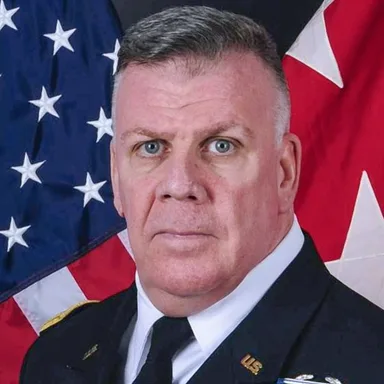
John Mulholland Retired U.S. Army Lieutenant General
The Meaning of Veterans Day and the Importance of Military Service
John Mulholland
Retired U.S. Army Lieutenant General John Mulholland tells John Catsimatidis that in his experience most Americans appreciate veterans, though only about 1 percent wear the uniform. He says Veterans Day, the anniversary of the end of World War I, honors all who served, while Memorial Day remembers the fallen, and that the military has become far too politicized.
Key takeaways
- Mulholland said he served almost 38 years and is an Army Special Forces officer by trade.
- He said he finished as the senior military officer at the Central Intelligence Agency.
- He said he would extend Veterans Day to honor the intelligence community as well.
- He said service is unique in the challenges and risks service members and their families face.
In their words
“Something like 1% of Americans actually wear the uniform.”
“So the less said about politics in the military, the better.”
“Many Americans confuse Veterans Day with Memorial Day, which is where we remember, of course, our fallen teammates who made the ultimate sacrifice in defense of the country.”
Quotes are word for word from the automated transcript, uncorrected; the summary and takeaways are editorial.
Transcript
Automated transcript · uncorrectedWith us today is Lieutenant General John F. Mulholland and his wife Miriam is with us too to talk about Veterans Day and everything that veterans have been through to save America and work for America. And today being Veterans Day, what the heck is going on? in America. Well, General, there’s so many things going on in America. We had
an election last week, and we have Veterans Day this week. How do the veterans feel that the American people appreciate them as much as they used to?
Well, of course, I can only go by what I know in my own life experience, but I do think that there is a... This experience with my own and then by my fellow teammates, I think there is a very strong sense of awareness across the country for the contribution our veterans have made to the security of our
country and the service they’ve provided. Again, very small proportion of Americans actually do serve, as I think people are well aware now. Something like 1% of Americans actually wear the uniform.
So I think.
overall. I mean, uh, again, my own experience is that most Americans do very much appreciate the service of veterans, um, as well as the folks, of course, still on actual duty, even though the actual experience of what it’s like to serve is, is thin across the country because so few Americans actually, you know, sign on the paper and put
the uniform on.
Understood. Now, um, How many years did you serve, and you had pretty high-up jobs in the Army, in the CIA, et cetera?
I had almost 38 years of service as a National Duty Army officer. I was honored to be able to serve probably the last third or so of my career as a general officer that— It did allow me to serve in some very senior positions in our special operations community.
I’m an Army Special Forces officer by trade and also finished up as the senior military officer at the Central Intelligence Agency, a position that’s known as the Associate Director for Military Affairs, where you’re supporting the director of CIA on things to do with the military because there’s close relationship between the Department of Defense and and the CIA.
And so many years ago, a position was established to recognize that and put an active duty general officer over there at CIA to assist with that relationship.
Understood. What else would you like to tell the American people today?
Over the last couple of years, the military has become far too politicized, which is anathema to what a Army that serves the Constitution of the United States should be about. So the less said about politics in the military, the better.
As far as Veterans Day is concerned, of course, it’s also the anniversary of the end of World War I, which is where the day comes from. Obviously, it’s of great significance to us. Many Americans confuse Veterans Day with Memorial Day, which is where we remember, of course, our fallen teammates who made the ultimate sacrifice in defense of
the country. Veterans Day is where we honor the service of Americans who have served in the armed forces, and I would extend it to, say, the intelligence community as well, because they, too, are a vital part of our nation’s security abroad. And that’s where we honor the service of those who’ve worn the uniform, whether they did it for
one tour of duty or for a career. They decided to serve in a way that so few Americans do decide to serve. And that service is unique in the challenges and the risks that service members face and, of course, their families as well. So it’s a great day. I think most Americans do indeed rally to the idea of
celebrating service. And again, in this case, it’s not necessarily commemorating our fallen. We always remember our fallen, but that’s Memorial Day. It’s an important distinction that Veterans Day is honoring those who served and whether they passed on and gone to their reward or are still among us. Time taken out of the year to specifically focus on recognizing
those who put on the uniform of the United States of America and serve this country, and whether it’s in conflict or not, they’re out there doing the hard work on behalf of our country.
Understood. Well, thank you, General, for coming on, and thank you for your service to our country. And does your wife, Miriam, have anything to say? Hi.
I would just like to say that I am a proud military spouse of my husband, you know, almost 38 years of service. but also we have four children, three of whom, um, served. Our daughter is still serving in the army and three of our in-law children, um, a daughter-in-law and two sons-in-law. Also one is still serving and
the other two are veterans. So we have a great deal invested in the military of our nation.
Well, thank you for everything you’ve done for our nation. I know you love our nation and you and your husband and, and, uh, Thank you for everything you’ve done, and we’ll catch up with you again real soon.
Well, you’re very welcome.
Sunday, November 8, 2026

Alaska's Election Challenges and the Growing Affordability Crisis
Mike Dunleavy Governor of Alaska
Republicans Must Listen to Voters and Get Back to Problem-Solving
Newt Gingrich 50th Speaker of the House
Poor Messaging and Extreme Rhetoric Hurt Republican Election Results
Nicole Malliotakis U.S. Representative from New York
Voters Are Fed Up With Political Division and Washington Dysfunction
Tom Suozzi U.S. Representative from New York
Securing New York's Northern Border Against Criminal Threats
John Sarcone First Assistant U.S. Attorney, Northern District of NY
Why Democrats Swept Key Races and Republicans Lost Ground
David Paterson Former Governor of New York
New York's Business Community Shouldn't Fear Democratic Dominance
Jay Jacobs Chairman, New York State Democratic Party
America Must Never Forget Its Veterans and Their Sacrifices
Jack Jacobs Medal of Honor Recipient, Retired Army Colonel

The Intrepid Museum's Remarkable History and Mission to Honor Veterans
Ken Fisher Chairman & CEO, Fisher House Foundation

Recognizing the Value of Veterans in the American Workforce
Bruce Mosler Chairman of Global Brokerage, Cushman & Wakefield

Honoring Fallen Heroes and Bridging the Military-Civilian Divide
Allison Jaslow Former CEO, Iraq and Afghanistan Veterans of America

The Path Forward for Republicans After Democratic Election Victories
Jesse Arm Vice President of External Affairs, Manhattan Institute

How NATO Expansion Shaped Relations Between Russia and the West
Kato Hetschinoff President, Russian Heritage
The Fight for Accountability One Year After the Ostrich Culling
Katie Pasitney Spokesperson, Universal Ostrich Farms


What Martian Meteorites Tell Us About the Origins of Life
Steve Kates Space and astronomy broadcaster (Dr. Sky)

Social Media Companies Must Answer for the Youth Mental Health Crisis
Lynn Shaw Founder of Lynn's Warriors

Midterm Election Fallout Triggers Market Selloff and Investor Uncertainty
John Terrett WABC Financial Analyst
