


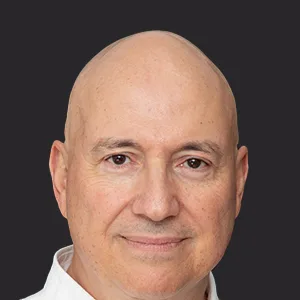
Dr. Peter Michalos WABC Medical Expert
Protecting Your Eyesight and Preserve Healthy Vision
Dr. Peter Michalos
Dr. Peter Michalos tells John Catsimatidis that vision is very important as we age, since falls and accidents often happen when eyesight diminishes. He says ultraviolet radiation aggravates cataracts, steroids accelerate them and smoking raises the risk of macular degeneration, while leafy greens and certain vitamins can slow it. He also describes new treatments, from injections in the eye to lens implants that change focus.
Key takeaways
- Michalos said newborns see only black, white and shades of gray, about 8 to 12 inches away.
- He said red is usually the first color babies can distinguish.
- Michalos said ultraviolet radiation, which aggravates cataracts, is cumulative over a lifetime.
- He said a large study found vitamins including vitamin C, zinc and lutein slowed macular degeneration.
- He said bleeding at the back of the eye can even be spot-welded.
In their words
“Many driving accidents are due to vision problems. That’s why people have to have vision tests before they can drive.”
“They’re like a camera, and that camera is actually an extension of the brain.”
“in the end, our mental and physical health is most important. The rest we can figure out.”
Quotes are word for word from the automated transcript, uncorrected; the summary and takeaways are editorial.
Transcript
Automated transcript · uncorrectedIt’s a new day and a new year, just about. I mean, after the election, we have to, you know, all come together. And with us today is Dr. Peter Michalos. And Dr. Peter, live long and prosper. And tell me, what advice would you give this week?
Well, this week we’re going to talk about a very important topic, and that’s our vision. And human vision is extremely important. And as we age, it’s very important to be able to navigate the world. And a lot of times falls and accidents happen when people’s vision starts diminishing.
Many driving accidents are due to vision problems. That’s why people have to have vision tests before they can drive. And our vision starts when we’re newborn babies. And in the beginning, we only see them black and white and shades of gray. And we only see things about 8 to 12 inches away when we’re newborn. And then around
one month old, we start getting some blurry vision. And the first color we actually see is red. It’s usually the first color that babies can distinguish. And then by one to three months, we can track things and moving objects and start to focus. And our eyes are very important.
They’re like a camera, and that camera is actually an extension of the brain. And we have a lens in the camera, and then we have the back of the eye called the retina. And we need all that to be able to see properly and function in the world.
And some of the things we can do to protect our eyes, we now know that, for example, something called cataract, which is a clouding of the lens, we can get painless progressive visual loss, and it’s aggravated by things like ultraviolet radiation, and we now know that’s cumulative over a lifetime.
We also know that things like steroids and even like intranasal steroids, people take puffers for different diseases. They also accelerate cataracts. People who take steroids for autoimmune disease, it’s a balancing act, or even steroid shots in their joints, That can also speed up cataract formation as well. And other things that can affect the eye. We now know
that smoking and people who smoke, that accelerates the risk of macular degeneration. We also know that diet affects it. Eating spinach, kale, and green leafy vegetable helps protect us from macular degeneration and slow it down. And there’s even large-scale studies. One is called the ARAGE-2 study. And in the ARIT2 study, they found that people who take vitamins
that contain vitamin C, zinc, lutein, zeanthenin, that slowed down the progression of macular degeneration. And some people actually started getting better. And that’s why especially people with light skin, light eyes, they tell people to take that along in addition to their diet. And the amazing new inventions where they can give you a shot in the eye, for example,
if you have macular degeneration or blood in the back of the eye, and it can shrink the blood vessels. Some of the great ones were developed by a Columbia University-trained scientist, Dr. Yancopoulos of Regeneron, who made one of the great medicines that can stop blood and leakage in the back of the eye. And other advances are, like
in cataract surgery, we have new lenses now that will be able to actually focus and change focus for distance and near. And these lens implants even have built-in UV light. We also have the ability to do laser on the eye to change the shape of the cornea. And if we have blood or hemorrhage in the back of the eye,
It can even be spot-welded at the back of the eye. And that was invented in 1938 by a guy in Germany, Miles Schwickerath, who took a lady with diabetes up to a rooftop, put liquid cocaine in the eye, dilated the pupil, and spot-welded it with a handheld magnifying glass. And that was the birth of laser. So all these amazing things
that have happened in technology to help us. And also eyeglass production. You know, one of our founding fathers invented bifocals, Ben Franklin. and people can see better. And years ago, you know, when people got older and they needed glasses, they basically couldn’t function in society. So importance of vision and eating those proper foods that we talked about, like
the green leafy vegetables and a healthy Mediterranean diet that contains... In other words, if our.
You know, we live on a planet Earth. And if our creator created it, whether it’s vegetables, whether it’s fruit, whether it’s nuts... If our creator created it for our purpose, then we should eat it, versus all the ingredients all the other companies add to things.
Yes, farm-to-table is very important. That’s why we included a whole chapter in our new book, The Death of Aging, on Amazon. It’s 512 pages, and we included what to eat for better health, for better eyes, and even did an entire section on all the great new advances that are happening in ophthalmology and improving eyesight. and the amazing
study that you and I talked about with the OSK Yamanaka genes for epigenetic reprogramming and restoring eyesight. So a lot of great things happening, and people need to keep listening to WABC for more ways on living healthier, because in the end, our mental and physical health is most important.
The rest we can figure out. And to learn more, go read thedeathofaging.com and find out more about health and living long and prospering.
God bless you, and thank you for all the lives you saved, and we’ll talk again real soon. Thank you.
Thank you, John, for always getting the truth out on the Cats Roundtable.
Sunday, November 8, 2026

Alaska's Election Challenges and the Growing Affordability Crisis
Mike Dunleavy Governor of Alaska
Republicans Must Listen to Voters and Get Back to Problem-Solving
Newt Gingrich 50th Speaker of the House
Poor Messaging and Extreme Rhetoric Hurt Republican Election Results
Nicole Malliotakis U.S. Representative from New York
Voters Are Fed Up With Political Division and Washington Dysfunction
Tom Suozzi U.S. Representative from New York
Securing New York's Northern Border Against Criminal Threats
John Sarcone First Assistant U.S. Attorney, Northern District of NY
Why Democrats Swept Key Races and Republicans Lost Ground
David Paterson Former Governor of New York
New York's Business Community Shouldn't Fear Democratic Dominance
Jay Jacobs Chairman, New York State Democratic Party

The Meaning of Veterans Day and the Importance of Military Service
John Mulholland Retired U.S. Army Lieutenant General
America Must Never Forget Its Veterans and Their Sacrifices
Jack Jacobs Medal of Honor Recipient, Retired Army Colonel

The Intrepid Museum's Remarkable History and Mission to Honor Veterans
Ken Fisher Chairman & CEO, Fisher House Foundation

Recognizing the Value of Veterans in the American Workforce
Bruce Mosler Chairman of Global Brokerage, Cushman & Wakefield
Honoring Fallen Heroes and Bridging the Military-Civilian Divide
Allison Jaslow Former CEO, Iraq and Afghanistan Veterans of America
The Path Forward for Republicans After Democratic Election Victories
Jesse Arm Vice President of External Affairs, Manhattan Institute
How NATO Expansion Shaped Relations Between Russia and the West
Kato Hetschinoff President, Russian Heritage
The Fight for Accountability One Year After the Ostrich Culling
Katie Pasitney Spokesperson, Universal Ostrich Farms
What Martian Meteorites Tell Us About the Origins of Life
Steve Kates Space and astronomy broadcaster (Dr. Sky)
Social Media Companies Must Answer for the Youth Mental Health Crisis
Lynn Shaw Founder of Lynn's Warriors

Midterm Election Fallout Triggers Market Selloff and Investor Uncertainty
John Terrett WABC Financial Analyst
Dr. Peter Michalos
Cutting-Edge Strategies for Extending Human Health and Longevity
Dr. Peter Michalos WABC Medical Expert
Fighting Cancer and Aging With the Latest Medical Advances
Dr. Peter Michalos WABC Medical Expert
Advances in Lung Cancer Detection and Personalized Treatment
Dr. Peter Michalos WABC Medical Expert
Healthy Eating, Stronger Immunity and the Science of Living Longer
Dr. Peter Michalos WABC Medical Expert
Limiting Sugar and Choosing Whole Foods to Support Healthy Aging
Dr. Peter Michalos WABC Medical Expert
