


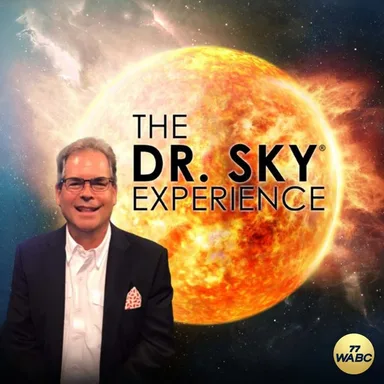
Steve Kates Space and astronomy broadcaster (Dr. Sky)
What Martian Meteorites Tell Us About the Origins of Life
Steve Kates
Steve Kates, known as Dr. Sky, tells John Catsimatidis about a two-pound meteorite found in the Sahara in 2022 that is thought to be a piece of Mars, one of about 435 such meteorites. He says new research suggests that comets may not have seeded Earth with life after all, and recalls the Silver Bird, a space plane Germany planned during World War II.
Key takeaways
- Kates said the Sahara meteorite contains trapped gases and other components.
- He said new research suggests amino acids from comets would have burned up from reentry friction.
- He said comets may have seeded life on Mars, which has less of an appreciable atmosphere.
- Kates said the main theory is that a collision stripped Mars of its atmosphere and surface water.
- Kates said the Silver Bird was meant to drop a bomb on the New York City area.
In their words
“This particular object, John, is actually thought to be a piece of the planet Mars.”
“Space planes are not a new idea.”
“Comets may not have seeded the Earth with life after all.”
Quotes are word for word from the automated transcript, uncorrected; the summary and takeaways are editorial.
Transcript
Automated transcript · uncorrectedSunday morning. What’s going on up in the skies? With us today is Steve Cates, otherwise known as Dr. Sky. And Steve, give us an update. What’s going on out there?
Well, good morning, John. We go to the planet Mars, and many people may wonder, did Mars ever have life? Well, here’s some potential evidence. Many people may not realize this. In 2022, in Africa, in the Sahara Desert, a large two-pound meteorite was found in the sands of the Sahara.
It’s called the Tinkhaza 001 sample. This particular object, John, is actually thought to be a piece of the planet Mars. And this is one of about 435 of these meteorites that have actually come down. How do we know? Because recent analysis, going back to the Viking landers, we find out in this particular meteorite, there are trapped gases and
other components. But the big question, John, should be, How did Mars wind up in a situation where those objects came to the Earth? Something must have hit Mars a long time ago to change its entire history geologically and atmospheric.
A fascinating find.
Well, I agree with you. I think, and who knows, if life was there, who knows, it might be, you know, a lot of people are saying that one of those moons might be artificial. Who knows?
We’ll know soon, John.
We’ll know one of these days. What else, Dr. Skye?
Well, John, here’s something fascinating for people who talk about the space planes. We’ve been talking about this, the US X-37B, the Chinese so-called secret Shenlong. But here’s something, John, from history. Space planes are not a new idea. The Germans in World War II, with a scientist and aeronautical engineer called Eugene Sanger, he developed a space plane known as the
Silver Bird. What was this? It was to be launched like a rocket, but on a long ramp into the sky. And they call this the New York City bomber. What a crazy title. Why? Because if Germany got the atomic bomb, John, this so-called space plane of the German regime was to drop a bomb on the New York City area. Thus,
it didn’t happen because smarter minds prevailed. But they almost came really close to developing the space plane. And also, as we know, thank God they never got the atomic bomb. But space planes are not that new, John.
Interesting. What else would you like to talk about? Any special mystery?
I got a good one, John. Here we go. The mystery of the week. Comets may not have seeded the Earth with life after all. I’ve been talking about this for years, a concept called panspermia, in which comets, when they collided with the Earth billions of years ago, released some basic amino acids for life to form. But new
research claims, it’s pretty obvious, that these comets may not have been able to do this because any of those amino acids would have burned up from the friction of reentry. And that’s an interesting story. The particles in that particular comet were called hydrogen cyanide, also one of the precursors of life. But, John, we figure out that comets may
have seeded life on Mars in the past. Why?
Because it has less of an appreciable atmosphere. And maybe those comets, if they indeed had the early particles of light, they, of course, may have landed on the surface. But again, John, as we mentioned at the beginning of this update, what caused any life on Mars if it did exist to perish billions of years ago? And the main theory right
now is this, a large asteroid or small planet that probably collided with Mars, sucking up its atmosphere and removing any of the water on the surface. The mystery continues, John, as we explore these great mysteries of the universe.
Well, I do believe that the planet Earth, that the creator has something to do with it because it’s too perfect and too intermingled to sustain life and protect life. And I’m not sure we’re ever going to find out.
even in our life.
I know, John, the mystery is big out there. Where did life in the universe come from? It ties into stories of the UAPs, the so-called flying saucers, and we continue to talk about it every week, Friday at midnight into Saturday, and also Saturday midnight to 2 a.m. Sunday on the Dr. Sky Experience. Great mysteries are explored and
stories of American exceptionalism and celebrity guests, and we appreciate the opportunity.
Thank you, Steve Cates, Dr. Sky, and and hope we can talk more in the future.
Thank you, John. Have a good Sunday.
Sunday, November 8, 2026

Alaska's Election Challenges and the Growing Affordability Crisis
Mike Dunleavy Governor of Alaska

Republicans Must Listen to Voters and Get Back to Problem-Solving
Newt Gingrich 50th Speaker of the House

Poor Messaging and Extreme Rhetoric Hurt Republican Election Results
Nicole Malliotakis U.S. Representative from New York

Voters Are Fed Up With Political Division and Washington Dysfunction
Tom Suozzi U.S. Representative from New York

Securing New York's Northern Border Against Criminal Threats
John Sarcone First Assistant U.S. Attorney, Northern District of NY

Why Democrats Swept Key Races and Republicans Lost Ground
David Paterson Former Governor of New York

New York's Business Community Shouldn't Fear Democratic Dominance
Jay Jacobs Chairman, New York State Democratic Party

The Meaning of Veterans Day and the Importance of Military Service
John Mulholland Retired U.S. Army Lieutenant General

America Must Never Forget Its Veterans and Their Sacrifices
Jack Jacobs Medal of Honor Recipient, Retired Army Colonel

The Intrepid Museum's Remarkable History and Mission to Honor Veterans
Ken Fisher Chairman & CEO, Fisher House Foundation

Recognizing the Value of Veterans in the American Workforce
Bruce Mosler Chairman of Global Brokerage, Cushman & Wakefield

Honoring Fallen Heroes and Bridging the Military-Civilian Divide
Allison Jaslow Former CEO, Iraq and Afghanistan Veterans of America

The Path Forward for Republicans After Democratic Election Victories
Jesse Arm Vice President of External Affairs, Manhattan Institute

How NATO Expansion Shaped Relations Between Russia and the West
Kato Hetschinoff President, Russian Heritage
The Fight for Accountability One Year After the Ostrich Culling
Katie Pasitney Spokesperson, Universal Ostrich Farms



Social Media Companies Must Answer for the Youth Mental Health Crisis
Lynn Shaw Founder of Lynn's Warriors

Midterm Election Fallout Triggers Market Selloff and Investor Uncertainty
John Terrett WABC Financial Analyst
Steve Kates

The Bizarre Natural Phenomena That Continue to Puzzle Scientists
Steve Kates Space and astronomy broadcaster (Dr. Sky)
Russian Satellites Track U.S. Spacecraft as Japan Targets Mars’ Mysterious Moon
Steve Kates Space and astronomy broadcaster (Dr. Sky)
Deep-Space Mysteries, UFOs and the Orionid Meteor Shower
Steve Kates Space and astronomy broadcaster (Dr. Sky)
The Mysteries of Mermaids, El Niño and the Antarctic Ice
Steve Kates Space and astronomy broadcaster (Dr. Sky)
Exoplanet Radio Signals, SpaceX’s Heavy Rocket Test and Nuclear Propulsion
Steve Kates Space and astronomy broadcaster (Dr. Sky)
Supersonic Jets, SpaceX’s Next Starship Launch & Trump’s Golden Dome Defense System
Steve Kates Space and astronomy broadcaster (Dr. Sky)
