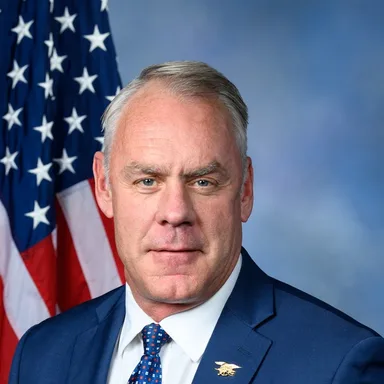
Ryan Zinke U.S. Representative from Montana
Trump’s Energy Strategy, Venezuela Oil and the Fight for America
Ryan Zinke
Former Interior Secretary Ryan Zinke, now a congressman from Montana, compares the first and second Trump administrations with John Catsimatidis and explains why the Interior Department controls most federal energy production. He recounts the origin of the “energy dominance” policy, weighs the Venezuelan heavy-crude deal, suggests a domestic oil price around $75, and urges voters to turn out.
Key takeaways
- Zinke said the second Trump team fired the inspectors general on day one and has a balanced court.
- He said Interior, not the Energy Department, handles federal leasing, inspections and all offshore production.
- Zinke said U.S. output rose from 8.3 million to 12.5 million barrels a day in his two years.
- He said Venezuela’s heavy crude suits Gulf Coast refineries but its facilities need heavy investment.
- Zinke suggested setting domestic WTI at about $75, calling $100 oil excessive.
In their words
“I should have brought a boat because it was a lot deeper.”
“He goes, dominate. I love that. Energy dominance. And that’s how it came, and now we are.”
“I haven’t seen any problem that’s not fixable. I really haven’t. What man breaks, man can fix.”
Quotes are word for word from the automated transcript, uncorrected; the summary and takeaways are editorial.
Transcript
Automated transcript · uncorrectedWell, with us today is, well, the 52nd Secretary of the Interior under Trump 45, Ryan Zinke, a businessman, yes. He was Secretary of the Interior. He was a SEAL Team member. He was a congressman of Montana. You’ve done it all. Which job did you like the best?
Well, you know, I always have to say I was a commander at SEAL Team 6. And I loved being around people that were focused, patriot, hyper-competitive. They just wanted to be the best in the world. And I was never the best jumper, diver, explosive expert, et cetera, but I always knew who was. And to be associated and
be a part of that group I think was an honor in my life. I enjoyed the secretary job. I think Article II, you know, they always say, You know, administration has the ball. I mean, you can do things faster than you can in Congress. Congress is an exercise in a little patience. But probably that’s how the founding fathers,
you know, put it. Because once you have a law, a law is permanent almost. So you want to be very careful what you put in the law. But, again, I enjoyed the SEALs probably the most. And then I enjoyed working for President Trump in 45. We were kind of the pioneers, by the way. There’s differences between the
45 and 47 group.
I have to tell you something, and we both know President Trump pretty well. I said to him when he was turning 80 years old, I said to him, Mr. President, because I know him for 40, 50 years, probably closer to 50, but I still call him Mr. President because he deserves the title. And by the way, the latest
is he beat me again on Twitter. The Forbes 400 list, I think he’s on for 6.9 this year. I’m only on for 6.2. So I lose again to my friend, President Trump.
Well, if you have to lose, at least you’re above 6, right?
Yes, I’m above that.
You’re in there.
And I said to him, Mr. President, those four years you had on the beach made you a great president, President 47.
Yeah, I think so.
By the way, he agreed to that, too.
Well, I think there’s three things that are different. One is that when they came in, they fired every inspector general on day one because they were rotten to the core. They would harass him. They were biased. So he fired him.
And second, remember in 45, he got three Supreme Court justices in. So those of us that came in won. Big difference. Big difference. And to a degree, a lot of us remember the night that he won on 45.
It was a surprise to a lot of us. And then all of a sudden we went to D.C. We knew that there was a swamp because that was part of the dialogue and part of it. We just didn’t realize how deep that swamp was.
It was very deep. And we tried to tell him. Some friends that knew about it from the outside tried to tell him. And the people we pointed out, the people that pointed out the people ended up getting fired instead of the people that were the swamp.
Well, and from a Montana perspective, you know, we knew it was a swamp, so I brought a set of hip waders. I should have brought a boat because it was a lot deeper.
A lot deeper.
And you’re right, and it was ingrained and, you know, And he learned, though. Remember, he was spied on before he was president by the deep state. And that was the Russian collusion, which was BS, as you know.
Big time. Not small time. Big time.
And then he was spied on during his presidency. That was the Ukrainian obstruction to justice. And then he was spied on after he was president. That was Mar-a-Lago. And that is by the deep state going after a president and And it’s there. And lastly, I think, you know, one is that he fired the IGs. He got a
court in. I’d say the court is more balanced than it is. It’s not a conservative court, but it’s more balanced. And lastly, I think this team is very serious. I think he picked well, you know, the cabinet and the people around him. And I think they’re doing good things.
I think the cabinet is very, very good. I mean, but, you know... Hopefully we can make more progress. Hopefully the American people, with the elections coming up in a few weeks, the American people will realize what a great job he did. Now, what you said to me before when we were talking, you said to me that the Secretary of the Interior
has more power over energy than necessarily the Department of Energy, in your opinion.
Well, in Department of Energy, 90% of it, and I love Chris Wright and Department of Energy are great folks, but mostly what they do is regulate and look at our nuclear arsenal. So 90% of their budget is that.
The other part of it is grants and innovation, but the core of producing, leasing, inspections is actually Department of Interior. All offshore is Department of Interior at one state or another, and then onshore federal lands. comes the Department of Interior.
As Interior, I helped write the executive order to go to energy dominance. I was in a room when the energy dominance term was made to President. We brought out the sheets and said at the time, Russia was number one.
I said, you know what, Mr. President, I think we can beat Russia. This is what we have to do. I think we can dominate them. He goes, dominate. I love that. Energy dominance. And that’s how it came, and now we are. And I’ll tell you how effective it was.
When I came in as secretary, we were 8.3 million barrels a day and declining. After two years, we were 12.5 million barrels a day and the world’s largest exporter of energy. And it makes a difference. And had we not taken that path, can you imagine what it would be today?
He is such a great businessman. And I’m going to ask you your opinion on this because this happened just now. He locked in 65 billion barrels of Venezuelan oil. That’s like a 30-year contract, if not more. And I think if you look at it as a business person on a balance sheet of the United States of America, it’s
worth trillions of dollars.
Well, I think also a point is you’re in the oil and gas business as well. It’s heavies. So most of our refineries down in Houston along the Gulf require some heavy crude in order to have the refineries, the efficiency on it. And Venezuela is primarily a heavy crude play.
So that will add a lot of economic engine to it. One time, Canada, we looked for heavy crudes coming down on the pipeline. That pipeline was supported by Trump. It hasn’t happened yet. But you’re right. That’s an enormous amount of energy. And in Venezuela, the plays on it is going to require a lot of investment because they siphoned
off a lot of it. They didn’t invest in it. A lot of the facilities are old. They’re environmentally disastrous, some of them. But we see that the oil companies, both in Europe and U.S., kind of stepped up the plate, provide some some infrastructure development that is needed. And I’m pretty confident that gas prices will go down somewhere between
60 and 70, and that’s a sweet spot.
I agree with you. I think the normal price is anywhere from 55 to 70 or 55 to 65. And that makes me even madder what happened, and I had that discussion with the president, is that they raised interest rates based on a temporary problem. And Greenspan and another fed chair, I can’t remember who, says you don’t raise
interest rates based on a temporary problem. What say you?
I would have to agree. And as far as, you know, the U.S., we consume about 20 million barrels a day or so. We can easily produce in the 15s. So what I encourage is, I guess, set the price. I hate to say price control’s. But these guys make money over 50. They do. They don’t make a lot, but
at 50 barrels a day, the engines are on, on oil and gas. But at 100, it’s excessive. So if you look at the United States, we only get 3% or 4% from the Gulf.
They’re making a zillion dollars at 100.
They’re making a zillion dollars, you know.
Especially our enemies.
Yes, indeed. So I think, you know, in this case, you should set the price at 75 and say, look, domestically, it’s going to be WTI at 75. I know it’s not free market, but, you know, Americans are paying a price, I think, for gouging.
Anything else you want to say to the American people?
You know, on this election coming up, you know, do your duty. You know, America’s a lot of things. We’re divided, but we’re not communists. And you look at these agendas. that you should work as much or as little as you want and the vocation you choose. The government now takes over grocery stores and housing and dictates your thought
in many cases. The agenda is just crazy. It is crazy. And I know some people don’t like the president, okay. But presidents come and go, but you get communism money. the sheets and we’re going to have it for a while.
And it’s dangerous. It’s not America. So I’d say everyone, you know, do their duty and get out and vote, express your opinion. But let’s vote for America.
Mr. Secretary, I’m going to call you Mr. Secretary because Once a secretary, always a secretary. The 52nd Secretary of Interior. You were a Navy SEAL. You were a Secretary of the Interior, a congressman. And you told me before the one job you do like is being a dad, too.
Yeah, I’ve had a lot of titles. You know, Commander, Congressman, Secretary. I enjoy dad the most. And if you talked about granddads, even better.
Granddads, even better.
But, you know, I’m an optimist, you know, as... going back into the House. I haven’t seen any problem that’s not fixable. I really haven’t. What man breaks, man can fix. But we do got to focus.
We can’t let the socialists take over the Democratic Party. You know what I tell people? Don’t speak evil about common sense Democrats. Ask them to vote for you as a Republican because voting for America is more important than voting for your party.
They’re not socialists. They’re communists. Read the agenda. It is right out of the communist manifesto on things. We have problems and challenges, but America and the Constitution matter. We’re still the greatest country in the world, and we’ve earned it.
Guys and gals, concentrate and go out and vote, but vote common sense rather than crazy.
Well, Mr. Secretary, thank you so much, and we’ll catch up again real soon.
Always a pleasure, John.
Sunday, September 27, 2026

Turkey, the Middle East and Cyprus’s U.S. Investment Boom
Nikos Christodoulides President of the Republic of Cyprus

Sounds Off on Iran, the UN and the 2026 Election
James Lankford U.S. Senator from Oklahoma

Sounds Off on the 2026 Midterms and the Battle for Congress
Jim Jordan U.S. Representative from Ohio
Trump’s NATO Strategy: “Europe Is Quickly Getting Stronger”
Matthew Whitaker U.S. Ambassador to NATO

The Washington Square Park Drug Crackdown: “We’re Going to Do Our Job”
Jamie McDonald U.S. Attorney for the Southern District of NY
Rips UN Walkout on Netanyahu: “Shocked and Appalled”
David Paterson Former Governor of New York

NYC Risks Losing Billions as Companies Shift Jobs to Texas, Florida and Beyond
Steve Fulop President & CEO, Partnership for NYC

“The Angels Among Us”: Miracles, Visions and Unbelievable Coincidences
Dr. Marc Siegel Physician; Fox News Medical Contributor

Lost Fishing Boat Found 50 Feet From a Block Island Wind Turbine
Mike Lombardi President, Green Oceans

Europe’s Security Crisis: Russian Threats, Narco Networks and Germany’s Shift Right
Jose Santamaria Chief Investment Officer, Fundamental Investment Services

Sounds the Alarm on Cell Phones and the Developing Brain
Dr. Mason Pimsler Geriatrician, Lincoln Medical Center



Supersonic Jets, SpaceX’s Next Starship Launch & Trump’s Golden Dome Defense System
Steve Kates Space and astronomy broadcaster (Dr. Sky)

“We Must Talk About Suicide” and Protect Our Kids
Lynn Shaw Founder of Lynn's Warriors

Markets Tread Water Ahead of the Fed Amid UN Week and Xi’s State Visit
John Terrett WABC Financial Analyst