


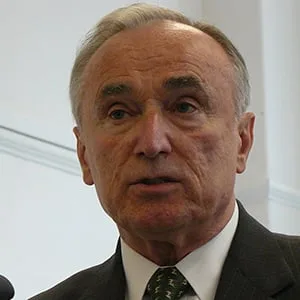
Bill Bratton Former NYPD Commissioner
Commissioner Sewell resigns, new Commissioner not yet named.
Transcript
Automated transcript · uncorrectedWith us today is the former commissioner of the NYPD. We got a big mess in on hands, not only in New York, not only in Chicago, not only in San Francisco, almost every big city we have. So what is today’s Bill Bratton? Bill Bratton? What the heck is America going to do? Well?
We’ve been here before we joined in the late nineteen eighties and early nineties. America was in the midst of a crime crisis. At that time we got out of it, and New York in particular, if you will know, we live here lily for almost thirty years had crime going down every year, so that by twenty eighteen it was
the safest year in the history of New York City in terms of crime. Around the country they did not do as well. They were doing pretty well, but not as well as New York. But all we had to fall apart around twenty eighteen nineteen. And my own belief is that this crime crisis was not created like the
one of the eighties around drugs, crack, cocaine, et set, a lack of attention to quality of life, type of activity, not having good systems to go after serious crime. By CompStat this crisis was created by political leadership around the country, Maya’s governor’s national officers, with the laws that they passed, the attacks on police, the attacks on a criminal justice system.
This is a system that was created by political leadership, and it’s going to take political leadership to get us out of it by passing laws that work, passing laws to control behavior, Passing laws that finally might do something about narcotics addiction, something about the homeless, something about the emotionally disturbed, something that the fifty years the politicians have
been dumping that onto America’s police forces.
But it’s coming from us from so many directions. We’re being I hate to say the word invaded by the migrants, but you know, we can understand getting a thousand guys, a thousand people, but I think New York has up to seventy or eighty thousand.
Well, the issue with the migrants shown is not so much crime that comes with them, because ironically the different studies haven’t exposure over the years. Puting going back to my time in La the migrant population basically does not commit as much crime as the population that’s already here native gone. Understandably, a lot of work is on in
that community is not reported to the police because the fear of the police coming from the countries they come from. But the cost of the migrant issue is the idea of to house them, to educate them, to take care of them medically. And we’re seeing New York City they’re talking for five to eight billion dollars to deal with
the fifty or sixty thousand in the coming So it’s not so much the issue of crime as the vast majority they’re going to find work. The vast majority they want to be here to work, educate their kids, or anybody else. But it’s the overall cost to our government that’s already bursty of the scenes with costs. As I
look at what already just passed for a budget, what the city call is looking at for a budget, where’s some money going to come from, don’t end up coming from tax payers, and where they’re going to go. We’re going to go to Florida. They’re going to go to Texas where they don’t have the taxes we have in
this state.
If you live in New York City, New York State, in the city itself, the taxes almost triple what they offer the host state of Florida.
I spend the first six almost seven months of every year John paying taxes. In other words, every dollar I make, basically in the course of the year, the first six seven months of the year, all I make goes to pay taxes. I’m going to fifty four to fifty five percent tax bracket. And it’s thank god I’m working and
I have income. But that is phenomenal. To move to Florida, I’ll be down, I think almost immediately, down to in the thirties. No, and it’s with best approaching a breaking point where a very progressive political leadership in both the city and the state just spending like drunken sales that there’s no limits to what they’re doing. And that’s the frustration,
because that money, unfortunately is not being spent, is going to be needed to deal with emotions just dury of the increasing drug addiction. Instead of trying to get people away from drugs, we have policies now, we got vending machines to encourage them to stay on drugs. We’re going to make it safer for you to use drugs so
you can spend the rest of your life not trying to get off drugs, but to stay on drugs. What happens when you stay on drugs, you want the next you want the next higher high. So you graduate from marijuana, you graduate to heroin, then you graduate to the next thing.
And that’s the problem with addiction, that there’s never enough drugs, there’s never enough high. And that’s effectively what we as a government are now starting to support in city at the city, state after state, this idea that we will sustain your drug gbot rather try to get you off for drug habt. It’s the world turned upside down in
many expect we’ve turned.
We’re pushing our people. I mean, our borders are up and we’re pushing our people to become drug addicts. We’re pushing you know what. I’m scared mostly of that are twelve to twenty six year olds will get hooked on drugs and ruin them for the rest of their lives.
I mean, our education system, our universities are under siege, and the Chinese are feeding more money in than ever before. But they have to be I don’t want to say more loyal to China, but we’re under attack in so many directions.
Well, the China issue also so much of the illicit drug trafficking that’s creating guests. Basically drugs that are created in China and smuggled in from China. I know, and all the various derivations that we’re now seeing recently. This is Italy for two weeks on vacation. Fortunate to go over there for two weeks. I did not smell mariljuna
for two weeks. Came back to New York and literally boom, as soon as you get back into the city, it hits you in the face. The only positive about the red cloud we had last week that we didn’t smell marijuana for a while because we were smelling other stuff.
And it’s so the literalization of the marijuana issue. For example, kids now twelve thirteen, fourteen, fifteen can get a hold of it. It’s so readily available. If we’re selling it illegally in twelve hundred sharps around the city, you think they care who’s coming in to buy it. They’re not checking for ideas. It’s a cash business. And the city
has totally lost control over the state has lost control over it. No, it’s so frustrating, John, is that our systems stretched to the breaking point in some instances have broken and the only way we can fix them is effectively through political leadership. But to get the political leadership that’s necessary, we really have a big struggle because in
this city, the state that the primaries control who basically gets into office. And I understand that the Republicans have about to found to vote Democrats about thirty percent nationally, but in the middle is forty percent people like myself, probably people like yourself, although I think you would have cleared Republican. But the Centrists. I’m not a Republican, another Democratic.
I’m an independent. I vote an issue, I vote for the person. And those forty percent can control elections. They certainly helped to control national elections. But at the local level, Centris don’t come out to vote in the primaries. So what do we end up with in New York? Basically we get the progressors come out to vote and put
in their candidates who are now elected in the general election. And we got Albany. We’ve got a professor’s city Council where I think what forty out of the fifty two city council members describe themselves as progressive left, or as we would describe them, wop and no wonder you can’t get control over any of the stuff that they have
created a climate where anything goes.
We’ve got to make a change in twenty twenty three, twenty twenty four. Otherwise our country is in tough shape. Bill Bratton.
We’ll keep trying, all of us. John Hepa, thank.
You, thank you for everything you’re doing, thank you for speaking out, and we’ll catch up again. Wilson
Sunday, June 18, 2023

Subway Marine indicted…just wrong.
Peter King Former U.S. Representative from New York

Will the legislature come back to finish business?
Zach Williams Transportation Reporter, Bloomberg Government
Redistricting favors Democrats. GOP must hold maps.
Ed Cox Chair, NY Republican State Committee

Radio program, Sundays 3:00-4:00 PM EST, 770AM radio. David Schoen guest.
Roger Stone Political Strategist & Consultant
No Labels looking for a third Party candidate. Waiting till Spring of 2024.
Former NC Gov. Pat McCrory

Fastest star in the universe. New moon, dark sky.
Steve Kates Space and astronomy broadcaster (Dr. Sky)
Interviews Joseph Pistilli CEO Pistilli Real Estate Group Chairman of Board First Central Savings Bank
Michael Stoler Real Estate Expert
Bill Bratton
Horrific crime on the subway this week. Random crime.
Bill Bratton Former NYPD Commissioner
The Venezuelan gangs. What should we be doing?
Bill Bratton Former NYPD Commissioner
