


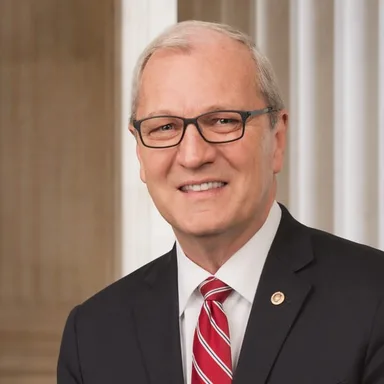
Kevin Cramer U.S. Senator from North Dakota
Washington Gridlock Raises Questions About Bipartisanship and Legislative Reform
Kevin Cramer
Sen. Kevin Cramer of North Dakota tells John Catsimatidis that Senate Democrats blocked a ban on insider trading by public officials, a voter photo ID requirement and a ratepayer protection bill that passed the House 417–3. He says Chuck Schumer is running scared of his party’s socialist wing, and welcomes the president’s “super intelligence” label for AI while urging that its development not be slowed.
Key takeaways
- Cramer said Democrats blocked the ratepayer bill to deny Ohio’s Jon Husted a talking point.
- He said Schumer fears AOC and Mayor Mamdani and passes that fear on to his caucus.
- Cramer said slowing AI development would hand the lead to China; be smart, not slow.
- He said data centers in North Dakota have helped bring electricity rates down.
- Cramer said the Senate did pass a college sports bill with new guardrails last week.
In their words
“And so when partisanship takes over, you can’t get common sense things done like stop insider trading.”
“Because if we slow down AI development in the United States, it’s going to go other places. And China’s doing it already.”
“We don’t want to do anything that stifles that, but we also don’t want to lose that moral compass, the ethical base that our country is founded on”
Quotes are word for word from the automated transcript, uncorrected; the summary and takeaways are editorial.
Transcript
Automated transcript · uncorrectedCalling in now is Senator Kevin Cramer from the great state of North Dakota. And well, a lot of hardworking, honest people up there in North Dakota, Senator Cramer.
Nearly all of them, near as I can tell. They’re hardworking, common sense people that just want a government to stay out of their hair and do no harm. But anyway, we’re trying to do, we’re doing our best for that.
Tell us what you have on your mind on a Sunday morning.
Yeah, so it’s, One of the things that’s on my mind a little bit is I regret that last week Democrats prevented us from proceeding to a measure that would ban insider trading by public officials. Can you imagine? That bill passed the House 417 to 3, and every Senate Democrat, I think maybe three or four may have voted for it.
I don’t know, but they prevented us from getting to 60 votes. to ban insider trading by government officials and, of course, to require photo ID to vote. Incredible.
They also blocked a bill, if you can imagine, they blocked the Ratepayer Protection Act. That’s the bill. I’m sorry, the Ratepayer Protection Act is one that was 417 to 3 in the House. And they blocked it. And all that would have done is it would have, you know.
Well, if it voted for 17 to 3, how do you block it?
Well, you block it in the Senate by not letting us get to 60 votes. And I think the problem with that is that it was a bill that was introduced by Senator John Husted, who, of course, is in a targeted Senate race in Ohio against former Senator Sherrod Brown.
And they’d rather have Sherrod Brown have a talking point than John Husted have a talking point. Now, I don’t know how you brag about stopping the Ratepayer Protection Act. Again, overwhelmingly supported by both the electorate and by the House of Representatives. But that’s their problem. They’re so warped, John, that these DSA folks that are running the Democratic Party,
these Democratic socialists, they’re so warped that they’d rather see the country fail than see another Republican senator win re-election.
I mean, it’s gotten too political, Senator. I’ve been around politics for 30, 40 years. I’ve never seen it so political before.
Yeah, it’s an interesting point, isn’t it? You live there in New York, of course, and right in the heart of the Democrat socialist agenda, and they’re trying to take over the city, which they’ve sort of done with Mayor Mamdani and, of course, AOC, who’s one of the most famous socialists of all time. Bernie Sanders, of course, remains
socialist royalty. But, yeah, I don’t know what’s happening to the deterioration here that’s allowed this hyper-partisanship. See, and that’s the part I think that disappoints me, John. I have a lot of good friends, including some from New York, that are Democratic members of the House and the Senate.
And they’re doing their best to sort of stand up against this, but it’s just overwhelming their party. And so when partisanship takes over, you can’t get common sense things done like stop insider trading. Now, the good news is we did last week also pass the Protection for College Sports Act. So at least that got done and We
provided some guardrails for college sports, which, as you know.
Are they scared to vote sanely, some of the Democrats?
So that’s a great question. Are they scared? I think they are afraid of some of their leadership. I think in the case of Chuck Schumer, who’s the Democratic leader in the Senate, he’s afraid of AOC and Mamdani. And so once transactional chairs... A majority leader, minority leader, depending on who’s at the majority, he’s no longer transactional. He’s
just scared. And so he takes his fear and he translates it into the rest of the caucus and threatens them with whatever a leader can threaten them with to make sure they don’t help us pass something important like, you know, voter ID or ratepayer protection or, you know, you name the common sense. So anyway, it’s frustrating. It’s discouraging.
Well, the other day the president had some event on AI. They had a trillion dollars worth of, I guess, businessmen in the office. Probably two trillion or three trillion. What did you make out about this whole AI thing?
Well, I think it’s interesting that the president— First of all, remember, the big announcement was he’s officially changing it from AI to SI for the executive branch. So it’s super intelligence, not artificial intelligence. Now, you know, I’ve heard the term supercomputing, of course, and I’ve heard super artificial intelligence, but super intelligence, I think I kind of like it in a way.
I think it’s the president acknowledging that this is in fact super. It’s not just artificial. My only little personal, maybe it’s doctrinal problem with it is it does imply that somehow these machines are smarter than people. And while we count on that to some degree, remember they are invented by people. They are programmed by people.
I put out a cat’s corner out on it, and I said it’s only as good as the programmers and only as good as the companies they work for, but because... I programmed computers in my company 70 years ago, 50 years ago, and they’re only as good as the programmers and only as good as the company that owns the programmers.
Yeah.
No, that’s true.
And, of course, the other information that they glean off the Internet and stuff, and God knows there’s plenty in the Internet that’s not true. So, anyway, all of that, it was fascinating. I do think this, John. You know, there’s all this talk about slowing down the progress and the...
growth of AI and the processing of it and whatnot, the development of it. And I think that’s silly talk, quite honestly. I think you need to be smart, but I don’t think you need to be slow. Because if we slow down AI development in the United States, it’s going to go other places. And China’s doing it already.
And we don’t want them to beat us at it. But I do think we need, and this is the benefit of North Dakota, when you talk about hardworking people, Coming from a state of 780,000 people, where I know about half of them personally, or at least they all have my cell number, we’re able to have family discussions
about these things. And that’s why when you look at data centers in North Dakota, data centers in North Dakota have actually helped bring electricity rates down because we have common sense application to it. We don’t get in the way of the development. We just fashion it in a way that’s good for everybody. And so... I think that
a little bit of that’s gotten lost at the national level. Panic has sort of set in. The Chinese bots have polluted our inboxes a little bit. We need to slow that part of it down and talk about it in a more sane and civil way. But we need to be the leader in AI, plain and simply.
We have to take the leadership, but we also have to acknowledge the dangers of it. And I think we have to proceed... Proceed with caution, but we have to proceed.
That’s exactly right. Very well said. Anyway, North Dakota is much like the rest of America in that we are forward-leaning thinkers. We’re innovators. If we weren’t, we wouldn’t have survived this long. We don’t want to do anything that stifles that, but we also don’t want to lose that moral compass, the ethical base that our country is founded
on and based on, While we do these big things, I don’t care if you’re doing space travel or you’re doing super intelligence or artificial intelligence. You want to do it in an ethical and moral way that puts people first.
And we can do that. We just need to have more family discussions about it.
Senator Kramer, thank you so much for calling in to the CATS roundtable on Sunday morning. And we’ll talk again real soon.
I always look forward to it. Thank you.
Sunday, October 4, 2026
Wisconsin Campaign Strategy Centers on Local Races and Election Administration
Ron Johnson U.S. Senator from Wisconsin

Social Media Lies and Leaving the Democratic Party
Alan Dershowitz Harvard Law Professor Emeritus
Michigan Senate Race Focuses on Costs and Energy Policy
Ronna Romney McDaniel Former RNC Chairwoman
Federal Prosecutors Uncover Nationwide Identity Theft and Benefit Fraud Scheme
John Sarcone First Assistant U.S. Attorney, Northern District of NY
New Hampshire Campaign Centers Economic Policy and Congressional Reform
John E. Sununu Former U.S. Senator from New Hampshire; nominee for U.S. Senate
New York Governor’s Race Centers on Public Safety and Economic Relief
Bruce Blakeman Nassau County Executive; nominee for Governor

Fiscal Accountability and Government Waste Drive Comptroller Campaign
Joseph Hernandez Entrepreneur; nominee for New York State Comptroller

Bruce Blakeman Is Stylistically Like George Pataki
Bernadette Castro Former NYS Parks Commissioner
Lieutenant Governor’s Departure Sparks Questions Over Transparency and Accountability
Christine Hanlon Chair, New Jersey Republican Party
New York City Business Leaders Confront Economic Competition and Safety Concerns
Steve Fulop President & CEO, Partnership for NYC

Beijing Uses Diplomacy and Trade Pressure to Advance Its Interests
Gordon Chang China Analyst & Author
Prostate Cancer Awareness and Why Early Detection Matters for Men’s Health
Ed Randall & Dr. Daniel Petrylak Fans for the Cure Founder & Yale Oncologist
Offshore Wind Projects Raise Concerns Over Maritime Safety and Search-and-Rescue Operations
Bonnie Brady Executive Director, LI Commercial Fishing Assoc.
FCC Wireless Radiation Standards Face Scrutiny Over Safety Concerns
Odette Wilkens President, Wired Broadband Inc.
The Stoler Report with Michael Stoler: Eli Weiss and Andrew Albstein
Michael Stoler Real Estate Expert
Limiting Sugar and Choosing Whole Foods to Support Healthy Aging
Dr. Peter Michalos WABC Medical Expert

Exoplanet Radio Signals, SpaceX’s Heavy Rocket Test and Nuclear Propulsion
Steve Kates Space and astronomy broadcaster (Dr. Sky)
How Smartphones and Endless Scrolling Affect Young Minds
Lynn Shaw Founder of Lynn's Warriors
Weak Employment Data Eases Rate Concerns as Disney and Mattel Make Headlines
John Terrett WABC Financial Analyst
Kevin Cramer
U.S.-Canada Partnership Vital to North American Security and Prosperity
Kevin Cramer U.S. Senator from North Dakota
Honoring Mothers With a Safer, More Secure America
Kevin Cramer U.S. Senator from North Dakota
Taking Out Iran's Navy Was More Important Than People Think
Kevin Cramer U.S. Senator from North Dakota
30% Less Canadian tourists travel to North Dakota
Kevin Cramer U.S. Senator from North Dakota
