


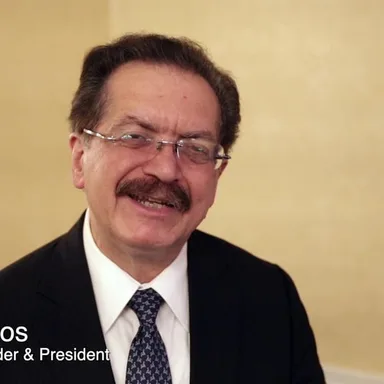
Louis Katsos President, EMBCA & Construction Executive
The Greek Revolution's Influence on American History
Transcript
Automated transcript · uncorrectedFor the July weekend, this weekend and with us today is a good friend of mine. His name is Loukatchos, and he is an entrepreneur. He is a philanthropist and a lover of a Greek in American history, because both revolutions happened within well fifty years ago apart. Well, lou Katchos, for did July, tell us what you feel and give
us your interpretation of everything that happened, John, don’t forget one of the most important days of not only American history, but world history is actually the fourth of July seventeen seventy six.
It was a nation.
Of people who are tired of taxation and who decided to become free from one of the largest actually the largest empire of that particular time period. It was an amazing thing that they decided to do. When we talk about American history and Greek history, we have to understand that philosophically, some of the issues that related to the
American Revolution and the concepts of democracy came in fact from ancient Greece, So that becomes extremely important and for us, for myself who was an immigrant actually and you also, John, who were an immigrant, we love this nation this nation is something that is a part of us, its ideals, its constitution. Certainly the Declaration of Independence that we talk
about now in this particular weekend was something to us of extreme importance and something that affected all the world, that affected the French Revolution and in fact affected the Greek Revolution itself, as you said, within fifty years after the American Revolution in eighteen twenty one.
And tell people so they understand how the Greek Revolution reflected on the American Revolution in how again it if affected the Civil War. I mean you have told me that story before.
Yeah, yeah, we’ve discussed this.
As we know, what took place in the American Revolution was something that other people aspired to, and certainly in the Greek Revolution, Americans came went actually to Greece to fight in Greece.
Plus also it was part of American history.
It was called the Greek Fever period of the eighteen twenties in the United States of America. Americans supported the Greek Revolution and in fact after the Greek Revolution because it was about slavery. Also, it was about slavery because the Greeks were under the Ottoman Empire and there were slaves within the Ottoman Empire. Those that fought within within Greece, Americans, etc.
Came back to the United States, including orphans from Greece, and in fact were members of the abolitionist movement and started the abolitionist movement in the United States of America itself. And the rhetoric that was used for the Greek Revolution was the exact same rhetoric that was used for the abolitionist movement by both white and black abolitionists of that period.
And then in terms of the of the Civil War, there were Greek merchants who went to America. They were involved in the cotton trade. And then when it became an issue of the South of perhaps England joining the South, they decided they decided to shift the where the cotton comes from to Egypt and to India and effect keep
England out of the Civil War.
Wow, is that how it happened.
That’s how it happened. That’s how it happened.
And England was really going to go on the side of the South. Well, yeah, don’t forget the mills of England. You know, they produced all the all the all the products for all over the world and they needed cotton for their mills and without cotton. People were afraid that they would stick with the South and say, hey, forget
about the North, let me stick with the South, because cotton is king. That’s what they used to say. Cotton is king.
Now we talked about the during the early Wars the Barbary Coast. Yes, and how do you compare what’s going on in the Barbary Coast versus homos.
Listen, things are never the same, but it’s almost the same because the reality is in the Barbary Wars what was taking place. The reason why we went into the Barbary Wars Jefferson started the Barbary Wars is because they were taxing our ships, et cetera. They were if we didn’t if we didn’t pay them to go across the
Mediterranean or where the Barbary Coast was, they in fact would take over our ships and in fact.
In slave Americans. Actually so, Jefferson said.
And by the way, in the budget it was close to fifteen percent of the American budget was paying off the Barbary pirates. Jefferson said. Part of the expression screw you, and he basically went to war with them on the basis of that. And it’s the same thing that’s taking place. And obviously the Straits of Hormos right now where they want to charge
people to go across, which is total nonsense.
It’s against international law.
Now, I mean, we we do the marine him. Can we say from from the shows of Triple Y to how does it go again? Uh, to the halls of Montezuma, Yeah, to the shows of Triple Yeah in the show, and we’ll say the shows of Tripley and the shores of Hormuz.
Yeah, that’s exactly correct. And John today today, since this is the weekend. One of the most important dates in the history of the United States, by the way, was July the ninth of seventeen seventy six in New York.
That’s when George Washington was there with the Continental Troops and he had the Declaration of Independence read in what was called the Commons which is now City Hall Park. And after they’ve read the Declaration of Independence, the people marched down to Bowling Green and dropped the massive statue that used to be there of uh of George, of
George the Third, the King of England. They knocked down a statue and basically melted and created forty two thousand bullets that they used for the revolution. So we’re going to re enact that on Thursday, July the ninth at We’re going to start at City Hall Park. We’re going to go down to Bowling Green, read the Declaration of Independence,
and then show a movie about the importance of July the ninth of seventeen seventy six.
The other thing, John, is that New York did not sign.
Into or agree to the Declaration of Independence until July the ninth, So for New York this is like the most important date relating to the revolution.
So the real date for Independence Day was July ninth in New York City versus everybody else.
For well, listen, it was passed in July the fourth, but New York had not signed on. New York had not signed on. All the twelve states had signed on. New York had not signed on. New York signed on on July and ninth. George Washington found out. George Washington then ordered them to read the Declaration of Independence, and
that’s when they did one of the most monumental things by dropping the statue of King George the third. Don’t forget John. At that time was an extremely dangerous time. There were nineteen thousand Continental American troops that were in New York, and the British were amassing the largest armada that was ever assembled by the British. Four hundred ships
were coming in with thirty two thousand soldiers into New York.
So it was an amazing time period.
And you have to say, you know, George Washington really took some big gambles because here he was with nineteen thousand troops and the British were putting bringing in thirty two thousand troops into New York. And for those who don’t know, the headquarters of Washington during that time period was actually one Broadway which was right across the street
from Bowling for Bowling Green Park, and Bowling Green is the first park of New York City where you have the fountain today in Bowling Green Park is where the statue of George the Third used to stand.
And that statue, like I said, was massive. It was a massive statue. They tied ropes around it, dropped it, and then and then.
Everybody celebrated the British, of course, the British, British, the British.
Of the two big items that I come back from this interview is I did not know the British almost joined the South in the Civil War.
Oh yes, yes, And it was a discussion Australia.
Homus versus the shows the Triple Lee and the third.
One was July ninth, July the ninth.
So I’m going to try to march with you. Yeah.
So I’m requesting all New Yorkers and anyone who’s in the city come to two City Hall Park. We’re going to assemble there exactly at the time time that George Washington said, which was six six o’clock, is when the parade starts.
We’re gonna assemble about five thirty.
Six o’clock in the morning, no evening evening, you’ve read it in the evening.
So five point thirty we’re gonna assemble there. Six o’clock.
We’re gonna march down Broadway. We’re going to go to Bowling Green. We’re going to raise the flags, the original flag in the current flag.
And by the way, the second flag.
Pole is the flagpole that the Federation of Hellenic Society is a Greater New York put up.
Well, thank you so much, and we’ll catch up with you again real soon, and I’ll be there July night.
Thank you so much, John,
Sunday, July 5, 2026
Strengthening Middle East Alliances While Confronting Iran's Regional Influence
Mike Huckabee U.S. Ambassador to Israel

Calling for Political Moderation and Government Accountability
Joe Manchin Former U.S. Senator from West Virginia

Celebrating Independence Day and Wyoming's American Heritage
Harriet Hageman U.S. Representative from Wyoming; nominee for U.S. Senate

An America First Strategy for Global Security and Foreign Policy
Dylan Johnson Assistant Secretary of State for Global Public Affairs

The White House's Vision for America's Economic Future
Kush Desai Assistant Director of National Intelligence–designate for Strategic Communications; Former White House Senior Deputy Press Secretary
The Democratic Party Needs to Return to the Center
David Paterson Former Governor of New York

Celebrating America's Heritage and Suffolk County's Future
Ed Romaine Suffolk County Executive

New Jersey's America 250 Celebration and Voter Roll Concerns
Christine Hanlon Chair, New Jersey Republican Party
A Common-Sense Democratic Vision for Law and Order
Lou Raptakis Rhode Island State Senator

Geopolitical Challenges in the Middle East and Asia
General Blaine Holt Brigadier General USAF (Ret.)

Chasing the American Dream in New York
Dick Grasso Former Chairman & CEO, New York Stock Exchange
Joining 77 WABC to Discuss News, Politics and the Trump Presidency
Michael Cohen Former Attorney to President Trump & 77 WABC Host
President Trump's Trade Strategy Is Reshaping North America
Steve Moore Economist; Co-Founder, Committee to Unleash Prosperity

Renegotiating USMCA and the Challenges Facing North America
Pamela Falk Foreign Affairs Analyst & U.N. Correspondent

NYC's $125 Billion Budget Faces Long-Term Risks
Andrew Rein President, Citizens Budget Commission
NYPD is Facing Staffing Crisis as NYC Refuses to Hire More Officers
Vincent Vallelong President, Sergeants Benevolent Association

Apple's Future Under New Leadership and the iPhone 17
Daniel Shaffer President & CEO, Shaffer Asset Management

Expanding Medicare Access to Weight Loss Medications
Dr. Mason Pimsler Geriatrician, Lincoln Medical Center


How to Prevent Heat Stroke and Stay Safe in Extreme Heat
Dr. Peter Michalos WABC Medical Expert

Understanding Solar Storms, GPS Disruptions and Deep Space
Steve Kates Space and astronomy broadcaster (Dr. Sky)

KIDS Act Must Include Protections for Children
Lynn Shaw Founder of Lynn's Warriors

Wall Street Hits Records Amid Economic and Business Shifts
John Terrett WABC Financial Analyst
Louis Katsos

Lou Katsos: America's First Overseas Victory at The Battle of Derna
Louis Katsos President, EMBCA & Construction Executive
Greek Independence Parade Celebrates Shared History With America
Louis Katsos President, EMBCA & Construction Executive
Greek Independence Day 200 years of freedom.
Louis Katsos President, EMBCA & Construction Executive
Turkish lobbyist seeks to suppress talk of the Armenian genocide.
Louis Katsos President, EMBCA & Construction Executive
