


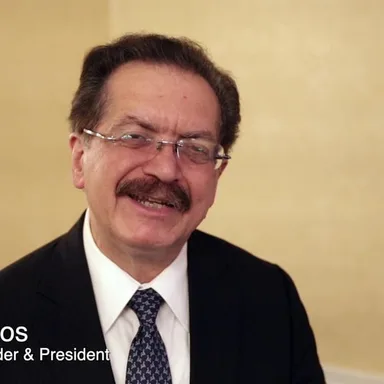
Louis Katsos President, EMBCA & Construction Executive
Lou Katsos: America's First Overseas Victory at The Battle of Derna
Transcript
Automated transcript · uncorrectedSunday morning, Mother’s Day. Well with us today is Lou Katsos, a real estate professional, entrepreneur as a philanthropist and he loves history. Well, Lou, we were talking the other day and you had a few things in mind, because history repeats itself and you love history. So tell us what you have on your mind on Mother’s Day.
Okay, on Mother’s Day, John, and this particular time period, we’re talking about the two hundred and twenty first anniversary of the Battle of Darna, which took place in eighteen oh five. It was the first battle that America fought oversees, and actually one it was the first overseas battle. So it was a dramatic episode in the history of the
United States. So let me explain why it related to the First Barbary Wars. For those who don’t know about American history. A general fought the battles overseas called the Barbary Wars. So the First Barbary War took place from about eighteen oh one to about eighteen oh five. And the reason why they had the Barbary Wars was because
the Mediterranean Sea for centuries, John was shaped by the Barbary states of North Africa. They included what is now Libya, Algeria, Tunisia, and Morocco, and they were semi autonomous states within the Ottoman Empire. And these rulers demanded tribute payments from foreign nations in exchange for safe passage of merchant ships that were traveling through the Mediterranean. Now, America when it won
its liberation did not really have a navy, etc. It was protected by England before seventeen seventy six. But after that, the Barbary pirates, starting in the late seventeen nineties, started to ask the Americans for tribute and john this may be shocking to many people, but fifteen to twenty percent of the total US federal revenues at that time period
was connected to payment of tribute, ransom, gifts, and naval arrangements involving the Barbary pirates. So what they did was if you didn’t pay, they would capture your ships and they were enslave your people. So Americans, American captives were actually enslaved in slave markets, forced labor, diseases, etc. And in some cases these Americans were held for ten years
or more up for ransom. And when the Barbary pirates wanted to raise the ransom price to Americans. Jefferson said, screw you, basically, and that was the declaration of war against the Barbary pirates. So, in this particular battle that I mentioned in the anniversary, John, the two hundred and first anniversary, which is which is right now, America with
the Marines basically also incorporating Greek mercenaries and some Arab regional Allied fighters met in Egypt and basically crossed the desert into Libya and fought that particular battle. And that’s where you get the famous song, the famous Marine Corps song and the phrase to the shores of Tripoli, and they won the battle. There were American ships also outside
of the of the fortifications of Turner, which were firing shots while the Americans and the Greek space.
So I bet you, I bet you Americans don’t know what the show they all sing the shows of trip Americans fabab We don’t know what that’s all about.
Yeah, not only that, John, it really relates to what’s happening today. You know. In other words, historical importance and modern relevance. For example, the Barbary Wars carried enormous symbolic importance to the United States, and they demonstrated that America could no longer submit indefinitely to corrosion abroad and was prepared to defend its commerce, sovereignty, and national honour through military action. Now, when you look
at what’s happening, for example, in the Straits of Harmose, Okay, where you have modern tensions involving Iran and revolve around the ability to disrupt a control one of the world’s most critical maritime car It is, in other words, roughly twenty percent of global seaborne oil and natural gas through the state Straits of Harmose. It it almost seems a
similar type of situation. So the question is, you know, like two hundred years ago, what the United States tolerate coercion against international maritime commerce or what did use military power to defend freedom of navigation.
So we’re talking about when we’re talking about her Moose, we should start that we will have a song in the future for the marines quality to the shoes of Hermose.
Well, yeah, John, Yeah, people don’t understand it. They’re they’re they’re talking about a couple of months or so or even more of gas prices being higher, et cetera. Not understanding. Many people don’t comprehend, you know, the ability of others later on to have missiles with nuclear warheads that could target the United States and kill ourselves, our children, and
our grandchildren. In other words, people are complaining, you know, telling America not to get involved, et cetera. Meanwhile not understanding that these are significant things that could wipe us out. So, you know, I to a certain degree, I have to say that what is taking place right now by the United States, in my personal opinion, I approve of it
quite frankly. We cannot allow people to have nuclear weapons to have terrorism, and they’re basically terrorists. The government people are terrorists, not the people themselves in Iran, but the government of Iran is a terrorist, you know, a country, there’s no doubt about it, the largest, you know, creator of terrorism around the world. And they have to be stopped.
And I think what Jefferson did was a positive thing and the moment in history this particular week.
So the President Jefferson and UH President Trump will stand side by side from the shores of Tripoli to the shores of Hermus. That’s correct. Thank you so much for coming on this Mother’s Day Sunday morning. And we’ll catch up with you again.
So thank you so much, John, thank you
Sunday, May 10, 2026
Climate Mandates Are Hurting Working Families
Paul Zuber SVP, NY Business Council
A New Memoir of Service and Leadership for New York
Peter King Former U.S. Representative from New York

Pied-à-Terre Tax Will Hurt Investments in NYC
Suzanne Miller President, Empire State Properties; WABC Real Estate Analyst
Wind Turbines Pose Risks to National Security
Bonnie Brady Executive Director, LI Commercial Fishing Assoc.
Reviving National Conversation Through Books and Ideas
Steve Israel Former U.S. Representative from New York

New York's Leadership and the Cost of Radical Policy Shifts
Jessica Proud Senior Adviser to Rep. Langworthy (R-NY)
Running for Governor to Restore Common-Sense Leadership in Pennsylvania
Stacy Garrity Pennsylvania Treasurer; nominee for Governor
U.S. Must Adapt to a Changing Global Security Landscape
Newt Gingrich 50th Speaker of the House
NATO Is Obsolete in a Changing Global Order
General Paul Vallely Retired Major General, U.S. Army
Pushing for Government Transparency on UFO Records
Timothy Burchett U.S. Representative from Tennessee
Honoring Mothers With a Safer, More Secure America
Kevin Cramer U.S. Senator from North Dakota

Honoring Motherhood, Family, and Spiritual Love on Mother's Day
Alveda King Activist, Author & Niece of Dr. Martin Luther King Jr.


The Martian Moon Phobos May Be Destroyed
Steve Kates Space and astronomy broadcaster (Dr. Sky)


Parents Are Fighting for Online Accountability Laws
Lynn Shaw Founder of Lynn's Warriors
Louis Katsos

The Greek Revolution's Influence on American History
Louis Katsos President, EMBCA & Construction Executive
Greek Independence Parade Celebrates Shared History With America
Louis Katsos President, EMBCA & Construction Executive
Greek Independence Day 200 years of freedom.
Louis Katsos President, EMBCA & Construction Executive
Turkish lobbyist seeks to suppress talk of the Armenian genocide.
Louis Katsos President, EMBCA & Construction Executive
