


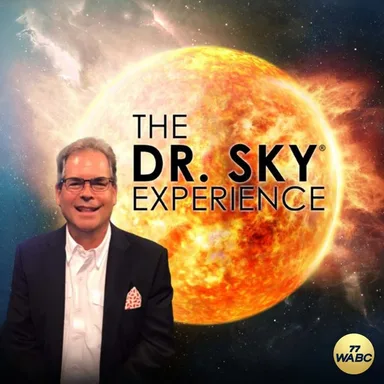
Steve Kates Space and astronomy broadcaster (Dr. Sky)
The Martian Moon Phobos May Be Destroyed
Transcript
Automated transcript · uncorrectedSunday Mother’s Day with us today is Steve Kates otherwise donate doctor Sky, and he’s always entertaining giving us expanding online. So what the heck is going on out there someplace on moon, the moon Mars, Well, doctor Sky, what’s up on this Mother’s Day?
Well, good morning, Happy Mother’s Day to everybody out there, of course the great mothers that we of course honor today. John, we begin with something very interesting many of us in grammar school. We’re all taught, and no problem by us, not our fault, that all the planets in the Solar System go around and relatively perfect circles. But honestly, if
you dig into it, it’s not really true. So planets do not necessarily move in those perfect circular orbits. They move around in something called a Barry center. And this is interesting, John, It’s the center of mass in which one or more celestial bodies orbit. So in simple Earth explanations we find out that if you took Jupiter and
the Sun, there’s a different location in which all these planets move around. None simply as simple as maybe we made it in grammar school. And it’s all due to celestial mechanics. So there’s a lot of complicated Berry centers.
Can you imagine if you build out from the Sun the planets all the way out to the universe, there’s a lot of stuff moving around, John, that’s incredible.
Well, I tell you it’s it is incredible when you look at it in a big picture of all those planets out there are just moving in a certain direction for billion years, and it’s just incredible.
Well, John, we have the subject that you and I love so much, and that’s more information about Mars. Now we’re going to zoom into the great one. These are the two little moons around Mars, Damos and Phobos, named after the amazing horses that rode around in the Greek and Roman amphitheaters called Panic and Fear. They were discovered
back in eighteen seventy seven. But John, here’s the fascinating thing about Bobos. Really like a little rubble pile, astronomers think, meaning a collection of just a bunch of rocks that kind of form together and over time. Guess what will happen, John, Forbos will slowly move this isn’t going to happen tomorrow and become destroyed because of the gravity of the planet
Mars and little tiny Phobos, John, do something called roche limit. What’s that? That’s when an object redleaces so much of itself due to the gravity forces of the big planet. And what will happen to Phobos? This is very sad.
It will be destroyed, and then Mars will have a ring like center. And that distance John, that this will happen is probably somewhere about less than three thousand miles above the surface of Mars. Lobos now is about thirty five hundred miles. And if you were to do the moon, John, and figure the Moon and the Earth and the Earth
and the Moon, John, if the Moon got closer than eleven thousand miles, it too would suffer the dynamics of disruption, and that would not be a good thing for the Earth. So let’s hope they stay out there at least our moon agreed.
Well, didn’t we talk about Phobos in one time that they were worried that might be artificial and it might be hollow whatever.
Nobody knows. But the Japanese have sent a spacecraft John to the Phobos little satellite, and probably by the end of this decade we will hopefully, hopefully we’ll still be there. Of course, we’ll be able to find out more about the geology of this object. Some say it could be hollowed out, as I said before. Some say it could
be just a rubble pile of material from the asteroid belt. But that mystery continues. And talking about the mystery of the week, John, this is always fascinating. Here’s a question. If the sun went out as you and I were standing outside, a horrible thought. It would have happened eight and a half minutes before that event took place, because
that’s how long it takes light to get from the Sun to the Earth. The artists of ways to talk about it. This is horrible. Obviously, total darkness, the Earth and the planets would spin off into interplanetary space. This one the Earth at sixty seven thousand miles Obviously the Earth in short order would be the coldest place that
we’ve ever experienced. Who knows that we would be alive. And the other one is the atmosphere, John, would freeze over time and collectively crash down to the frozen planet. So every day that you see the sun shining, you know it’s a true blessing in disguise.
Well, I always you know, when I wake up in the morning when I see the sun shining, it makes us feel.
Good, absolutely, and I love those positivities, especially as the honor mothers all over the world are the great things that they do and have done, and that’s why we salute mothers all over the world. It’s a great story, John, about the wonders of the universe, as we like to talk about the great mysteries here on talk radio seventy
seven WABC.
Thank you so much, Steve, Kates and Jay listening to your show every Friday, Friday morning and Saturday morning. You’re on from midnight to two am Saturday morning and on Sunday morning from midnight to two am. Well, we’ll see you again soon.
Well, thank you John for the opportunity
Sunday, May 10, 2026

Climate Mandates Are Hurting Working Families
Paul Zuber SVP, NY Business Council

A New Memoir of Service and Leadership for New York
Peter King Former U.S. Representative from New York

Pied-à-Terre Tax Will Hurt Investments in NYC
Suzanne Miller President, Empire State Properties; WABC Real Estate Analyst
Wind Turbines Pose Risks to National Security
Bonnie Brady Executive Director, LI Commercial Fishing Assoc.

Lou Katsos: America's First Overseas Victory at The Battle of Derna
Louis Katsos President, EMBCA & Construction Executive

Reviving National Conversation Through Books and Ideas
Steve Israel Former U.S. Representative from New York

New York's Leadership and the Cost of Radical Policy Shifts
Jessica Proud Senior Adviser to Rep. Langworthy (R-NY)

Running for Governor to Restore Common-Sense Leadership in Pennsylvania
Stacy Garrity Pennsylvania Treasurer; nominee for Governor

U.S. Must Adapt to a Changing Global Security Landscape
Newt Gingrich 50th Speaker of the House


NATO Is Obsolete in a Changing Global Order
General Paul Vallely Retired Major General, U.S. Army

Pushing for Government Transparency on UFO Records
Timothy Burchett U.S. Representative from Tennessee

Honoring Mothers With a Safer, More Secure America
Kevin Cramer U.S. Senator from North Dakota

Honoring Motherhood, Family, and Spiritual Love on Mother's Day
Alveda King Activist, Author & Niece of Dr. Martin Luther King Jr.



Parents Are Fighting for Online Accountability Laws
Lynn Shaw Founder of Lynn's Warriors

Steve Kates
Deep-Space Mysteries, UFOs and the Orionid Meteor Shower
Steve Kates Space and astronomy broadcaster (Dr. Sky)
The Mysteries of Mermaids, El Niño and the Antarctic Ice
Steve Kates Space and astronomy broadcaster (Dr. Sky)
Exoplanet Radio Signals, SpaceX’s Heavy Rocket Test and Nuclear Propulsion
Steve Kates Space and astronomy broadcaster (Dr. Sky)
Supersonic Jets, SpaceX’s Next Starship Launch & Trump’s Golden Dome Defense System
Steve Kates Space and astronomy broadcaster (Dr. Sky)
The Science Behind Hurricanes, Cosmic Radiation and the Universe
Steve Kates Space and astronomy broadcaster (Dr. Sky)
Ben Franklin, Mars, and Asteroid Mining
Steve Kates Space and astronomy broadcaster (Dr. Sky)
