


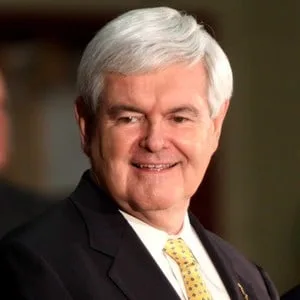
Newt Gingrich 50th Speaker of the House
U.S. Must Adapt to a Changing Global Security Landscape
Transcript
Automated transcript · uncorrectedBut coming up to a long weekend, a long weekend with Mother’s Day, well with us today is is speaker Gingridge. I’m never going to say former speaker, because he’s always going to be my speaker. Speak a good new ging Ridge.
Give us your evaluation on a Friday night before a long weekend.
Well, I think the biggest thing in the near future is President Trump’s visit to Beijing. This is a real I think crossroads and the decision Ping is going to have to think about whether he wants to continue to try to compete with US or whether he wants to cooperate with US. And I just noticed that yesterday, for example,
they announced the two former defense ministers. We’re both given death sentences which have been suspended for two years. But as a signal, I remember these guys who are in the military, and it’s a signal of the degree to which Jim Ping is unhappy with the owners of the military.
And of course, every time you turn around, Chinese weapons systems are failing. So they couldn’t protect Venezuela, they can’t protect Iran, they don’t do much good in Russia. And so I think suddenly his dream that he could somehow take us on and occupy Taiwan. I think he’s having to reassess everything. And at the same time, their population
is starting to drop because of their one child policy, and they’re going to go down from about a billion, four hundred million to maybe as low as six or seven hundred million by the end of the century. And that means they don’t have many young people. China is a country in transition, and President Trump will be visiting
it at a moment when it could lead to a truly remarkable breakthrough. That’s what we should hope for, was this could be a very big deal or not. If it’s not, then Trump will just keep marching on. But if it is a really big deal, it’ll be historic and will reshape a great deal of what’s happening around
the world.
Understood and I you know that’s truthful, And tell us, what do you think is the next step?
Well, look, I think they’ve got you know, the President can’t move on until Iran is resolved one way or another. And I think his hope is that the sheer pressure. In some ways, the Department of the Treasury is more important than the Department of War because they are cutting off money at such a level that the Iranian government
may literally not be able to function in a matter of a couple of weeks. And so the guys who are hardliners, who are very tough, who understand warfare and they understand taking casualties, but they end up having literally no money and they can’t pay their troops and the cans of saying what they’re doing. Then they conclude that
they have to agree to a deal that they don’t like because the alternative is breaking the entire regime. And I think that’s what Trump is counting on, and I think his hope is that over the long run, the Iranian people will take power back because this government will be so dramatically weakened by us. But it is a
it’s a big moment in the history of the world, and it’s a big moment in the presidency of Donald Trump.
Understood. One more thing I just need your opinion on. In the New York Times did a article on Friday morning saying that we’re running low on on on on ornaments armaments. Okay, you see my English was not my first language. Any opinion in that, because I guess they can. Yes, the pulsitive situation.
Yes, there are two things wrong. One, we build exquisitely amazingly advanced weapons, and they’re very exclusive, and so normally we have relatively limited stocks of how many and we’ve been using them up, both giving them to the Europeans to give the Ukrainians and then using a lot of them up against their ramp. There are two problems. One
is to expand production, which we’re doing, but the other is use common sense and use less expensive weapons. The Ukrainians are now building a million drones a year, and they’re very sophisticated drones. They’re hitting places in Russia twelve hundred or thirteen hundred miles away. They’re tearing up the Russian oil industry. They also have defensive drones. You know,
they built drones for like two thousand dollars. We build Patriot missiles for seven or eight or now nine million dollars. Well, she’s using a nine million dollar missile to kill a two hundred dollars drone. I mean, look, John, you are a great businessman who’ve been amazingly successful. If somebody walked into you and said, I got this great idea, I’m
going to spend nine million dollars to kill a two hundred million dollar missile. You immediately know that’s so stupid. You wouldn’t know why you’re having the conversation. And so they’ve got to go through a real transition. They’re beginning to they begin to buy a lot more drones for one thing. But there’s no question in the short run,
we’re going to have a shortage, and you know, if the Chinese were willing to take gigantic risk, they could decide this was the moment to test us, because frankly, we’ll be able to scrape together enough stuff where Iran, but in the process we’re moving things out of everywhere else in the world. So, but that was a decision
we made a long time ago. We used we used to have a policy to be able to fight two major wars at the same time. We gave that up as too expensive. So now you have the consequence we’re able to play one pretty significant war at a time, and we’re gonna have to rebuild our industrial base to
be able to do more than that.
Exactly, the new wars we we have the drones, and the new wars is that people don’t realize it yet. We’re never gonna send troops in again because against the Department of Defense of the Pentagon, whoever it may be.
They’re preparing soldiers that are robots. So is that they gonna be the new warfare drones and robots and in underwater in underwater. Uh, And they’re working on underwater drones.
Yeah, there’s a there’s a development. It’s called probably have the wrong The ghost is called the Ghost Shark, which is being for Australia, which is an onmanned submarine, which means you don’t have to have oxygen, you don’t have to have space, you don’t have to have a commissary or a kitchen. And then that submarine carries a large
number of torpedoes. It can go out about two thousand miles by itself in an onman setting. And it’s the beginning of a different world. If you look at the Ukrainians carefully, they are now I think eighty percent of the casualties that they’re imposing in the Russians come from drones.
Not They have really saved a lot of Ukrainian lives because they backed their troops out. You know, we used to have this rule in World War Two. The slogan was send a bullet, not a body, and we would go into an area and use a huge amount of artillery fire, a huge amount of tank fire, that we
would minimize the risks to Americans. And I think what you’re seeing now is the combination of artificial intelligence, space based assets and the devices like drones that are going to revolutionize warfare in ways we can’t even quite imagine it.
And you’re absolutely right, and we’re going to end it on this. And the other item is the fact that well, you know, space for us, the real purpose for space for us and how they’re going to be used, and nobody talks about that yet.
That’s right, and frankly worries the Air Force and the Navy because there are a lot of things you could do from space that you wouldn’t necessarily have a manned airplane doing.
Understood. Thank you so much for coming on, and let’s talk again real silm.
It always started. Good to talk to you, John,
Sunday, May 10, 2026

Climate Mandates Are Hurting Working Families
Paul Zuber SVP, NY Business Council

A New Memoir of Service and Leadership for New York
Peter King Former U.S. Representative from New York

Pied-à-Terre Tax Will Hurt Investments in NYC
Suzanne Miller President, Empire State Properties; WABC Real Estate Analyst
Wind Turbines Pose Risks to National Security
Bonnie Brady Executive Director, LI Commercial Fishing Assoc.

Lou Katsos: America's First Overseas Victory at The Battle of Derna
Louis Katsos President, EMBCA & Construction Executive

Reviving National Conversation Through Books and Ideas
Steve Israel Former U.S. Representative from New York

New York's Leadership and the Cost of Radical Policy Shifts
Jessica Proud Senior Adviser to Rep. Langworthy (R-NY)

Running for Governor to Restore Common-Sense Leadership in Pennsylvania
Stacy Garrity Pennsylvania Treasurer; nominee for Governor


NATO Is Obsolete in a Changing Global Order
General Paul Vallely Retired Major General, U.S. Army

Pushing for Government Transparency on UFO Records
Timothy Burchett U.S. Representative from Tennessee

Honoring Mothers With a Safer, More Secure America
Kevin Cramer U.S. Senator from North Dakota

Honoring Motherhood, Family, and Spiritual Love on Mother's Day
Alveda King Activist, Author & Niece of Dr. Martin Luther King Jr.


The Martian Moon Phobos May Be Destroyed
Steve Kates Space and astronomy broadcaster (Dr. Sky)


Parents Are Fighting for Online Accountability Laws
Lynn Shaw Founder of Lynn's Warriors

Newt Gingrich
Economic Frustrations and Socialists Causing Voter Anxiety Ahead of Midterms
Newt Gingrich 50th Speaker of the House
"The Big Government Socialists Are a Disaster for the Country"
Newt Gingrich 50th Speaker of the House
Democrats' Radical Shift Threatens America's Political Stability
Newt Gingrich 50th Speaker of the House
The Democratic Party Has Lost Touch with Mainstream America
Newt Gingrich 50th Speaker of the House
Energy Prices and Iran Remain Central to U.S. Policy
Newt Gingrich 50th Speaker of the House
