


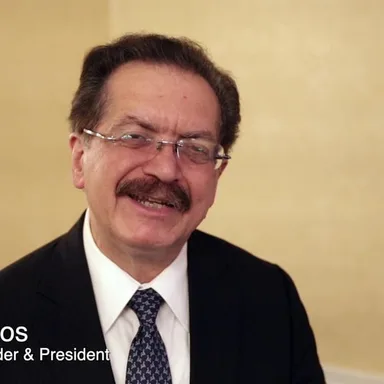
Louis Katsos President, EMBCA & Construction Executive
Greek Independence Parade Celebrates Shared History With America
Transcript
Automated transcript · uncorrectedSunday morning. Well, we got a parade on Fifth Avenue and it’s the Greek Independence Day parade, and well hopefully the Sunday is shining and for the whole day and with us today is lu Katsos, the chairman of the parade in lou I mean the Greeks usually the sun shines upon them. What’s going on today.
Well, today we’re parading and celebrating the two hundred and fifth anniversary of the start of the Greek of Greek independence in the war against the Ottoman Empire for liberty. And also this particular year, John, because it’s a very special year. It’s also the two hundred and fiftieth anniversary of the Declaration of Independence. So in this particular year,
we’re linking up the two nations, and it’s the logo is really two five two fifty, and it has to do with the linkage of these two nations over a period of time from the American Revolution, which was affected by classical Greece and all the writings that they had in terms of liberty and democracy and all the rest
of that.
And so what you’re saying is that the American Revolution had an effect on the Greek Revolution to win their freedom from the Ottoman Empire.
Yeah, I’m saying both.
I’m saying that the Greece itself had an effect on the American Revolution to begin with in seventeen seventy six, Oh tell us that yes, don’t forget all the presidents, the founding father, et cetera of the United States of America.
In the early days, they were all educated in classical Greek, They spoke the Greek language.
They actually went to school.
You couldn’t go to college in those particular days unless you knew Greek and Latin. So the effects of the ancient writings affected the American Revolution in terms of the concepts of democracy and liberty and all the rest of that.
So that’s important.
But then at the same time, two generations later, when the Greek Revolution broke out, the American felt an affinity to the Greeks because like the American Revolution, where they fought against an empire, and this time it was the English Empire. In the particular case of the Greeks, they were fighting against the Ottoman Empire. And it was a
tremendous linkage in America with that, and that was a part of American history which was called the Greek Fever period in the eighteen twenties of American history. Thousands of people were involved raising money, et cetera, and some Americans actually went to fighting Greece. One of them, the first one who went, in fact, was George Jarvis, who was
from New York. He fought and he died in Greece. And it was also a relative of George Washington who fought in Greece, died in Greece and is buried in Greece.
Wow, I mean, I bet you a lot of the American people are hearing news for the first time. So there’s going to be a big parade. And this parade has been going on for how long? The Greek Independence Day.
It’s been going on since nineteen thirty eight.
But in reality, the Greek Independence Day parade, which originally was down Broadway where they went to city Hall and they raised the Greek flag, was from eighteen ninety three.
And what time dos it start on Sunday?
It starts at one thirty down down Fifth Avenue.
Down Fit Avenue, upfit that ex excuse me, upf upfit that and it starts around where the Pierre Hotel is.
I understand that is correct. We’re starting at the Pierre Hotel.
That’s going up to bout what’s seventy ninth Street, seventy nine street, Yes, yes, So it’s going to be a great Greek Independence State parade. A lot of bands, a lot of floats.
A lot of bands, a lot of floats.
There’s one hundred different contingents that are the marching. As a matter of fact, your group from w ABC will be there and towards the front of the parade, actually behind the e F zones, so you know it’ll be it’ll.
Be a great occasion.
And a lot of people are coming from Greece with their traditional outfits, so it’s going to be a very exciting, exciting event.
And I want to add John that not only is this.
A Greek parade, it’s also an American parade. And let me explain what I mean by that. Like I said that it’s part of American history. Americans fought and died there. And at the same time, the Greek Revolution affected the American abolitionists movement as well as the women’s suffrage movement, because when a revolution took place, a lot of people
were involved.
They were using the rhetoric to free the Greeks from the Ottoman Empire.
And that same rhetoric was used after the Greek Revolution by some of the people who actually fought in Greece who came back to the US.
That same rhetoric was used to the freeing of the slaves.
As a matter of fact, both black abolitionists and white abolitionists used the same rhetoric that was.
Used for the Greek Revolution for the abolitionist movement.
So now you’re taking you from American Revolution seventeen seventy six to the Greek Independence eighteen twenty one.
Yes, to the abolition the abolition movement.
Even in a civil war, John, there were Greeks who fought who actually were Greek. In some cases orphans who came to the United States during the Greek Revolution, came to the US and actually fought for the US within the Navy, within the Navy, for example. And even scholars were here that were physicians, et cetera for the North. Okay,
So they came here and actually fought for the United States and the American Civil War. Wow, not only that, John Listen, we can go further back. We can go to the first Battle of the United States overseas, the Battle of Drna in eighteen eighteen oh five, which had to do with the Barbary Pirates. Okay, in those days,
it’s almost similar to what’s happening today. The Barbary Pirates did not allow ships to go in unless they paid, and the United States before they before they had their freedom from England, was.
Part of England, and England was paying.
France was paying to go through the Mediterranean so they could trade to the Barbary Pirates. When the US became free the Barbary coast, the Barbary Pirates asked the US to pay to pay to go across. The US into into its early days, was paying close to almost I don’t know the exact number, but ten percent of the
national the national budget to pay the Barbary pirates to go across the Mediterranean. Jefferson said, excuse my language, screw you, and the Barbary War started the first battle of the United States overseas, which was the Battle of Darna. The Marines went down there. That’s what they mean by the shores of Tripoli. When the Marines went there, there were
more Greeks fighting with the Marines than there were Marines themselves. So the Greeks were actually involved with America and the Battle of Dara, the first battle overseas, in the first battle of the United States won.
Well, lou Katsus is with us this Sunday morning, and we started talking about Greek Independence Day. But lou Katzo’s not only in the real estate business, but a true historian. And I like how you’re filling us all in on the history. Now, I’m gonna ask you just your opinion.
What’s going on right now? You know, there’s an old expression that lu Katzo’s history repeats itself absolutely. What is going on right now with Iran in the Strait of whomos? Well, it seems similar to what it was.
It may seem crazy, but this is almost almost analogous to the Barbary Wars. Actually, people want to charge people to go across and you know, to do trading, et cetera.
And the United States said at that point, no, it’s not happening.
We had actually two Barbary Wars by the way in the United States, and.
So so it’s a similar situation.
Will they stop My opinion is no, until we do what happened in the in the Barbary Wars.
My opinion and what happened in the Barbary Wars. If fishery repeats itself.
In the Barbary Wars.
They came in with their with their ships, okay, the merchant ships, et cetera.
And they invaded the area and took over basically, and and that ended the Barbary Wars.
In other words, if you don’t take over then in that area where they create the war, then you don’t win at the end. Yeah.
Not only that, it’s not so much taking it over, it’s it’s they went in there and basically defeated them, and they understood that they cannot they cannot continue to charge to go across the Mediterranean.
Lou Katza’s chairman of the Greek Independence. They parade, thank you for the history lesson God, bless you, God bless Greece, God bless America. And and you we’d like you to come on more often, because history does repeat itself.
Whenever you like, John and thank you and then join us on Fifth Avenue on Sunday today. Actually yeah,
Sunday, April 26, 2026

GOP Agenda is Focused on Inflation, Energy, and Government Efficiency
Steve Scalise House Majority Leader

Progress on Combatting Crime, Cartels and National Security Threats
Christopher Raia Deputy Director, FBI


New Federal Tactics Target Cartels
Frank Tarentino DEA Associate Chief of Operations, Northeast Region
Protests and Rhetoric Could Drive Investment Away From New York
David Paterson Former Governor of New York
Sen. Murphy's Actions and National Loyalty
Benjamin Proto Chairman, Connecticut Republican Party

Transit Planning Failures Ahead of World Cup
Christine Hanlon Chair, New Jersey Republican Party

Tax Hikes Could Drive Away NYC's Top Taxpayers
Steve Fulop President & CEO, Partnership for NYC

Mamdani Faces Veto Fight and Fiscal Strain
Craig McCarthy City Hall Bureau Chief, New York Post

NYC Fiscal Crisis Is Driven by Overspending
Andrew Rein President, Citizens Budget Commission

Explosives Discovery on Long Island Raises Broader Security Concerns
Jake Novak Political & Economic Analyst, CNBC Columnist

Historic Reenactment to Honor Washington's First Inauguration
Joni Bryan Founder, 917 Society

Artemis IV Targets Astronaut Return to Moon by 2028
Dr. Weiping Yu NASA Physicist & Spacecraft Subsystem Manager
The Stoler Report with Michael Stoler: Chris Bradicich
Michael Stoler Real Estate Expert


Incoming Fireballs, a Super El Niño and the Power of Our Sun
Steve Kates Space and astronomy broadcaster (Dr. Sky)

Demonstrations on Capitol Hill Showcase Demand for Child Safety Legislation
Lynn Shaw Founder of Lynn's Warriors

Wall Street Faces Volatility as AI Investments Reshape Markets
John Terrett WABC Financial Analyst
Louis Katsos
The Greek Revolution's Influence on American History
Louis Katsos President, EMBCA & Construction Executive
Lou Katsos: America's First Overseas Victory at The Battle of Derna
Louis Katsos President, EMBCA & Construction Executive
Greek Independence Day 200 years of freedom.
Louis Katsos President, EMBCA & Construction Executive
Turkish lobbyist seeks to suppress talk of the Armenian genocide.
Louis Katsos President, EMBCA & Construction Executive
