


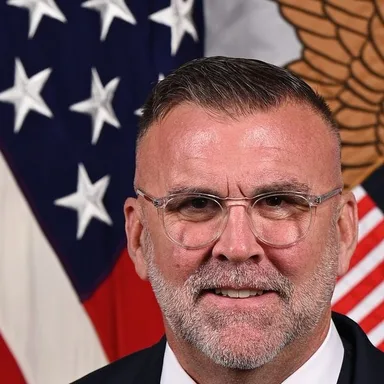
Michael Dodd Assistant Secretary of War for Critical Technologies
America's Military Technology Priorities and the Race to Stay Ahead of China
Michael Dodd
Michael Dodd, Assistant Secretary of War for Critical Technologies, tells John Catsimatidis that the department cut its named critical technology areas from 14 to six, and that he owns three: contested logistics, quantum battlefield information dominance, and scaled directed energy. He says China and Russia are no longer near-peer adversaries but peers in a number of technology domains.
Key takeaways
- Dodd said his office reviews adversaries’ capabilities against America’s own to drive its project sprints.
- He said directed energy work covers high-energy lasers and high-performance microwaves, from drones up to cruise missiles.
- He said shooting down low-cost, one-way attack drones with high-cost interceptors is unsustainable.
- He said he also owns microelectronics, including the trusted chips the department puts into its systems.
- He said the sprints aim to meet, exceed or leap ahead of China and Russia in priority domains.
In their words
“And translated quite literally, my job is to cause our adversaries nightmares and ensure that they have sleepless nights.”
“But they are no longer a near-peer adversary, right? China, Russia, they are a peer-to-peer adversary in a number of these technology domains.”
“we were shooting them down with million-dollar missiles, and they’re realizing that that is not sustainable. There has to be a better way”
Quotes are word for word from the automated transcript, uncorrected; the summary and takeaways are editorial.
Transcript
Automated transcript · uncorrectedCalling in right now is Michael Dodd, and he serves as the Assistant Secretary of War for Critical Technologies. I guess he’ll tell us what that means. And he’s under the office of the Undersecretary of War for Research and Engineering. Well, what does all that mean?
No, thanks, John. I appreciate the opportunity to connect and kind of kick some ideas around. So, yeah, I’ll put the initial paint on canvas. Secretary Hegseth, last March, of 26, we went from 14 named critical technology areas down to six.
And I’ll hit on those six in a second, but I want to, I think, really drill in on why we named those six, the three that I own, and kind of what we’re doing about it. So our construct, and this will help kind of set it up, I also own the Office of Strategic Intelligence Analysis, for the department.
And what that oversimplified means is we review adversarial capability against our own capability and utilize those data inputs for driving the project sprints that we execute. And again, to maybe distill that down another layer, we’re looking within my office to gain a disparity of technological capability between us and our adversaries. So the six named critical technologies are
scaled hypersonics, are biomanufacturing, and those live over in a component also here in research and engineering and science and technology. Those are longer lead time items. And to the right of me is artificial intelligence, and that lives over in our chief digital AI office, or really a newly rebranded superintelligence office. And then I own our contested logistics, our
quantum battlefield information dominance, and scale-directed energy. And I wanted to talk very quickly about each one of those. So in our scale-directed energy, those are high-performance lasers or high-energy lasers and then high-performance microwaves. And in that, we’re using lasers or directed energy to shoot down both drones in a one-to-many response. and all the way up to, like,
counter-cruise missiles. So everyone’s, I think, fairly well aware of the cost disparity of our cost per kill in shooting low-cost, one-way attack drones down with high-cost interceptors, right? Unsustainable. So directed energy is really coming out of the sea.
You can’t use a million-dollar missile to shoot down a thousand-dollar drone.
Well, we were shooting them down with million-dollar missiles, and they’re realizing that that is not sustainable. There has to be a better way, and, of course, directive energy is just that.
Now, you interacted with Space Force?
We work with all the services and all the unified combatant commands, yes.
Understood. And I understand we’ve got some very sophisticated weapons up there.
We absolutely do. We absolutely do. And then I also own our microelectronics, our semiconductors, chips, all the trusted microelectronics that we put into our systems because they are foundational in everything that we do. I own that in my portfolio as well. So a broad portfolio, but, again, driving toward creating a disparity of technological capability between us and
our adversaries.
Are the Chinese or the Russians getting ahead of us, or we’re still way ahead?
So certainly a conversation for a different room and a different classification level, but I would oversimplify, say, you know, what is publicly available is the fact that China primarily is certainly challenging us in a number of technology domains and or prospectively passing us in some of those domains.
I’d go back to my earlier comment of the emphasis that we’re putting on and the sprints that we’re executing is, again, to meet, exceed, or surpass or leap ahead China and Russia in the technology domains that we’re placing the most emphasis and bets on. But they are no longer a near-peer adversary, right? China, Russia, they are a peer-to-peer adversary
in a number of these technology domains.
Understood. What else would you like to tell the American people?
Well, I think what’s important for our citizens and our service members and warriors to know is I got the best job in the department. And, you know, my construct and directive from Secretary Hagstaff and Honorable Michael, my boss, who’s the chief technology officer for the department, you know, I’ve got a tagline on my correspondence, insomnia adversarius nostris.
And translated quite literally, my job is to cause our adversaries nightmares and ensure that they have sleepless nights. And when they wake up in the morning and thinking about challenging the United States, they say, not today.
Understood. Keep fighting. Keep America number one. And thank you for everything you have done. And God bless America.
Thank you, John. I appreciate all you do for our country and our warriors as well. Thank you, sir.
Thank you so much, and we’ll catch up again real soon. Thanks.
Sunday, November 15, 2026
Rolling Back Regulations and Unleashing American Energy
Lee Zeldin EPA Administrator

Navigating Senate Rules to Advance Key Republican Priorities
Kevin Cramer U.S. Senator from North Dakota
Washington Must Maintain Pressure on Iran
General David Petraeus Former CIA Director & Four-Star General

Inside His Prison Years and His Views on Today's Democratic Party
Rod Blagojevich Former Governor of Illinois

Democrats Must Unite and Avoid Internal Infighting
David Paterson Former Governor of New York

New York’s Budget Surplus, Rainy Day Reserves and Fiscal Challenges
Tom DiNapoli New York State Comptroller

Fighting Human Trafficking, Promoting Faith and Reaching Hispanic Voters
Bob Unanue Former CEO of Goya Foods

The Legacy of Stanley Zabar and the Family Behind the Legendary New York Deli
Bill Wachtel Founding Partner, Wachtel Missry LLP

The Growing Financial Struggles Facing Small Business Owners
JT Foxx Entrepreneur & Investor

New Medical Breakthroughs Are Changing Alzheimer’s Diagnoses
Dr. Mason Pimsler Geriatrician, Lincoln Medical Center


Reversing the Effects of Aging and Maximizing Your Healthy Years
Dr. Peter Michalos WABC Medical Expert

The Future of Moon Exploration and Preparing Humans for a Mission to Mars
Steve Kates Space and astronomy broadcaster (Dr. Sky)

Congress Must Act Now to Protect Children from Online Dangers
Lynn Shaw Founder of Lynn's Warriors

Wall Street Weighs Nvidia Controversy Amid Growing AI Investments
John Terrett WABC Financial Analyst
