


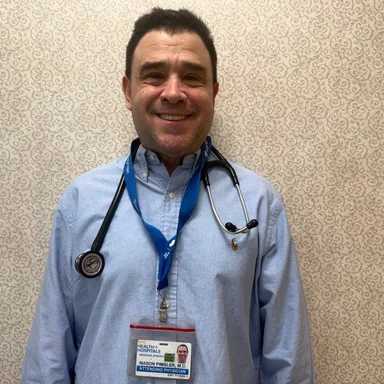
Dr. Mason Pimsler Geriatrician, Lincoln Medical Center
New Medical Breakthroughs Are Changing Alzheimer’s Diagnoses
Dr. Mason Pimsler
Dr. Mason Pimsler, a geriatrician at Lincoln Medical Center, tells John Catsimatidis that Alzheimer’s disease is becoming like the new cancer of the brain, and that there have been two major advances in how it is diagnosed and treated. He says new FDA-cleared blood tests can identify the plaques linked to the disease, and that two new drugs have been shown to decrease clinical decline.
Key takeaways
- Pimsler said more than 7 million Americans have been affected by Alzheimer’s disease and dementia.
- He said the first FDA-cleared Alzheimer’s blood test came out in 2025 and measures tau and amyloid.
- He said the plaques are proteins that grow out of control and slow down the brain’s neurons.
- He said microplastics could be adding to the plaques, though he has no evidence-based proof.
- He named the drugs Leqembi and Kisunla, and said doctors sometimes don’t want to recommend them.
In their words
“it’s becoming like the new cancer of the brain, Alzheimer’s, dementia.”
“I don’t have any evidence-based proof, but I think that it could be adding to these amyloid and tau plaques”
“Don’t give up hope. There’s these two new drugs that are approved for Alzheimer’s.”
Quotes are word for word from the automated transcript, uncorrected; the summary and takeaways are editorial.
Transcript
Automated transcript · uncorrectedSunday morning with us is Dr. Mason Pimsleur.
And he’s got a few things to tell people that you’re going to find very, very useful.
Well, Dr. Mason, give us your evaluation.
What’s going on this week that you felt that people should know about it?
Good morning, John, on Sunday. I feel very important because it’s becoming like the new cancer of the brain, Alzheimer’s, dementia. It’s affecting patients 65 and older, although younger, but we have over 7 million Americans in our audience that have been affected by this. So there’s been a couple of breakthroughs in this area recently. There’s been two major advances, actually,
on how we are diagnosing and treating Alzheimer’s disease. And if anyone can remember how former President Reagan had it, and there really wasn’t much to do. And then through the years, they would come with drips and drabs with other types of medications. But now we have new FDA cleared blood tests that can clearly identify, and this is
like with cancer too, but can identify the biological changes associated with Alzheimer’s disease. So if you get a blood test, we can see if someone is starting to develop what we call these plaques, where a lot of people in the audience hear about, and they’re called amyloid plaques. And the blood tests can tell us. One was approved in 2025,
and it was the first FDA-approved test to come out. and it measures the tau and amyloid plaque.
Now, what is that?
Just to put it in simplified terms so everyone understands, it’s these proteins that we normally have in our brain, but they grow out of control. And when they grow out of control, they slow down the neurons. What are the neurons? That’s a functioning part of the brain that can communicate with other neurons that make us think cognitively.
So if we have too many of these plaques, that are normally there but grow out of control, our memory starts to decline and we start to have other effects. Wow.
Now, the other thing is they’re saying that part of the Alzheimer’s problem might be that the plastic in the bottles or the plastic that’s associated with getting into our bloodstream is possibly causing the brain problems.
Have you heard that?
I had with the nanoparticles, the microplastics. I have heard that and I’ve heard it with other things too. And I do believe it because we’re consuming so many bottles of water, so many other types of drinks, beverages with plastics.
And who knows what’s in the drinking water just through the fountain. So I think that it could be adding, I don’t have any evidence-based proof, but I think that it could be adding to these amyloid and tau plaques that are causing the Alzheimer’s disease. Because we’re pretty sure now that these plaques are related, that there’s a causal effect,
not just that they’re there.
Now, the other thing.
Is I want you to study it because I’ve read other studies that if you eat okra, okra, for some reason, removes those plastic from the blood system.
Would you look into that? Thank you.
No, that’s a great point because I’ve really never heard it about it. I know okra’s a vegetable from a flowering plant, but I’m going to do that, actually. And if it’s something that is valid in that, what you’re saying, I’m going to recommend it.
Yeah, report it back to our WABC audience.
Yeah, no, that’s great. I want to get that known. The audience should be looking that up. And it comes in, I know okra comes in different things like beans, eggplants. and stuff like that. But then it should be down as a recommendation, and I would recommend it strongly to my patients, definitely.
Well, the same way, when you eat beets, when I eat a lot of beets, or have beet salad, I take half the blood pressure medicine.
So check that one out, too.
No, I believe. That one I’m totally up in believing because it dilates the blood vessels and it makes your pressure lower. Absolutely. And I think it is very bright, smart. It has so many different effects to beets. And I think that a red beet diet and a Mediterranean diet, which includes beets, is very healthy and can do that
with the blood pressure. And there you go. You just gave an excellent proof of it with your blood pressure.
Well, thank you so much for coming on.
Anything else you want to tell our audience on a Sunday morning?
No, that was just it. And just that there’s two new drugs. Don’t give up hope. There’s these two new drugs that are approved for Alzheimer’s. Sometimes the doctors don’t, they say they don’t want to recommend it, but it has been shown to really decrease the clinical decline. So if you have an older family member that has it, please,
these medications have been helpful. One is called Linkembi. And the other is Kisunla, K-I-S-U-N-L-A. And I see how the effects on patients are. So it’s very helpful.
Well, thank you so much.
And I wish the audience the best. And thank you, John. Excellent show.
We’ll catch up again real soon.
Absolutely. Please have a blessed one in the audience.
Sunday, November 15, 2026
Rolling Back Regulations and Unleashing American Energy
Lee Zeldin EPA Administrator
Navigating Senate Rules to Advance Key Republican Priorities
Kevin Cramer U.S. Senator from North Dakota
Washington Must Maintain Pressure on Iran
General David Petraeus Former CIA Director & Four-Star General
America's Military Technology Priorities and the Race to Stay Ahead of China
Michael Dodd Assistant Secretary of War for Critical Technologies
Inside His Prison Years and His Views on Today's Democratic Party
Rod Blagojevich Former Governor of Illinois
Democrats Must Unite and Avoid Internal Infighting
David Paterson Former Governor of New York
New York’s Budget Surplus, Rainy Day Reserves and Fiscal Challenges
Tom DiNapoli New York State Comptroller

Fighting Human Trafficking, Promoting Faith and Reaching Hispanic Voters
Bob Unanue Former CEO of Goya Foods

The Legacy of Stanley Zabar and the Family Behind the Legendary New York Deli
Bill Wachtel Founding Partner, Wachtel Missry LLP

The Growing Financial Struggles Facing Small Business Owners
JT Foxx Entrepreneur & Investor
Reversing the Effects of Aging and Maximizing Your Healthy Years
Dr. Peter Michalos WABC Medical Expert
The Future of Moon Exploration and Preparing Humans for a Mission to Mars
Steve Kates Space and astronomy broadcaster (Dr. Sky)

Congress Must Act Now to Protect Children from Online Dangers
Lynn Shaw Founder of Lynn's Warriors
Wall Street Weighs Nvidia Controversy Amid Growing AI Investments
John Terrett WABC Financial Analyst
Dr. Mason Pimsler

Fighting Cancer Through Prevention, Nutrition and Medical Innovation
Dr. Mason Pimsler Geriatrician, Lincoln Medical Center
Taking Control of Aging Through Fitness, Nutrition and Relationships
Dr. Mason Pimsler Geriatrician, Lincoln Medical Center
Sounds the Alarm on Cell Phones and the Developing Brain
Dr. Mason Pimsler Geriatrician, Lincoln Medical Center
Questioning the Reliability of Modern Medical Tests
Dr. Mason Pimsler Geriatrician, Lincoln Medical Center
New York's Debate Over End-of-Life Care
Dr. Mason Pimsler Geriatrician, Lincoln Medical Center
Protecting Yourself From Legionnaires' and Cyclosporiasis
Dr. Mason Pimsler Geriatrician, Lincoln Medical Center
