


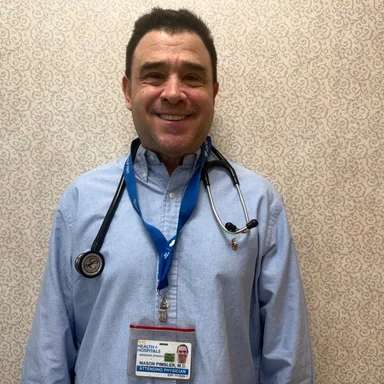
Dr. Mason Pimsler Geriatrician, Lincoln Medical Center
Taking Control of Aging Through Fitness, Nutrition and Relationships
Dr. Mason Pimsler
Dr. Mason Pimsler, a geriatrician at Lincoln Medical Center, tells John Catsimatidis that the goal is not just to live longer but to live better, keeping strength, mental sharpness and independence with age. He recommends resistance training with light weights and 1 to 1.2 grams of protein per kilogram of body weight daily, and says patients need advocates and people need friends, since loneliness can shorten life.
Key takeaways
- Pimsler said resistance training from the 40s into the 80s keeps muscle mass and helps avoid sarcopenia.
- He said the weights can be two or five pounds, lifted every day, even at a desk.
- He said even younger patients need an advocate to reach doctors by phone and get through tests.
- He said he has a 102-year-old patient who is independent and has a good quality of life.
In their words
“I like to say living longer is not enough. The real goal is to live better, maintaining our physical strength, mental sharpness, independence, and quality of life as we age.”
“one of the biggest mistakes people make when it comes to aging is that the physical decline is going to be inevitable.”
“loneliness could actually shorten your life as well”
Quotes are word for word from the automated transcript, uncorrected; the summary and takeaways are editorial.
Transcript
Automated transcript · uncorrectedSunday morning with us today is Dr. Mason Pimsleur, and he’s a good friend, and he’s an award-winning internist with the New York City Health and Hospitals, and he specializes in geniatrics and helping elderly people. Well, Dr. Pimsleur, tell us, what have you done this week to save a life?
Well, interesting stuff first.
Thank you, John.
Good morning to you on this Sunday morning. I like to say living longer is not enough. The real goal is to live better, maintaining our physical strength, mental sharpness, independence, and quality of life as we age. So that’s what we’re going to talk about today on how we could make ourselves stronger. better when we turn.
To be 80, 90, and as you.
And I always say, to live to 100, which is not far, that’s not far-fetched at all, actually. So I say like one of the biggest mistakes people make when it comes to aging is that the physical decline is going to be inevitable. And we can’t do anything about that.
But what we can do is we can make sure that we keep our muscles good. We keep our brain health good. And we do that through maintaining good muscle mass for the muscle part. And that because we don’t want to get sarcopenia. So what we need to do is we need to do weight resistance training when we’re
in our 40s and 50s and continue it in our 60s, 70s and 80s.
And it doesn’t have to be heavyweights.
It could be two pounds, five pounds weights that we just lift every day with our hands and do it while you’re at your desk doing it. They sell these on Amazon and other companies. And we need to eat proper protein to maintain our muscle mass. So I’m focusing on muscle mass the most so we can keep our
core in place and keep our body musculoskeletal in place. And I wanted to also bring up about protein, that we have to eat a special amount of protein. And it should be 1 to 1.2 grams of protein per kilogram.
So if, say, someone weighs 65 kilograms, you multiply that by 1.2 grams. And that will give you the right amount of protein. So I want the audience to know at home, hey, how much protein should I eat each day?
And it should be whatever your kilogram weight is and multiply it by 1.2, which is simple formula to do protein shakes, chicken, fish, stuff like that. And that all can help us when we turn to be in our 70s and 80s so we can walk well, we can have good gait, all that stuff, John.
I understood. Now, let me ask you a question. Is the average age going up, especially in New York City, where we have the best hospitals in New York, so are the elderly versus the average for the whole country?
How do you see it? I mean, because you’re there every day.
I’m on the front lines. I’m an internist, but I’m a fellowship trained geriatric specialist. So I was at the VA hospitals all over, did my training. So, yes, the average age is going up. I have a patient 102 years old with good quality of life, independent.
She’s a home health aide.
She does for someone that’s 70-something years old. So New York City, yes. Other places have very good health care, too. But the average age is no longer 80, 75. Now the average age, what I see, should be, people are going to debate it and say no, but I should see easily in the early 90s to mid-90s.
So until then, me and you have talked about it. We talked about it with Dr. Michalos. We’re looking for a doctor. Yeah, we’re looking for the there’s a lot of people out there looking for that gene that turns off and makes us die at the age of 95, give or take five years.
Yes, but look at your friend, Dr.
Vagalos, right? And look how he’s living and he’s older.
So even without finding that so quickly, we still can do well, very well. That’s what I want to give people hope. I see it all the time. You asked me about savings. So I did a colonoscopy when they didn’t want to do it. And we discussed this before on a patient that was 82 years old or 81
years old. And they found the colon cancer and they removed.
It at Columbia, actually. And she’s doing well now on chemo. So you have.
The elderly people. If they don’t have an advocate, then they’re going to die.
John, even younger, if they don’t have an advocate to get through the doctor’s phone numbers to get through the tests. And if a doctor just says something and the patient isn’t up to date, they just accept it.
It’s no good. I have that happen all the time. And I’m.
Becoming burnt out I have patients that I have to keep calling in the hospital yeah they’re going to die and another thing that’s so important other than medical is people need friends people need companions because loneliness could actually shorten your life as well John understood it could cause cardiovascular Dr.
Mason Pimsleur we’re out of time but I want to continue this discussion And thank you for coming on this Sunday morning. And we’ll talk again real soon.
Oh, I want to thank. Thank you very much. WABC doing a great job getting this out there.
Thank you so much.
Sunday, October 11, 2026
Protecting America From Foreign Threats and Winning the AI Race
Jay Clayton Director of National Intelligence
Unleashing American Energy Dominance Through Sweeping Deregulation
Lee Zeldin EPA Administrator
Protecting Florida's Prosperity From Progressive Policies
Ashley Moody U.S. Senator from Florida
Fighting Inflation, Cutting Taxes and Lowering Energy Costs for American Families
Mike Lawler U.S. Representative from New York

Taking on California's Political Machine With a Plan to Cut Costs and Revive the State
Steve Hilton Candidate for Governor of California
Confronting Russia, Iran and China as Global Threats Intensify
General Jack Keane Retired Four-Star General, U.S. Army

Why Midterm Losses and Impeachment Threats Won't Derail Trump
KT McFarland Former Deputy National Security Advisor
Pushing E-Bike Safety Regulations and AI Safeguards
Julie Menin New York City Council Speaker
Aging Infrastructure and Cyber Threats Put America's Water Supply at Risk
Robert F. Powelson President & CEO, National Association of Water Companies

From Late-Night TV to Novelist With The Refuge
Carly Hillman Novelist; Former Late Show Producer
Voters Deserve a Debate in the 38th Senate District Race
Thomas Ossa President, Rockland News
The Stoler Report with Michael Stoler: Eli Weiss and Andrew Albstein
Michael Stoler Real Estate Expert
Healthy Eating, Stronger Immunity and the Science of Living Longer
Dr. Peter Michalos WABC Medical Expert

The Mysteries of Mermaids, El Niño and the Antarctic Ice
Steve Kates Space and astronomy broadcaster (Dr. Sky)
The Social Reckoning Highlights the Need to Protect Children Online
Lynn Shaw Founder of Lynn's Warriors
Corporate Earnings and Fed Decisions Set the Tone for Wall Street
John Terrett WABC Financial Analyst
Dr. Mason Pimsler

Sounds the Alarm on Cell Phones and the Developing Brain
Dr. Mason Pimsler Geriatrician, Lincoln Medical Center
Questioning the Reliability of Modern Medical Tests
Dr. Mason Pimsler Geriatrician, Lincoln Medical Center
New York's Debate Over End-of-Life Care
Dr. Mason Pimsler Geriatrician, Lincoln Medical Center
Protecting Yourself From Legionnaires' and Cyclosporiasis
Dr. Mason Pimsler Geriatrician, Lincoln Medical Center
Expanding Medicare Access to Weight Loss Medications
Dr. Mason Pimsler Geriatrician, Lincoln Medical Center
Bringing Preventative Healthcare to the South Bronx
Dr. Mason Pimsler Geriatrician, Lincoln Medical Center
