


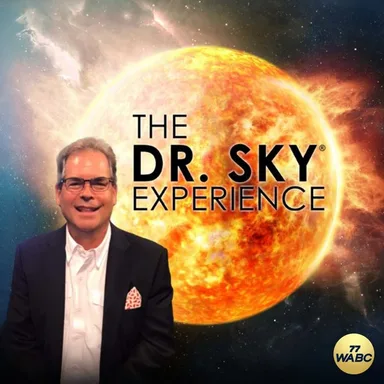
Steve Kates Space and astronomy broadcaster (Dr. Sky)
Full Hunter's moon this week.
Transcript
Automated transcript · uncorrectedWith us today is Steve Kates, otherwise known as Doctor Sky, and we talked to them every Sunday morning to see what’s going on up in the planets and the skies in the world of Good Morning. Steve Kates tell us what’s going on?
WELLO morningdn’t happy Sunday morning to you and the listeners of the Cats Round Table John. In this edition, we’re going to introduce a story that’s kind of interesting. The Earth may have other small moons, not just the moon itself.
And the story on that is this a near Earth asteroid may be part of our moon. In other words, it might have come from our moon. These are called near Earth asteroids. And it has an interesting name because it was discovered by astronomers in Hawaii. It’s known as camo oh ali Wa. It’s one hundred and fifty feet
in diameter. And as I said before, maybe part of our moon created by an explosion of an asteroid that pushed this object into space. So now we find out that the Earth, among other little objects, may have a small moon in addition to our regular moon. And how do they think it’s part of the moon. They analyze
the spectrum, you know, to find out what it’s made of, and it matches many of the rocks that the astronauts found from Apollo fourteen. And there’s going to be a spacecraft sent by the Chinese known as Tianwin Tu in May of twenty twenty five to try to scoop up samples.
So the adventure and the mystery just continues. Amazing, don’t you think.
It is amazing? How long do you think this is up there? Like that?
They’re saying, John, that this probably was up there for a couple of hundred million years, but we only detected it just recently. And it all goes well, Well, first of all, it only gets within nine million miles of the Earth. It’s not going to hit us anytime soon.
That’s the good news, folks. But what’s interesting about it.
Nine million miles of the Earth? I mean, how far is the.
Mine million miles away? Well, the Moon’s only two hundred and fifty.
Thousand miles, so that one is really fun.
It is and lucky for us. But it may be in orbit John, as they’re saying, maybe for at least three hundred years around the Earth. So the point is the Earth may have other objects that orbit around it, not just the big object we call the regular Earth’s moon, which is fascinating.
Did we create a name we move on?
Well, that’s the name that they gave it. It’s a name. I’m not sure what it means in Hawaiian. But the name again is kamo Owa Lewa, which has something to do with some sacred rituals in Hawaii. They name a lot of these objects after the goddesses and gods in ancient history that come from mythology in the Pacific Islands.
Fascinating stuff. But John, we moved from there deep out into the Solar System with the Voyager spacecraft. You know, in nineteen seventy seven, both of these objects were launched out into space. And there’s years ago now absolutely, And I remember in New York City I watched the launch.
And now I’m here in what as I’m sixty seven years young. Ye, it seems like, you know, a long time ago. But the spacecraft John is still orbiting out into space. The Voyager one is fifteen billion miles away from the Earth and the Voyager two is twelve point five billion miles away from the Earth. And they had
a few issues a few years ago about sending back some bad data. So what did NASA do. They sent a whole new software upgrade. Imagine this a software upgrade just to send out to the spacecraft. It takes twenty three hours. Imagine when you and I download something off the internet, it usually takes well larger the file, the
longer the time. But can you imagine twenty three hours to one of those the Voyager one. That is amazing. It’s the farthest man made object ever in space and it’s still continuing to tick. That is incredible.
It is sending back signals, it sure is.
And even though we’re talking about sending it one way, it takes that many hours, let’s say with Voyager one, twenty three hours just to pick it up. And you may be wondering, John, how do they pick up a signal like that? Well, out in the Mahabi Desert and around the world, there are these gigantic antennas. You may
have seen them in the movie like Contact. One’s called the Goldstone Tratting Network. I think it’s like a two hundred and thirty foot giant looks like a giant radio telescope. So imagine the frequency coming from that far they’re still able to perceive it. I find that quite amazing. But John, we always talk about the mystery of the week and
the mystery of the week. This is kind of interesting, I thought, so people can really see how we expand their minds. How long would it take you to drive to space? Well, space is officially listed at sixty two miles above the Earth, called the Carmen line. So if you were to drive at sixty miles an hour, which
most people don’t, but if you did, that would take you, obviously a little over an hour straight up, as ludicrous as that sounds. But to get to the space station, which is about two hundred and fifty miles above the Earth, it would take four hours of drive time. We’ve driven four hours in cars before, but imagine that. But here
comes the bizarre one. If you drove to the moon at the same speed, it takes one hundred and seventy five days. Now that seems crazy, but here’s one. If you actually walk to the moon. Talking about this totally bizarre thing, the average speed of a walker is maybe about three and a half miles per hour, it would
take you and I John seven point three years. John, my legs are tired. So the mystery solved. Even the moon that close would take that long. So can you imagine how far these other objects are in space? That’s amazing, It.
Is amazing, and well, you know that’s what expands.
Onlines absolutely And just in time for Halloween, I wanted to add this from Albert Einstein. He wasn’t really a big fan of quantum physics. That’s the stuff we’re talking about about how the universe works in the super subatomic level.
He called it, and I quotes spooky action at a distance end quote, apropool for Halloween. But he also said something very interesting. Einstein believed everything had empirical data that you did and you know, calculations on a board, and his quote goes like this, God does not play dice with the universe end quote. Amazing things, John, as we
expand people’s minds and encourage them to go to WABC radio dot com the doctor s Guy experience. And it’s always a privilegent honor to be here on the Cat’s roundtable doing wat John, expanding our minds on things we probably don’t hear about and appreciate you and the entire station and staff.
Well, thank you, Doctor Skuy Steve Kates, and hope to see you in person soon and break some bread together.
Yes, John, I look forward to that and have a great Sunday to you and the listeners.
Thank you so much
Sunday, October 29, 2023

The next confrontation with China will come in the Philippines.
Gordon Chang China Analyst & Author

The new Speaker of the House, Mike Johnson, is a good, solid Conservative. The country will grow to like him.
Peter King Former U.S. Representative from New York

Beginning to see Venezuelan families begging on the streets.
David Paterson Former Governor of New York

Joint appearance with Anthony Scaramucci on WABC Radio 10/31/23.
Andrew Cuomo Former Governor of New York

Joint appearance with Governor Cuomo on WABC Radio 10/31/23.
Anthony Scaramucci Founder and Managing Partner of SkyBridge


Biden administration is weak leadership.
Judge Jeanine Pirro U.S. Attorney for the District of Columbia

Greece is emerging from its recent fiscal problems.
Prince Pavlos Crown Prince of Greece

Interviews Stephen Kliegerman & Robin Schneiderman of Brown Harris Development Marketing
Michael Stoler Real Estate Expert

Steve Kates

Exoplanet Radio Signals, SpaceX’s Heavy Rocket Test and Nuclear Propulsion
Steve Kates Space and astronomy broadcaster (Dr. Sky)
Supersonic Jets, SpaceX’s Next Starship Launch & Trump’s Golden Dome Defense System
Steve Kates Space and astronomy broadcaster (Dr. Sky)
The Science Behind Hurricanes, Cosmic Radiation and the Universe
Steve Kates Space and astronomy broadcaster (Dr. Sky)
Ben Franklin, Mars, and Asteroid Mining
Steve Kates Space and astronomy broadcaster (Dr. Sky)
The Search for Dark Matter and the Mysteries Hidden Beneath Antarctica
Steve Kates Space and astronomy broadcaster (Dr. Sky)
Earth's Extreme Forces and the Fight Over Pluto
Steve Kates Space and astronomy broadcaster (Dr. Sky)
