


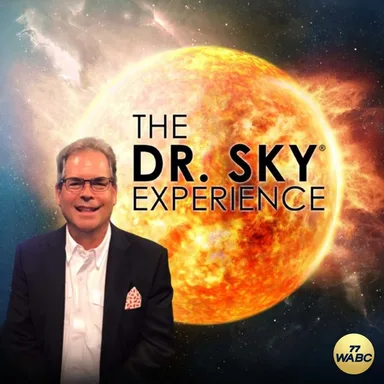
Steve Kates Space and astronomy broadcaster (Dr. Sky)
Japanese asteroid contained the building blocks of life.
Transcript
Automated transcript · uncorrectedWith us today is Steve Kates, otherwise known as Doctor Sky, and he’s with us every week and we look up in the sky and we say, well, what the heck is going on? Well, well we have doctor Sky to tell us, and he he engages on mind in so many ways. Steve Kate said, tell us what’s going on
this week?
Well, good morning, John, and happy Orthodox Easter to everyone listening this morning on this beautiful Sunday. Well, we want to start off with the mystery of the week. First, how about this? Where did organic molecules come from? On an asteroid? Well, here, this is an amazing story. Organic molecules.
John found in return mission samples from an asteroid known as Ryugu Japanese name it’s an apollo asteroid. The translation of Ryugu means the Japanese dragon God’s palace. But what do they find? This is material that was brought back to the earth, something called yourcill one of the building blocks of RNA as well as niasin B three. Sounds
like something you would take for your health. And how about this? All this on this diamond shaped asteroid three thousand feet in diameter, and this was collected by a Japanese spacecraft called Hayabusa two back in July of twenty nineteen. Now, if that doesn’t knock it out of it, let’s.
Just tell all the people, because not everybody knows. In other words, the Japanese had a a what do you call it, a space rocket land on this asteroid and transmit back the problem or the information or bring it back.
Well, it brought it back. It actually scooped up material from the surface of the asteroid brought it back, which is even more incredible. And the scientists examining like they did when they brought back moon rockets. I mean, we’re moon rocks from the Moon launches. We find out that they’re finding these organic compounds in this particular asteroid. So
what’s amazing about this? It goes to talk about this as something that’s very interesting. Our concept John, that’s called panspermia we’ve talked about it is that maybe from comets and asteroids, life was seated throughout not only maybe this Solar System, but throughout all of space. And it’s also another spacecraft that’s actually coming back Hyabusa too. I should say,
excuse me, we should talk about another spacecraft called Ocyrus Rex, which actually is bringing back material from an asteroid called Benu later this year. But imagine that vitamins like beat niacin B three, as far as this building block material of RNA. These are some great times to be talking about science. It’s amazing, It is amazing.
And I was talking to our mutual friend Frank moranoti O to day, Yeah, and he recorded this writer that wrote about Apollo one through eleven and got a lot of information on things that the Apollo astronauts have seen and weren’t allowed to disclose. Have you heard about that?
I have, John, And there’s many theories about that. I mean, some claim from the other side of the equation that there was actually some other spacecraft seen on the surface of the Moon, and some other objects that were maybe seen, as we call them today, und identified aerial phenomenon. So the point of the matter is when we talk about
asteroids that are seething life or seeding life out through the universe by comets or asteroids, this is just amazing. But closer to home, this is another subject that’s amazing. There’s now thought to be a large area of mountains and other ancient structures surrounding the Earth’s core. Geologists to talking about an extinct, ancient, ancient ocean bed some eighteen
hundred miles below the surface of the Earth, showing that the Earth’s interior is more complicated than one thought. So we’re learning so much as we expand people’s minds on this particular show on the Cat’s Round Table on Sundays, we’ve just begun to scratch the surface on all these subjects.
Of the bottom line to me, John, as life exists in many places in the universe, whether the Apollo astronauts saw something extraterrestrial or other encounters, Isn’t it just amazing to be able to think now in this age of twenty twenty three, that we’re just beginning to scratch the surface on what may be a very populated universe. As
we’re talking today.
I think there’s a lot more out there than we know. And Steve Kates hope, I hope we live long enough to find out something more than we know today.
I did, John. And to wrap it up, there’s so many things that people can see. This particular weekend, we find out that there’ll be on the other side of the Earth on April twentieth, what’s called the Total Hybrid Solar eclipse. We can talk a little bit more about that next week. You’d have to be over there in
that path to see it. Very unusual. But for the rest of us watching the skies, a meteor shower call the lyroids is going to open up be peaking on the morning of the twenty third, but still high in the east by a bright star Vega. You may get to see a few of these things. And this is
what we’re talking about, debris from comets which may have seeded life in the universe. You get to see them as shooting stars. More information always, John, as you know at WABC radio dot com for the Doctor Sky experience.
And again a happy Orthodox Easter to all those out there that’s celebrated.
Well, thank you so much. And I celebrate all religious holidays. You know why when it comes time to go to heaven, I want to make sure I cover role bases.
I’m with you, John, Thank you, and have a good Sunday.
Steve Kates, thank you, and keep expanding onlines. It’s a lot of fun. Thank you.
Always a pleasure. Thank you.
Sunday, April 16, 2023

No progress on the budget. Side-tracked by Judge selection.
Zach Williams Transportation Reporter, Bloomberg Government

The State's in a mess. Left-wing judges and no budget.
Ed Cox Chair, NY Republican State Committee
Happy Greek Orthodox Easter.
Fr. Alex Karloutsos Greek Orthodox Protopresbyter and Former Vicar General

Crime and the Justice Department.
Peter King Former U.S. Representative from New York
A lack of respect for U.S. leadership has led to a world predicament.
Newt Gingrich 50th Speaker of the House
The EPA is overreaching with electric vehicle mandates.
Former EPA Admin. Andrew Wheeler
World is facing a new alliance, Saudis, Russia, and China.
Mike Pompeo Former U.S. Secretary of State


Interviews: Robert Knakal, Founding Partner Massey Knakal Realty Services
Michael Stoler Real Estate Expert

Steve Kates
Deep-Space Mysteries, UFOs and the Orionid Meteor Shower
Steve Kates Space and astronomy broadcaster (Dr. Sky)
The Mysteries of Mermaids, El Niño and the Antarctic Ice
Steve Kates Space and astronomy broadcaster (Dr. Sky)
Exoplanet Radio Signals, SpaceX’s Heavy Rocket Test and Nuclear Propulsion
Steve Kates Space and astronomy broadcaster (Dr. Sky)
Supersonic Jets, SpaceX’s Next Starship Launch & Trump’s Golden Dome Defense System
Steve Kates Space and astronomy broadcaster (Dr. Sky)
The Science Behind Hurricanes, Cosmic Radiation and the Universe
Steve Kates Space and astronomy broadcaster (Dr. Sky)
Ben Franklin, Mars, and Asteroid Mining
Steve Kates Space and astronomy broadcaster (Dr. Sky)
