


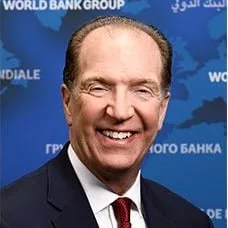
David Malpass Former President, World Bank Group
The Fed has many tools to confront inflation.
Transcript
Automated transcript · uncorrectedWith US today is David R. Malpass. He was Under Secretary of Treasury under Trump administration and then President of the World Bank from twenty US nineteen for a five year term ending April ninth. David Mauntpass, so many things happening in the world. You handled the entire world for the World Bank. Give us an update of what you
think is happening.
Hi, Jack. The growth is slowing on a global basis. That’s not surprising because you have high interest rates, but you also, I think, have this regulatory overhang worldwide. Governments are saying don’t produce, don’t produce. They’re trying to slow down the economy in order to bring down inflation. And it’s just not a good model at all. You need
more production in order to in order to help with this big inflation album. And so the burden I think is on the new politicians. In the US case, Kamala Harris has to say what is she going to do differently that that helps the US get out of the rut.
We’re in a rut where growth is you know, running two percent. For Reagan, it was running five percent. It was even running seven percent at the time that he was running for re election, So the burden is heavily on Harris to say, will you do anything differently on taxes, on energy, on regulation to get us out of the.
Rutuh the the but really maybe the inflation go up was what President Biden did would be oil industry.
He doubled the price of oil, which created thirty percent rise in food UH and now also the Suez Canal and the uh Red Sea is closed because a big uh Iranians. So the White House has created the inflation, and then the Central Bank has increased the rates to a degree where they’re trying to solve the problem that
the White House is created. Did I say it?
You did? This overlap from the government spending too into the monetary policy is really concerning. It used to be that there was some separation between the two. You know, Paul Volker talked about that if you, if you would do better on fiscal I could do I could have lower interest rates. But we’ve lost that. So the bet
is buying the bonds that the government issues, so that actually is almost like appeasement. It kind of helps the government keep up doing the proflicacy, the excess spending that they’ve gotten so accustomed to politicians love it and they want to stay in office, so they say, let’s spend money on it, and the FED then buys the bonds.
So we’ve got to break that apart and say, look, the Central Bank shouldn’t be shouldn’t be participating in fiscal access, but we’re we’re not doing that. And John, I want to come back to this problem, which is really a big one. On a global basis. Growth is slowing everywhere and that means more refugees, more countries that can’t afford
us goods, and so it makes the situation harder for us when the rest of the world is feeling the pain.
Understood. In addition, the influx of migrants in the European community, I think France in Germany have finally reached the level they don’t want to take it anymore.
They are they are not very good at incorporating people into their countries or picking ones for the skills. They’re trying to pick the skills that they need from immigrants. I’d say there is you know, on the Guddam side.
It means that like France’s population is not going to go down as fast as Italy’s because they take people from around their their previous colonies from French speaking Africa, and so that’s propping up the population some, but they need to get the skills for competitiveness. Look, Europe is really losing out in their ability to compete in the
rest of world. There’s one clear area, and I mean many clear areas. One is on energy. They just aren’t making energy. They could, but they aren’t doing it. Then the nuclear power would be really valuable, but Germany said no to that, and so they’re stuck importing natural gas from the US. Basically that it’s just not enough that
you can’t be competitive if you’re getting your energy from all the way across the ocean. And now the US can help support the world with better energy policies. If we could break through the nuclear regulatory barriers, that would be huge. If we could break through the pipeline barriers.
I don’t know if you saw that article earlier in the week about Texas. The pipelines our full. They’re making so much oil the pipelines can’t hold it. But the regulatory policy means they can’t build more pipelines, so you end up with oil prices back above eighty dollars a arrow.
The Biden administration has tied up the pipeline situation, which is the most efficient of delivering will. Meanwhile, the Biden administration the Democrats has also approved that the future of energy to replace oil someday, maybe over the next thirty forty years is SMOs a small modular reactors nuclear reactors.
Yeah, and you know, so I’m back to this. The burden is on Kamala Harris to say, what will you do differently than Biden? Because what he was doing did not work. We see that in the national debt. It’s gone over thirty five trillion dollars and they have no real plan to do anything different. When you let’s simplify
it down to the growth rate, they’re comfortable. They’re claiming that this is a good growth rate, and I’m saying it’s half of what we need. We need a sustained period of five percent growth, and we can do that.
That’s not out of line for economics. If you have good regulatory policy, good federal reserve policy, good energy policy, you’re going to get five percent and that’s going to mean better jobs for people across the country. And so the burdens really on her of what are you going to do different and unless she says it, and we
have to assume it’s going to be more of the same.
The other question is is the Federal Reserve winning too long to reduce interest rates? Because it’s not really the fault of the American people, it’s the fault that the White House has not done anything to open up the Red Sea and the Suez Canal.
You’re stating that correctly stated they’re stuck, and so they’re they’re in kind of a bind. The rest of the government isn’t doing what it needs to do to bring inflation down, and they’ve said that they don’t want to bring interest rates down until inflation comes down. So I think there’s different ways you can go at this. One
is the Fed could say that to the rest of the government, look where stuck. We can’t cut rates until you do better on your job. You can do what they’re doing now, which is wait for the economy to slow and inflation comes down fractionally and then you declare victory.
So that’s that looks like what the strategy is going to be. I think there has to be a full rework of the FEDS models so they so that they connect better the value of the dollar to the inflation rate to the production of the economy. And so there has to be a you know, a vision where you
can have interest rates be lower for lower, for longer, across the whole curve. One more point on this. What they’re doing is really bad for small businesses. They’ve got the short term rates high. That doesn’t hurt the big companies.
That hurt and it doesn’t hurt the government because the government, you know, just adds it to the national debt. They always get to borrow the money. So it hurts small businesses. And you see that across the country shelves that are empty inventories that that companies can’t afford, and it hurts their business so they shut down. So that’s in all
of the data is showing us this.
And what the Fed is not realizing by not lowering interest rates, it’s hurting the real estate industry, almost putting it the real estate industry in recession, which is creating a problem for the banks. They now have six hundred and seventy five banks on the watch list that might have to be.
Whatever exactly, And think of the illogic of you can’t afford construction loans, so you know, construction loans are some of the most valuable because you get started on a project, you have to grow something to get the materials, and then you finish the project and you sell it and they can get a mortgage or of you know, long
term financing from markets, so that you and so what we’re doing right now is choking off construction across the country of all different types. And let me do the flip side. If you fix that problem, meaning you create an environment where short term interest rates can be lower, then you immediately have this burst of activity that will
help everybody. Everybody finish the projects that they’ve been trying to get done. And that is within our reach. That’s why I, you know, I really think that a better fed policy can give us as much as two percent more GDP growth in the in not you know, not in the way in the future, in the near term.
By stating properly what causes inflation, meaning bad government policies, but also that you need small businesses to solve the inflation problem, they never say that.
David Malpass, former Undersecretary of Treasury under President Trump and and President of the World Bank, thank you so much for coming on and enlightening the American people on Sunday morning.
Thanks John, catch up real soon. Bye bye b.
Sunday, August 4, 2024

Mayor Adam's Choice for Corporate Counsel.
Randy Mastro Partner, Dechert LLP; Former NYC First Deputy Mayor

Report on Paris Olympics. Better to watch on TV.
Alfonse D'Amato Former U.S. Senator from New York

The Safe Hotels Act is not so safe for hotels.
American Hotel Association Pres. Kevin Carey

The assassination attempt has changed America.
Roger Stone Political Strategist & Consultant
Book: Risks and Returns: Creating Success in Business and Life.
Former Sec. of Commerce Wilbur Ross


Shawn Rosenthal, Vice Chairman, Debt & Structured Finance, CBRE
Michael Stoler Real Estate Expert

What Cities may become too hot to live in? Climate Change.
Steve Kates Space and astronomy broadcaster (Dr. Sky)

David Malpass
The Economic Strategy to Counter China
David Malpass Former President, World Bank Group
U.S. Strength Lies in Innovation and Energy Independence
David Malpass Former President, World Bank Group
Small businesses are key to economic growth.
David Malpass Former President, World Bank Group
Will the Fed finally move on to cut interest rates?
David Malpass Former President, World Bank Group
Trump has rearranged the world order of trade.
David Malpass Former President, World Bank Group
World Bank chairman discusses tariffs.
David Malpass Former President, World Bank Group
