


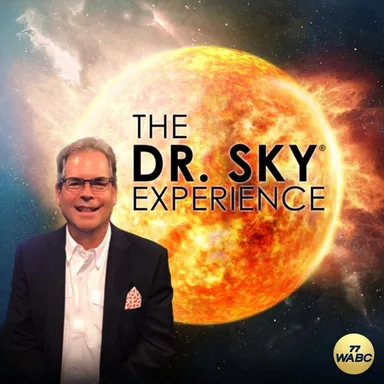
Steve Kates Space and astronomy broadcaster (Dr. Sky)
June skies in the night.
Transcript
Automated transcript · uncorrectedWith us this Sunday morning is Steve Kates, otherwise known as Doctor Sky, and he, well, every Sunday morning he makes a smile, look up in the sky and say what’s going on up there? And once in a while we look down and say what’s going on down here? Steve?
Where do we start today?
Well, John, good morning. As we move here towards Sunday and on Sunday, just a week away or so from the summer sautice. That’s another story, but John would talk about deep space radio astronomers, John, are finding out that there’s a strange signal coming from the universe. Now we’ve heard this before, but this particular signal repeats every fifty
three point eight minutes. Now what’s weird about that is that most of these signals that come from space repeat every few seconds. So nobody understands what this is. Why does the signal repeat every fifty three point eight minutes?
So embedded in this are three different radio signals. Now, some astronomers believe it could be from a neutron star. These are collapsed stars that spin like a light house. And if it happens to be that, the Earth, even though thousands and thousands of light years away, gets in the path of that beam, you’d get signals. So nobody
understands what this is. Further opening our minds on Sunday, John to some of the uniqueness and what strangeness of the universe. Interesting.
Well, the only problem is that Steve will never know because it’s going to take a zenion years to pull it down.
Absolutely, and John, closer to home, we’ll talk about Starliner. Finally. We know it got into orbit, moving and docking with the International Space Station, but they have some serious issues they’re trying to resolve them with helium leaks on the thrusters of that particular spacecraft. Why is that important Because if you’re sitting there with a joystick trying to dock
with the big space station, you know, the big hotel in the sky, that’s an issue. They’ve already docked, so now they’re never extend their mission up there, maybe an extra week. They’re going to do a space walk that’s probably already happened. But the interesting thing is they’re going to return, they say by June the eighteenth. Well, what’s
unusual about that, John, is that this particular crew will be the first NASA manned crewed vehicle that will actually land or come back on land. Now we all know the Russians do this all the time. America is always deployed and landed in the ocean like the Apollo. We remember the early Gemini and Murcury. So where’s it going
to come down? There’s a couple of landing sites that are selected, but more than likely in the desert southwest where I am White Sands, New Mexico. And what’s interesting about that, John, if you look on the map of White Sands, you can actually see that whole thing from space, so it’s an easier way to navigate your spaceship. So
that’ll be interesting. That’ll be the first manned crude landing of an American spacecraft. Quite it pretty interesting, don’t you think.
Now? Is it going to come down? Is it going to be dropped down by helicopters or is it going to land like the Space Show?
Well? No, it has a parachute system on it, which hopefully works. But what makes it not disintegrate when it hits the ground is this big bladder. It’s like an inflatable balloon if you want to call it. So hopefully all those things have to work in tandem. So this is quite fascinating because I’m unlike the Space Shuttle, which
was a type of aircraft spacecraft in one we know that this is quite an amazing feat for the American space program. All eyes will be on this particular mission.
To me, an amazing fleet is to take off on the same aircraft that you’re going to land with.
Well, absolutely, and that is in progress too, because there’s many other projects out there that we can talk about overully in the future about mini shuttles that actually can take off, let’s say, from rocket power and land and come back to say an airport or a designated location.
And Richard Branson has a concept like that, but they have to get above the ground of course, in an aircraft rocket type system. This is interesting, John, with Mystery of the Week we always talk about and you and I were kind of wondering if maybe we should talk about this and what is it? Where does the salt
in the ocean go? Where did it come from? Well, over the billions of years, we know from geology that volcanoes, rock formations, and all the other kind of things that have minerals in them added to what we know today as the salt in the oceans. So the question would become does the salt go up into the atmosphere or
does it stay in the ocean. Well, think about this one leader John of seawater has thirty five grams of salt. Now that’s a word that we look up, or a concept we look up in a book. But here it is.
If you were to get rid of this particular salt in the oceans, you’d be getting rid of forty five million billion tons of salt. Even though that’s not going to happen, thank goodness, it would cause potential earthquakes because it’s the reduction of the weight, which is heavier that salt water than regular clean, you know, rainwater. So the
final solution to this is the evaporation of seawater does not you know, reduce the salt. The salt stays in there. This evaporates up into the atmosphere. We know simply that it returns as rain water.
So it’s just if you’re stuck in a ship in the middle of nowhere and it does rain. So if you catch the rain that’s drinkable water instead of drinking the salt water.
Absolutely, it would be horrible. We’ve seen many movies. We’re down their plane pilots and you know people in World War two or whatever they are flying, or people who have been ships that they go out and they have no way to move the boat or propulsion. You’re obviously right, you don’t want to drink the seawater because there’s no
way for you to simply get rid of the salt content. That would be horrible to dehydrate you. So the evaporation which we see of moisture coming off the ocean, obviously it returns as clean water. So yes, you could drink that if you were sitting out there. But in many places around the world, rain like that is pretty infrequent.
In some cases. That’s an interesting story. But we wrap it up with the June skies. John, this is interesting that summer South coming up this week a major revenge as the sun reaches the highest point. Of course, kind of ironic. The Earth is farthest away from the song on July third, go figure when everything is so hot,
and the reason is the earth zor but is not round, it’s elliptical. And look for later in this week. The beautiful as we call it, the beautiful honeymoon, full honeymoon or full strawberry moon, adorning our skies, more information always, of course, and proud to be with you on the Cat’s round Table in this great radio station, the Doctor
Sky Experience where at WABC radio dot com, wishing everybody want great summer, beautiful skies and great health and God Bless America.
God Bless America. Thank you, Doctor Sky.
Sunday, June 16, 2024
The GOP will win back the House and Senate this year.
NY GOP Sen. Candidate Mike Sapraicone

Trump and his legal problems are a diversion.
Alfonse D'Amato Former U.S. Senator from New York

Migrant crime flourishes as NYPD struggles.
David Paterson Former Governor of New York

This is going to be a good year for Republicans.
Ed Cox Chair, NY Republican State Committee

Albany sessions end with congestion pricing shocker.
Zach Williams Transportation Reporter, Bloomberg Government

ISIS at our borders and Russian warships in Cuba.
General Jack Keane Retired Four-Star General, U.S. Army

Amnesty for illegal immigrants? ISIS at the border.
Ron Johnson U.S. Senator from Wisconsin



Steve Kates
Russian Satellites Track U.S. Spacecraft as Japan Targets Mars’ Mysterious Moon
Steve Kates Space and astronomy broadcaster (Dr. Sky)
Deep-Space Mysteries, UFOs and the Orionid Meteor Shower
Steve Kates Space and astronomy broadcaster (Dr. Sky)
The Mysteries of Mermaids, El Niño and the Antarctic Ice
Steve Kates Space and astronomy broadcaster (Dr. Sky)
Exoplanet Radio Signals, SpaceX’s Heavy Rocket Test and Nuclear Propulsion
Steve Kates Space and astronomy broadcaster (Dr. Sky)
Supersonic Jets, SpaceX’s Next Starship Launch & Trump’s Golden Dome Defense System
Steve Kates Space and astronomy broadcaster (Dr. Sky)
The Science Behind Hurricanes, Cosmic Radiation and the Universe
Steve Kates Space and astronomy broadcaster (Dr. Sky)
