


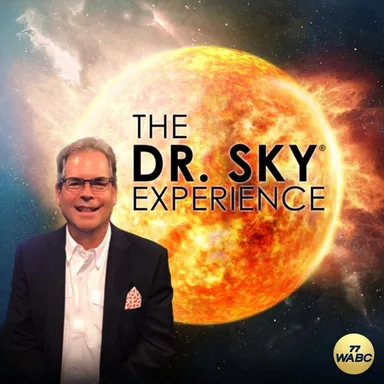
Steve Kates Space and astronomy broadcaster (Dr. Sky)
A New Comet Discovery and Humanity's Return to the Moon
Transcript
Automated transcript · uncorrectedSunday morning. What is this Steve Kates otherwise known as Doctor Sky and Steve give us your input. What’s interesting that’s going on.
Up then, well, good morning and happy Sunday to you and the listeners. John, we talk about comments. Many people may not realize this. They’re the last material after the creation of the Solar system, allegedly here four and a half billion years ago. But here’s some news, maybe it’ll be breaking news. A new comet’s been discovered. The acronym
maps for a large telescope that’s found this object. It’s what they call a sungrazing comet, discovered back on January thirteenth. John, it’s a group of comets known as crutz comments. These are comets that get close to the Sun. At the bottom line for our viewers, we may have this incredibly bright comet visible in the sky probably sometime maybe in
early April. We’ll have to see what the comet does. But back in nineteen sixty five, John, we had another comment called Tsseki and that comment was as bright as half a full moon. So we never know, but this may be an awakening for people that have not seen these celestial signs of the sky. Thought it’s important to
report it on the cats, right, and.
You know you’re absolutely right. But you know, we look at the comments and we know what they do. But it’s hard to envision these things just going out for thousands of years, billions of miles and just goes on forever.
It’s just it’s mind boggling.
It sure is. On the creation of holes. Is imagine born and a half billion years ago on a universe that we think was created thirteen point eight billion years But John, the story continues as we get closer in the news. A milky way we know has a giant black hole or object like that at the center of
the galaxy that’s twenty seven thousand light years away from us to be exact. But John, this particular black holes allegedly eats stars for breakfast. So imagine our Sun’s nearly a million miles in diameter eight hundred and sixty five miles to be precise. But now astronomers think another mechanism may be responsible for this. On a side note, John,
we only see four percent of the entire universe. That’s what they call baryonic matter. So astronomers are trying to figure out two very strange parts of quantum physics. One is dark matter and the other one is dark energy.
So simply, astronomers say that this particular mechanism in the center of our milky ways may be fueled by something in gravity, which is called dark matter. And dark matter, John compromises twenty seven percent of the universe, and the other strange one, this is sixty eight percent of the universe, is even more bizarre, something called dark energy. Boy, do
we have a lot to learn, don’t you think?
Well, I don’t think we know anything about anything, and it’s such a big universe, and I wish we knew the truth. I wish in our lifetime we’re going to get to learn the truth.
Well, I’m going to be. But here’s one, John, that’s really off the charts. We always end off proudly with the mystery of the week. Here’s the question, what’s the most expensive substance in the universe? John? The strange one is called antimatter. Now, one gram of antimatter, if you could actually see it created, would be worth sixty two
point five trillion dollars. I don’t know where they get the number from, but some figures say it could be as high as twenty seven hundred trillion dollars. Is this bizarre? Well, only tiny amounts have ever been created in this thing called tiny nanograms. But the problem is, John, it must be stored in advance magnetic traps or it collapses when
it hits normal matter. You get a collision. John, that’s called pure energy. Can you imagine that a power source for the future, something as bizarre as antimatter. That’s a real strange one, don’t you say?
I’m still looking how we get to whoop speed?
That’s exactly right. Well, in Star Trek they gave us the concept, but they never gave us the formula. So we’ll have to see June just now.
And we’ve got to wait till least the twenty second century or something in twenty third century.
Right, we have to be pat Well, when are.
We going to the well? First step? When are we going back to the moon?
Well to go in March, Artemis two is going to take four astronauts around the moon like Apollo eight did. But John the landing on the moon. And this is a very nebulous answer, but I always give you truth.
They don’t really know, but they’re saying, Artemis three, John could land on the south pole of the Moon as early as maybe twenty twenty eight. Some overly zealous individuals overly optimistic said twenty twenty seven, I don’t think that’s possible.
China may beat us there because they seem to have a more focused space program right now. But then again, John, you never know, we might pull a rabbit out of somebody’s hat and surprise everybody. That’s an interesting story which will continue, and we always remind everybody to listen to the Doctor’s Sky Experience with these answers and more. Again,
we move into Friday midnight Eastern time to two am Saturday, and then we do it once again proudly Saturday midnight to two am Sunday, right here, John, and we have you to thank for permitting me to be behind that microphone.
Thank you, Steve Kates, Thank you so much, and we’ll talk again real soon
Sunday, February 15, 2026
The NYPD Has Made Strides in Modernizing Their Force
Jay Clayton Director of National Intelligence

How Foreign Billionaires Quietly Influence American Democracy
Scott Walker President of Young America's Foundation

The Ways and Means Committee Is Tackling Foreign Money in American Politics
Jason Smith U.S. Representative from Missouri

The U.S. Economy Is Booming and Will Enter the Next Phase of Growth
Steve Moore Economist; Co-Founder, Committee to Unleash Prosperity
Creating an Investigative Documentary About Canada's Killing of Healthy Ostriches
Drea Humphrey
Why the U.S. Is Massing Military Power in the Middle East
General Jack Keane Retired Four-Star General, U.S. Army


The Fentanyl Free America Strategy and the Fight to Save Lives
Frank Tarentino DEA Associate Chief of Operations, Northeast Region


Breaking Down the Dynamics of the New York Gubernatorial Race
Jesse Arm Vice President of External Affairs, Manhattan Institute
Offshore Wind Farms Threaten Fishing Communities
Bonnie Brady Executive Director, LI Commercial Fishing Assoc.

New Jersey's 11th District Special Election Has National Implications
Christine Hanlon Chair, New Jersey Republican Party

A Healthy Environment and Smart Cooking Habits Lead to Long-Term Health
Dr. Peter Michalos WABC Medical Expert



Steve Kates
Russian Satellites Track U.S. Spacecraft as Japan Targets Mars’ Mysterious Moon
Steve Kates Space and astronomy broadcaster (Dr. Sky)
Deep-Space Mysteries, UFOs and the Orionid Meteor Shower
Steve Kates Space and astronomy broadcaster (Dr. Sky)
The Mysteries of Mermaids, El Niño and the Antarctic Ice
Steve Kates Space and astronomy broadcaster (Dr. Sky)
Exoplanet Radio Signals, SpaceX’s Heavy Rocket Test and Nuclear Propulsion
Steve Kates Space and astronomy broadcaster (Dr. Sky)
Supersonic Jets, SpaceX’s Next Starship Launch & Trump’s Golden Dome Defense System
Steve Kates Space and astronomy broadcaster (Dr. Sky)
The Science Behind Hurricanes, Cosmic Radiation and the Universe
Steve Kates Space and astronomy broadcaster (Dr. Sky)
