


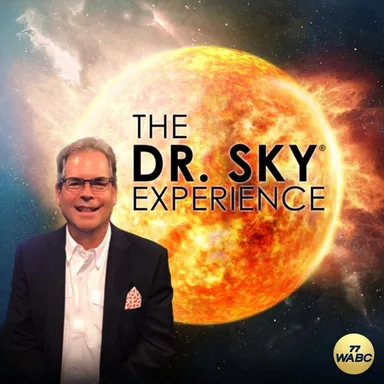
Steve Kates Space and astronomy broadcaster (Dr. Sky)
The great solar eclipse April 8, 2024
Transcript
Automated transcript · uncorrectedWhat is this morning is Steve Kates otherwise notice doctor Sky and he brightens up our Sunday mornings by giving us all kinds of adventurous things that are going on in the skies. Well, Steve tell us what’s going on?
Well, good morning, John, Good to be with you on Sunday morning. As always, we begin with weather. Here’s something strange. It’s called the polar vortex, and it’s spinning backwards. But what is it? John, of polar vortex is a low pressure area in the upper atmosphere in both poles, causing cold air to circulate around the poles. But it normally
flows in a counterclockwise rotation. But here’s the news scoop. But as of March forth, John, it’s been turning the other direction, and meteorologists and scientists think it’s caused in part by what we call planetary waves, gravity waves like ripples in the atmosphere, like currents in the atmosphere. But the change in direction, John, of the polar vortex may
not be due to many of the things that we think are just meteorological. And here we go, it’s possibly due to an increase in ozone. In the polls. We’ve heard that. But it even gets more interesting. It may be due to solar activity on the increase come out this tsunamis on the Earth and earthquakes that actually force
these gravity waves around the world. What does that big anomaly mean. It means that in this particular case, the weather is getting stranger and it may not just be about climate change. John, what do you think, Well, I don’t know anymore.
And the Earth, like we always said, the creator, whoever created this world, has created it to adjust itself. So anytime there’s a problem the Earth, it has hurricanes, earthquakes, tornadoes, because what the purpose of that is is to adjust anything it needs adjusting. What do you think anything else?
Well, John, it’s interesting. It’s like the Earth naturally and I agree with you as a healing process that we’re still trying to figure out. But quickly, as time permits, we’ll go to SpaceX. Did you know, folks that SpaceX has launched twenty six rockets so far in twenty twenty four, and that’s just some eighty four days. They’ve launched twenty
five Falcon Nines, one big Starship and the last starship three. John got the Starship spacecraft into an orbital position, and of course they’re still experimental. But the next one get a little bit. This Starship four is set for launch probably as early as May, known as IFT four. But John, here’s something fascinating. Every week we talk about the mystery
or the where did the moons of Mars come from? Now a new theory is kind of interesting, and here it is. Those two objects, Gamos and Phobos. Some think are artificial moons, some think they’re captured little asteroids. But recent indications say that a long time ago, Mars was hit by another large planetary object and it blew material out,
thus forming these moons. Now why do they think that? Because some of the surface material of Foos, the larger of the two moons, John has a basaltic, leaning rock like condition, very synonymous to what the surface of Mars is like. From the rovers. What we know, but we’ll have to wait till twenty twenty five when we find
out when the Japanese send this interesting mission to these Mars moons, Japan’s Mars Moon Exploration mission. Now that is quite fascinating, and isn’t that amazing, John? The moons of Mars I’ve always been intriguing, and they still are today.
I think there’s more to than meets the eye. Many a time, we have never been successful on landing a craft on any one of those two moons, Is that true?
That is correct, John. It’s a strange thing because the gravity there. If you and I were standing on one of those moons, you almost could jump off the surface and go out into orbit. So they’re small, they’re obviously in motion close to the planet Mars. But we’ll have to see.
And the big mystery, the big mystery are the Martians that escaped Mars living in those moons. Someday, someday we will find out. But that’s what Sunday mornings are for, is to dream and to think about things like that.
Right, John, and we wanted to just mention real quick the solar eclipse only fifteen days away. But here’s some quick tips. If you have a smartphone, whether it’s a PartiallyClips or total, get a tripod, put your camera on there and phone and get a solar filter for it.
Lot the focus at totality so that it doesn’t wander. And for those more technical, use what’s called the burst mode. That means you press the button on your camera and it shoots many pictures in a few seconds, shoot in what’s called the raw mode, so you can edit those pictures better and simply no handheld videos of the eclipse.
Learn more. As always at the Doctor Skuy Experience, we have some grad eclipse updates at WABC radio dot com. John, it’s always a privileging a hontor to be on the Cats Round Table with the listeners here and around the nation.
Well, Steve Kates, doctor Sky, thank you for updating this this Sunday morning and making our Sunday morning a little bit brighter. Well with three clips, maybe maybe a little bit darker.
So John, we’ll be talking about that morn next week. Thank you.
Sunday, March 24, 2024
Governor Hochul still facing crime problems despite the National Guard.
David Paterson Former Governor of New York

Both the City and state are facing severe budget problems.
Hank Sheinkopf Political Consultant

Senator Menendez will not run as a Democrat.
Eric Shuffler Founding Partner, River Crossing Strategy Group

The time for electric vehicles has passed.
Steve Moore Economist; Co-Founder, Committee to Unleash Prosperity

Israel's continued bombardment of Gaza.
John Bolton Former U.S. National Security Advisor

Invasion on the southern border.
Tommy Tuberville U.S. Senator from Alabama; nominee for Governor

This week's guest: Andrew Goldberg, Vice Chairman, CBRE
Michael Stoler Real Estate Expert

Heavy metals and your health. Mercury and arsenic levels.
Dr. Peter Michalos WABC Medical Expert
Steve Kates
Russian Satellites Track U.S. Spacecraft as Japan Targets Mars’ Mysterious Moon
Steve Kates Space and astronomy broadcaster (Dr. Sky)
Deep-Space Mysteries, UFOs and the Orionid Meteor Shower
Steve Kates Space and astronomy broadcaster (Dr. Sky)
The Mysteries of Mermaids, El Niño and the Antarctic Ice
Steve Kates Space and astronomy broadcaster (Dr. Sky)
Exoplanet Radio Signals, SpaceX’s Heavy Rocket Test and Nuclear Propulsion
Steve Kates Space and astronomy broadcaster (Dr. Sky)
Supersonic Jets, SpaceX’s Next Starship Launch & Trump’s Golden Dome Defense System
Steve Kates Space and astronomy broadcaster (Dr. Sky)
The Science Behind Hurricanes, Cosmic Radiation and the Universe
Steve Kates Space and astronomy broadcaster (Dr. Sky)
