


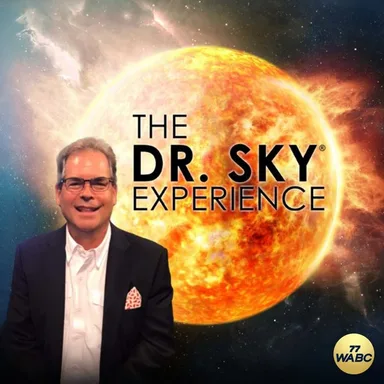
Steve Kates Space and astronomy broadcaster (Dr. Sky)
First images of atones.
Transcript
Automated transcript · uncorrectedSunday morning. Well with us today is Steve Kates, otherwise known as doctor Sky, and he entertains us every Sunday morning because when we look up in the skies, what’s up there? Where did it come from? Where are we going? Well, Steve Kates give us a briefing for this Sunday morning.
Well, good morning, John, and to you and all the listeners around the world. Here we go into the more micro world. We know the universe is filled with atoms. These there’s little particles that kind of run around, keeping it simple, around the nucleus of other parts of the atomic structure. I guess what right now? Physicists have actually
identified by imaging, John, what they call free range atoms. What’s that? These are atoms that float out and away from you know, individual elements. And how did they do it? They use this incredibly powerful We would call it, for simplicity, a microscope of sorts. But what’s so incredible about this is looking deeper into the quantum world world. In other words,
what’s really behind these atoms? What’s really about the structure of the universe. And just to give you an idea, these particles are just the tenth of a nanometer. Now the nanometer is a billionth of a meter. So the world in the universe is much more complicated, filled with these things called atoms. From the creation of the universe
about thirteen and a half billion years ago, amazing imaging.
Now nobody really understands the atoms. They don’t they it’s so hard to understand in what is the what makes up the atom?
Well, we really don’t know, John, I mean this is always truth here on your show and every show that I’m part of around here. And this is interesting that when we go back to the Greeks, this tiny term at homos, which means this is smaller than the visible eye.
To keep it simple, nobody really understands what it is they have charges. They obviously have some sort of repulsive or attractive force. But the more of these particular atoms that surround the different elements with all protons and neutrons help to give them more mats. So if you look at the atomic table, these are some of the basic
you know, the basic of most basic ingredients. But when the universe exploded, John, as we call the Big Bang thirteen point seven billion years ago, trillions, and my number is even small by comparison of these tiny subatomic particles.
But why in perspective is this important. It’s because really nobody understands the true definition of what’s in the quantum world. We’re learning every day about the mysteries such as these tiny things called atoms. A most amazing story for sure.
And when you and the amount of energy when the old words split the atom and it creates an atomic bomb, the amount of energy released is unbelievable. I guess that’s you know.
It comes back to the this is something absolutely and we talk about this fission of the splitting of atoms, not necessarily what we now talk about with the sun infusion, but just think about this. Allegedly the temperature at the base point ground zero of the nuclear weapon is reaching a million degrees fahrenheit. And you’re so right. Once these atoms,
you know, in the fission process with uranium and plutonium, they get just out of control. And obviously this is something like the power on a different way. The stars run on fusion, but unimaginable amounts of energy. And speaking about the universe, here’s another interesting update. The Milky Way may contain one hundred billion stars. That’s just our galaxy.
Down among trillions of galaxies. But astronomers are now saying, based on estimates, that around seventeen percent of the stars in the Milky Way may harbor at least one Earth size. Got to be careful, not Earth like, lifelike planet, but eyes like the Earth. And if you do the math with an estimated hundred billion stars in the Milkie Way,
that means there could be a minimum seventeen billion Earth sized planets. John, that’s just in this Milkie Way. Isn’t that just mind boggling?
Mind boggling, Mind boggling? What else you have for us this Sunday morning.
Well, we got a mystery of the week always, and this one’s fascinating. The Russian Space Agency reports that they have developed a more powerful version of what scientists call a magnetic plasma accelerated simple English, it’s a rocket engine of the future. And how they do this, it’s a long story, but we’ll make it simple. We talk about
this particular concept where you can actually get a magnetic field where you place electrodes over two different areas in which you’d find a force coming out of this. This is not a chemical rocket by any means. So if you’ve thought about this as they have, and people think about it. Right now, chemical rockets would take us nine
months allegedly to get Mars, but if you could develop these plasma type rocket motors, you would be able to do this. It’s based on two electrodes. These charge particles pass between them and high voltage is then applied to the electrodes and that current creates a magnetic field, John, which is called the whole effect in science. And what
is that. It obviously generates a force for you could push a rocket, so you just have to build it on a larger scale. That’s the problem. But right now, John, they’ve developed the whole thrusters, and this is always interesting.
The propulsion is still too small. It’s only capable of lifting a piece of paper at this point. But if you could develop large scale plasma rockets, you could theoretically get to Mars in months, John, and not years. So the future looks bright. Experiments continue, and obviously we’ve just touched the tip of the proverbial rocket motor Iceberg at
this point in time.
Well, I always look forward listening to you on Friday nights at midnight and Saturday nights at midnight, which is Saturday morning and Sunday morning. You’re on from twelve o’clock to two o’clock, the whole country leading. You know you’re being led by WABC and yes, well those they can’t you keep me up all night.
Well, it’s an honor to be there, John, and I just want to talk very quickly in space history. On this date May eighteenth, nineteen sixty nine, fifty six years ago, many of us weren’t even born. Apollo ten launched to the Moon. That was the dress rehearsal for Apollo eleven, and those two astronauts who descended with the lunar module
got down to about fifty thousand feet John, and then they had to come back up. Imagine being those two when you’re that close to the Moon. They could have been the first, but it wasn’t their time yet we know Apollo eleven did it. A great Sunday to you and all the listeners. As we always remind people, well,
I always remember to keep your eyes to the skies, your planets in the morning sky Venus before sunrise in the southeast, and Mighty Jupiter in the northwest. John at sunset, have a great thank you you too,
Sunday, May 18, 2025

Putin skips peace talks in Ukraine.
General Blaine Holt Brigadier General USAF (Ret.)




Book coming out on President Biden. Trump's Saudi trip.
Peter King Former U.S. Representative from New York

Trump has rearranged the world order of trade.
David Malpass Former President, World Bank Group



Does Putin plan to march across NATO countries?
Matthew Whitaker U.S. Ambassador to NATO

Trump's extraordinary trip to the Middle East
Kevin McCarthy 55th Speaker of the House



Your genes and longevity. Fixing broken genes is coming soon.
Dr. Peter Michalos WABC Medical Expert
Steve Kates
Deep-Space Mysteries, UFOs and the Orionid Meteor Shower
Steve Kates Space and astronomy broadcaster (Dr. Sky)
The Mysteries of Mermaids, El Niño and the Antarctic Ice
Steve Kates Space and astronomy broadcaster (Dr. Sky)
Exoplanet Radio Signals, SpaceX’s Heavy Rocket Test and Nuclear Propulsion
Steve Kates Space and astronomy broadcaster (Dr. Sky)
Supersonic Jets, SpaceX’s Next Starship Launch & Trump’s Golden Dome Defense System
Steve Kates Space and astronomy broadcaster (Dr. Sky)
The Science Behind Hurricanes, Cosmic Radiation and the Universe
Steve Kates Space and astronomy broadcaster (Dr. Sky)
Ben Franklin, Mars, and Asteroid Mining
Steve Kates Space and astronomy broadcaster (Dr. Sky)
