


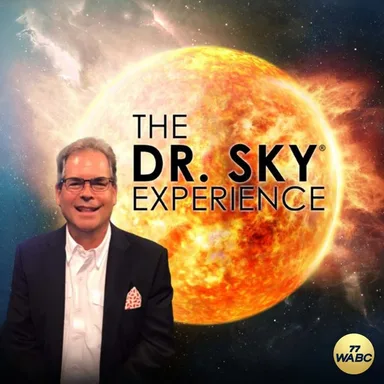
Steve Kates Space and astronomy broadcaster (Dr. Sky)
Laser Communication Is the Future of Data Transfer
Transcript
Automated transcript · uncorrectedSunday morning. Well with us today is Steve Kates, otherwise known as Doctor Sky, and I always love those mysteries he talks about, and I always love his stories about the Moon, about Mars. What are we talking about today.
Steve, Well, John, good morning to everyone. Happy Sunday morning. But we go right into it. We’re talking about an amazing feat. China sends a laser signal out from twenty two thousand miles in space down to the ground with a two watt laser. How many people may go, well, what the heck’s the purpose? We were finding out that
more NASA, the Chinese Space Program, and the Russians have actually been utilizing this vehicle of communications, speaking or getting data on a light beam. So China did this about a year ago and now it’s just coming to the surface.
There was one gigabyte per second of downloadable data from way out there, which is called the geosynchronous area, and they’ve mastered something John, that’s very hard to do. When that signal comes down laser in the infrared, it has to penetrate the atmosphere, so the atmosphere just like you’re looking through a fish tank. They figured out mathematically with
something called adaptom optics how to do this, But this isn’t the first time that we’ve used this. America takes the lead in my opinion. A psyche spacecraft John, that’s way out there headed to this asteroid actually sent a signal the same technology back in December of twenty twenty four from three hundred and seven million miles. So guess
want a new vehicle for communicating in space in the future. As it’s coming about is being able to get data transmitted on an infrared laser. That’s amazing.
Now the most important thing is it faster? Absolutely? How much faster is it? Is it? Well?
John? Really truly, this is how we answer this and always truth. Radio waves travel at the speed of light, and these lasers do. But here’s the problem with the old communication radio. You don’t have the ability to download as much data. So the true answer is they’re traveling pretty much at the same speed. But look at all
the amount of data that you can get off of a laser, which is the whole point of the conversation that in itself is really not earth shattering.
So more data, more data at the same speed.
Though, absolutely, John, And you know this is going into deep Conversation with Space. In this edition we find out we know about Artemis the Moon mission. We’re trying to land there maybe in twenty twenty nine, we hope with the manned spacecraft. But there’s something called the Artemist Accords.
What’s that? That’s in the State Department have been working out where seventy countries have signed this non binding political agreement so that they can cooperate in space. I know that sounds hard to believe, but the interesting part about this is it’s all due to cooperating with astronauts and rescues in space and coordinating the global problem of space junk.
But John, guess what two countries haven’t signed up on this, which is pretty much obvious. We look at Russian and we look at China, but the rest of the world seems to be going along trying to figure a way to all get along in outer space. And there’s a lot of legal things that will be coming up, for instance,
who owns the Moon? How do you even take claim to that? These are issues that need to be solved. But we saved the best for last, John, the mystery of the week. What is a space gun? Now many people may think we’re talking ray guns. But this is interesting, Harp.
It’s a project called the High Altitude Research Project. This has been years ago. There was a giant sixteen inch gun with one hundred and nineteen inch barrel and guess what it did, John, It actually shot a projectile up and into space. Space begins at sixty two miles above the Earth. This one reached one hundred and twelve miles
up in space. And it was actually set up on the islands of Barbados. And people may wonder, why would you do that in that tropical paradise. Well, you get to the equator. When you launch something into space, you send it to the east. The speed of rotation of the Earth is fastest at the equator. So whatever projectile
you’re launching or shooting into space, the extra velocity of the iris rotation helps that to get up and away from the Earth. So a ground based gun has actually done something incredible. I find that totally amazing.
Now, one more thing, I understand that Elon must Nassa release some pictures a few days ago of Elon Musk’s rocket hitting the Moon, and I remember a couple of people, including you, were scratching ahead about that because you were watching on your on your telescope.
Yes, sir, absolutely, yes, John. What we know from orbit there’s a spacecraft called Lunar Reconnaissance Orbiter, and there’s a Korean satellite they found and took pictures before of this hit the Moon, and they took pictures after. But whatever that you know, crater that this rocket, you know, when it’s landed to the Moon created get a load of this.
It’s allegedly sixty feet in diameter from an object that’s only about maybe forty or fifty feet long. So the point is a rocket body like that can produce a lot of damage on the surface of an object, obviously the Moon. And this is good because in the future when asteroidal impacts come and other things like spacecraft, we
need to protect the astronauts on the Moon obviously. So that is a late revelation. It’s a sixty foot crater made by Elon Musk Booster rocket. Amazing stuff.
Thank you so much, and I look forward to listening to you every Friday night midnight to two am and every Saturday night midnight to two am. And God bless you and God bless Mark.
Thank you John for the opportunity, and always remember keep your eyes to the skies, have a great Sunday
Sunday, August 23, 2026
Expanding American Energy Production to Lower Costs and Strengthen the Economy
Lee Zeldin EPA Administrator

Iran and Ukraine Are Creating New Challenges for Global Security
General David Petraeus Former CIA Director & Four-Star General

New York's Green Energy Push Is Threatening Grid Reliability
Claudia Tenney U.S. Representative from New York

Investigating Allegations of Non-Citizens Voting in New Jersey Elections
Jeff Van Drew U.S. Representative from New Jersey

Returning Education Control to States and Restoring Title IX Protections
Kimberly Richey Asst. Secretary for Civil Rights, U.S. Dept. of Education
The Rise of Black Candidates and the Changing Landscape of American Politics
David Paterson Former Governor of New York

E-Bike Recklessness Is Creating a Public Safety Crisis
George Borrello Senator from NY

Florida Is a Beacon of Freedom and a Stronghold for Conservative Values
Evan Power Chairman, Republican Party of Florida

From Baseball to Politics and the Fight to Preserve a Republican Majority
Mark Teixeira Nominee for Congress, TX-21; Former MLB Star

Democrats Are Losing Voters by Ignoring Affordability
Jerry Kremer Former NY Assemblyman & Political Columnist

A Common-Sense Republican Campaign Focused on Public Safety and Tax Relief
Michael LiPetri Nominee for Congress, NY-3; Former NY Assemblyman

Greece Faces Growing Tensions With Turkey and Rising Security Challenges
Prince Pavlos Crown Prince of Greece

Taxes and Regulation Are Driving Entrepreneurs Out of New York
JT Foxx Entrepreneur & Investor
Inflammatory Words Can Fuel Violence and Hate
Angelo Vivolo CUNY Trustee; Restaurateur & Philanthropist

The Growing Threat of Antisemitism and Violence Against Houses of Worship
Karen Schneier Dresbach EVP, Appeal of Conscience Foundation



Delaying Smartphones Can Protect Children From Online Dangers
Lynn Shaw Founder of Lynn's Warriors

Retail Results, Bitcoin Gains and Major Economic Developments
John Terrett WABC Financial Analyst
Steve Kates
Deep-Space Mysteries, UFOs and the Orionid Meteor Shower
Steve Kates Space and astronomy broadcaster (Dr. Sky)
The Mysteries of Mermaids, El Niño and the Antarctic Ice
Steve Kates Space and astronomy broadcaster (Dr. Sky)
Exoplanet Radio Signals, SpaceX’s Heavy Rocket Test and Nuclear Propulsion
Steve Kates Space and astronomy broadcaster (Dr. Sky)
Supersonic Jets, SpaceX’s Next Starship Launch & Trump’s Golden Dome Defense System
Steve Kates Space and astronomy broadcaster (Dr. Sky)
The Science Behind Hurricanes, Cosmic Radiation and the Universe
Steve Kates Space and astronomy broadcaster (Dr. Sky)
Ben Franklin, Mars, and Asteroid Mining
Steve Kates Space and astronomy broadcaster (Dr. Sky)
