


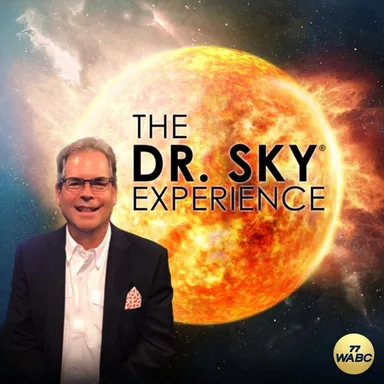
Steve Kates Space and astronomy broadcaster (Dr. Sky)
A huge sunspot could interrupt communication.
Transcript
Automated transcript · uncorrectedWell as Sunday Special. Steve Kates, doctor Sky is always with us and he brightens up our day on the weekend, especially because we look up in the skies and we wonder what the heck is up there. Steve Kates, doctor Sky, what’s in store for us this week?
Well, John, good morning to you and the listeners in a happy Mother’s Day to all the proud mothers around the nation, around the world. But last week we were talking about solar cycle twenty five, and here’s the latest update. John.
Last week, as you probably know and some of the other listeners had heard this, twenty eight flares on the Sun in twenty four hours just a few days ago. We don’t think this is unexpected because the solar cycle naturally is picking up. But John, this is one of the largest sunspot groups ever seen in sunspot cycle twenty five.
It’s called Active Region thirty six sixty four. What does it mean. It rivals the sunspot group in eighteen fifty nine when the Great Carrington event took place and that caused havoc around the world. The sun spot, just to be accurate, is about one hundred and forty thousand miles long.
Now that’s a massive size object on the Sun. But the big problem when these solar flares hit him. By the way, there are four CMEs not to alarm people, that are scheduled to either hit the Earth the atmosphere, probably giving us aurors. They call it a G three solar storm. Who knows the beauty of it is you
may get to see auroras and places in far southern latitudes of the United States. But John, who knows, not to be a pessimist, but the solar flare activity, indeed, we’re expecting something to happen. We haven’t had a big kill shot or anything like that. We’re overdue for this, at least according to the astronomers.
So are we talking about possibly losing a grid or losing some satellite? So what are we talking about?
Well, it’s a combination of all things. And always to be an optimist here, but reporting accurately. If we had the same energy that came out of the eighteen fifty nine of that called Carrington and again, it could very well disrupt our digital world in ways that we have really no way to prepare for. You know, people talk
about electromagnetic pulse weapons in the atmosphere from rogue nations that would shut us down. Well, Mother nature could do that itself, so there’s not much we could do about it. And that’s the interesting part about this whole story, the solar cycles kind of belching out a lot of energy.
The Sun’s done it for billions of years. So simply on that topic, we’ll keep you posted. But John, you and I have talked about something over the years that we’ve been doing this show. Proudly, here’s something that needs to be answered. What are cosmic rays? And we’re hearing more about this. They’re high energy proton particles from space.
They’re made by stars. Our own sun does it. But it was actually discovered in nineteen twelve by a person who later got a Nobel Prize, Victor Hess, when he sent a balloon experiment up. Simply, they’re harmful to astronauts on long duration missions. But the amazing thing that people may go, wow, I never knew that, doctor Sky, is
that millions of these low inner ge cosmic rays actually passed through our bodies all day long with no harm as the atmosphere protects us. But in deep space missions that’s something of great concern. That’s an important topic, John, in future space travel.
I agree with you. Now, the Moon, Mars, Jupiter, what else?
Well, John, there’s so much to talk about, but the moon. China’s Chunga six spacecraft is now orbiting the Moon. It’s going to set down on the Moon, hopefully in the next few weeks, and scoop up on the far side of the Moon on a crater called the Achenbasin and try to bring back maybe four pounds of material. What’s
interesting about that is that it’s never been done before in the sense of landing. The United States hasn’t done it on the far side. But don’t forget a closer to home mission called NASA’s Starliner, the spacecraft that had a faulty valve, is now scheduled to launch by May seventeen.
But John, we always end off on the subject of the mission.
Tell me, honor, tell our audience one more vibe. What is Starliner doing and what is this schedule to do today and in the future.
Well, great question, John, Starliner is by a Boeing project, and it’s also to get astronauts and cargo to the International Space Station. And this mission, which would be the first crude mission of Starliner built by Boeing, it’s a very sophisticated spacecraft costs a lot of money. So in simple terms, we have the ability now to stand astronauts
up and down to the space station. Other companies have done this because for so long, John, we’ve been plagued by the problem of having to use the Russian Soyu’s is the only way to get the space to the ISS.
So we wish them great success on that particular mission. But while I was mentioning before, John, my mystery of the week is honor of mothers all over the world. But here’s a question. It would be considered the mother of modern astronomy, well, in my opinion and many others, doctor Nancy Grace Roman. Who is she? In the nineteen
seventy she became the first chief of the Astronomy Department or office at NASA. She helps secure funding for the Hubble space telescope, and she was often called the mother of Hubble. Ba Reuben, another astrophysicist, also should be considered in that area of fame because she talked about dark matter, something that we really don’t understand. But to the many
other women and mothers out there, of course who maintain and talked about these particular subjects about science, and space. We salute all mothers, but I thought it a good tribute to talk about some that have done this in the area of science and space.
Well, Steve Case, thank you for coming on this Sunday morning, and we wish you a great day. And are you visiting. I hope your mom is still around.
Oh John, my mom passed on, as I like to call it, the infinite, many years ago. But on family and friends, we do have other folks that we’ll be celebrating with, and especially the mothers of the young children that we have in our family and many of the grandchildren of others in my family. So like with you
and everyone else out there, we cherish our mothers as we do our fathers, and obviously John, it’s an honor to be able to talk about these subjects here on the Cat’s Roundtable.
Thank you, Steve Takes, and we’ll catch up with you again real soon. Thank you.
Thank you, John
Sunday, May 12, 2024


Bodega workers have a right to defend themselves and their business.
Fernando Mateo President, NY State Federation of Taxi Drivers

Will Biden be replaced as nominee? Is RFK Jr. influencing the race?
Dick Morris Political Strategist and Author

Inflation is creeping back, and the Fed seems helpless.
Steve Forbes Editor-in-chief of Forbes


Border crisis has reached an alarming level.
Marsha Blackburn U.S. Senator from Tennessee; nominee for Governor


Steve Kates
Russian Satellites Track U.S. Spacecraft as Japan Targets Mars’ Mysterious Moon
Steve Kates Space and astronomy broadcaster (Dr. Sky)
Deep-Space Mysteries, UFOs and the Orionid Meteor Shower
Steve Kates Space and astronomy broadcaster (Dr. Sky)
The Mysteries of Mermaids, El Niño and the Antarctic Ice
Steve Kates Space and astronomy broadcaster (Dr. Sky)
Exoplanet Radio Signals, SpaceX’s Heavy Rocket Test and Nuclear Propulsion
Steve Kates Space and astronomy broadcaster (Dr. Sky)
Supersonic Jets, SpaceX’s Next Starship Launch & Trump’s Golden Dome Defense System
Steve Kates Space and astronomy broadcaster (Dr. Sky)
The Science Behind Hurricanes, Cosmic Radiation and the Universe
Steve Kates Space and astronomy broadcaster (Dr. Sky)
