


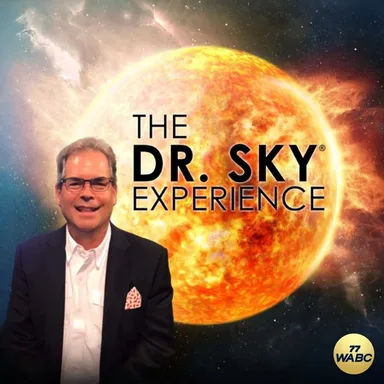
Steve Kates Space and astronomy broadcaster (Dr. Sky)
The Science Behind Hurricanes, Cosmic Radiation and the Universe
Steve Kates
Astronomer Steve Kates explains to John Catsimatidis why the Atlantic hurricane season has been so quiet, pointing to a Super El Niño and the Saharan air layer. He then turns to cosmic rays, which a French body has described as a workplace hazard for air crews, and to Quipu, a string of galaxies thought to be the largest known structure in the universe.
Key takeaways
- Kates said the Atlantic has had no hurricanes this late in the season for 50 or 60 years.
- He said Super El Niño winds shear off developing storms and the Saharan dust layer suppresses them.
- Kates said a French organization has classed radiation from space as a work hazard for frequent fliers.
- He said Quipu, a chain of galaxies 1.3 billion light years long, is the largest known structure.
- The autumnal equinox falls on Sept. 22 at 8:04 p.m. Eastern; the harvest moon is on the 26th.
In their words
“We’re finding out, John, that the hurricane season in the Atlantic... is really a dud so far.”
“A French organization has described radiation from space as a work hazard. And this is not a joke.”
“1.3 billion light years long, making the Earth and our solar system just a tiny little speck in the vast cosmos.”
Quotes are word for word from the automated transcript, uncorrected; the summary and takeaways are editorial.
Transcript
Automated transcript · uncorrectedSunday morning. With us today is Steve Cates, also known as Dr. Sky. And he, well, he explores our minds and tickles our minds of what the heck is going on out of space. Well, Steve Cates, tell us what the heck is going on this week.
Well, good morning. Good Sunday morning to you and the listeners, John. Let’s begin with something going on in the weather. And that’s, of course, very much dependent on these particular subjects. We’re finding out, John, that the hurricane season in the Atlantic...
is really a dud so far. Now, that may be good news to people, of course. We don’t want these catastrophic hurricanes. But the question has to be asked, why is this happening? John, for the longest time, this hasn’t happened like this for about 50 or 60 years, this late in the season, where if you look at the
Atlantic Ocean, there’s basically no hurricanes. We’ve had a few minor tropical storms in the Gulf of America. But here’s the answer, at least astronomers and meteorologists think. We’re going through the Super El Nino. What is it? It’s the big warming of the water just off the coast of, let’s say, South America, causing more of those hurricanes and typhoons.
But here’s the reason why this may be happening in the Atlantic with no hurricanes. The particular El Nino, the Super El Nino, has winds that cut off the top of these storms when they develop in the ocean. And, of course, water in the, you know, heated water makes hurricanes thrive. But there’s also another cause. This is not
written reported, John. There’s a gigantic dust layer called the Saharan air layer. What’s that? It’s gigantic dust that comes off the Sahara Desert in Africa. John, it’s the size of the United States, and it too destroys the development of hurricanes. So we have to watch all these things.
The Earth is changing as far as weather, but it always seems, as you and I agree, that everything seems to come out and balance itself. But that’s what’s probably happening. Why no hurricanes in the Atlantic?
Steve Cates did. earth balances itself out uh the creator who created the planet earth created us the planet we never run out of water for the last four billion years all the water we’re drinking it it gets recycled and we never run out of it the the the temperatures are steady because the hurricanes are used to bring
the temperatures up and down depending on where the planet earth is and where our Creator wants.
It to be. Well said. The Earth rejuvenates. But in this case, it’s kind of odd that we don’t have hurricanes, and that’s a blessing to many who don’t want to see the destruction. But, John, we move on to another.
What else would you like to talk about?
Go ahead. Well, I’ve got a couple of other good ones here, John. Cosmic rays. We hear about this. Sounds sci-fi. They’re particles from space, high-energy particles from deep in space and sometimes from the sun. Now it’s getting to be something that people are paying attention to There’s now a health concern. A French organization has described radiation from space
as a work hazard. And this is not a joke. The people who fly on airlines, let’s say you work for an airline and your life is dependent on flying all the time. They’re saying that the higher incidence to be up in the atmosphere in an airplane, not that we don’t scare people, is that these cosmic rays penetrate.
They’re very, very powerful. And some are trying to link a causation to cancers over long, long periods of time. But cosmic rays, John, are quite interesting. They were discovered back in the early 20th century. Victor Hess, this physicist, went up in a balloon, and he won a Nobel Prize in physics in 1936 for identifying these. But, John,
here’s another bizarre thing. The old days when we watched our television sets and we watched TV stations go off, we saw that snow that appeared, you know, like in movies like Poltergeist. What is that? John, it’s the white noise from the explosion of the universe billions of years ago.
All those energetic particles are what we actually witnessed. We didn’t really know it. And that is bizarre. But it leads to the big one, John, always the mystery of the week. What’s the largest structure in the universe? Well, astronomers are very much studying this. They now believe that there’s this object called Kipu. It’s basically, for a South
American term, like a knot. you’d have on a rope. But what is Kipu? John, it’s a gigantic collection of galaxies, like on a string. Get a load of this. 1.3 billion light years long, making the Earth and our solar system just a tiny little speck in the vast cosmos.
Amazing how big the universe really is. And that’s probably the largest now known universe structure, this Kipu, this large big string of material. 1.3 billion light years, John. That’s amazing.
There’s a lot more secrets out there in that universe than we know about. And we just have to keep exploring. And I hope we find out before our time is up more than we know now.
Absolutely, John. And that’s the way this particular week shapes up. I hope you’ll new week. Coming up, don’t forget, the autumnal equinox, September 22nd, 8.04 p.m. Eastern Daylight Time. And the beauty of the full harvest moon, John, on the 26th, Don’t miss it. Great things happening above our heads.
Thank you so much, and we’ll talk again real soon.
Have a great day. Have a great Sunday.
Sunday, September 20, 2026

Exposing Anthony Fauci in New Book 'Why Fauci MUST Rot in Prison'
Peter Navarro White House Senior Counselor for Trade & Manufacturing

The GOP’s 2026 Agenda and the Battle Over America’s Political Direction
Joe Gruters RNC Chairman

Arizona’s Political Battle Over Elections, Water and Development
Andy Biggs U.S. Representative from Arizona; nominee for Governor

A Plan for a Safer New York and Lower Taxes
Bruce Blakeman Nassau County Executive; nominee for Governor

The New World Order and the Challenge Facing Western Democracies
Ido Aharoni Aronoff Former Israeli Consul General in New York

His Campaign for Congress and the Fight for House Majority Control
Michael LiPetri Nominee for Congress, NY-3; Former NY Assemblyman

Trump-Xi Summit Raises Questions About China and Global Security
Gordon Chang China Analyst & Author

Inside Iran’s Opposition Movement and the Fight for a Secular Republic
Alireza Jafarzadeh Deputy Director, National Council of Resistance of Iran

The Democratic Party’s Identity Crisis and Its Working-Class Disconnect
Hank Sheinkopf Political Consultant
House Vote Advances the Fight to Keep AM Radio in New Cars
David Donovan Senior Policy Adviser, NYS Broadcasters Association

Spain’s Immigration Crisis and Europe’s Border Battle
Jose Santamaria Chief Investment Officer, Fundamental Investment Services

Hildebrandt’s Celebrates 100 Years of Ice Cream and Family Tradition
Zack Sarf Co-Owner, Hildebrandt's Ice Cream


Protect Your Skin From UV Radiation and Reduce the Risk of Skin Cancer
Dr. Peter Michalos WABC Medical Expert

Open-Air Prostitution and Human Trafficking Crisis on Queens’ Roosevelt Avenue
Lynn Shaw Founder of Lynn's Warriors

Interest Rates and Global Markets Amid U.S.-China Trade Tensions
John Terrett WABC Financial Analyst
Steve Kates
Exoplanet Radio Signals, SpaceX’s Heavy Rocket Test and Nuclear Propulsion
Steve Kates Space and astronomy broadcaster (Dr. Sky)
Supersonic Jets, SpaceX’s Next Starship Launch & Trump’s Golden Dome Defense System
Steve Kates Space and astronomy broadcaster (Dr. Sky)
Ben Franklin, Mars, and Asteroid Mining
Steve Kates Space and astronomy broadcaster (Dr. Sky)
The Search for Dark Matter and the Mysteries Hidden Beneath Antarctica
Steve Kates Space and astronomy broadcaster (Dr. Sky)
Earth's Extreme Forces and the Fight Over Pluto
Steve Kates Space and astronomy broadcaster (Dr. Sky)
Laser Communication Is the Future of Data Transfer
Steve Kates Space and astronomy broadcaster (Dr. Sky)
